
Main points
- Foxconn confirms cyberattack on North American factories. Hackers stole 8 terabytes of data, including confidential documents from Apple, Nvidia, Intel, Google, and Dell.
- The attack hit factories in the US and Mexico, the Nitrogen group claimed responsibility, and file recovery may be impossible due to an error in the encryptor's code.
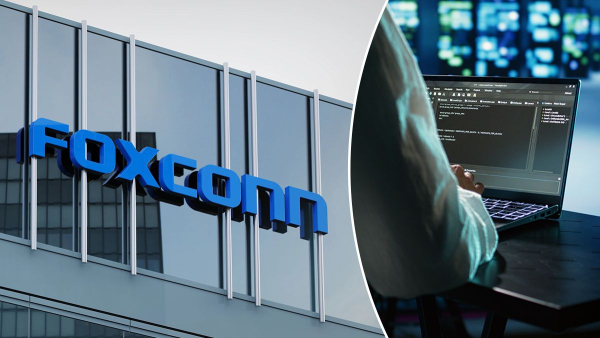
Hackers attacked Apple's main partner / Collage 24 Channel/Depositphotos/Freepik
Electronics giant Foxconn has been hit by a massive cyberattack targeting its main customer, Apple, with hackers claiming to have stolen confidential information.
What is known about the attack on Foxconn?
Taiwanese corporation Foxconn, a key partner of Apple and one of the largest electronics manufacturers in the world, has officially confirmed the fact of a cyberattack on its North American factories. The incident became known after a hacking group called Nitrogen included the company in its list of victims on a data leak website. The attackers claim that they managed to steal an impressive amount of information – almost 8 terabytes of data, including more than 11 million individual files, writes MacRumors.
The hackers claim to have obtained confidential instructions, internal design documents, and technical drawings related to giants such as Apple, Nvidia, Intel, Google, and Dell. While the exact nature of the stolen materials has not yet been disclosed, cybersecurity experts suggest that they could include operational records, employee data, or even secret developments that have not yet reached the market.
Foxconn representatives confirmed the hack in a comment to The Register, but avoided direct answers to questions about whether customer information was actually stolen.

Some Foxconn factories in North America were hit by a cyberattack,
– a Foxconn official commented discreetly.
He added that the cybersecurity team immediately activated the response mechanism and implemented measures to ensure the continuity of production and supplies. It is now known that the affected factories are gradually returning to normal operations.
How was it?
The attack affected plants in Wisconsin, Texas, Ohio, Virginia and Indiana, as well as facilities in Mexico. The campus in Mount Pleasant, Wisconsin, was particularly hard hit. The outage began on Friday morning, when Wi-Fi access was completely lost, and later the plant's critical infrastructure stopped working.
We were ordered to turn off our computers and not to log in under any circumstances,
– one of the factory employees told WIRED reporters on condition of anonymity.
Employees even had to fill out paper timesheets because the digital terminals were out of order.
Responsibility for the attack was claimed by the Nitrogen group, which has been operating since 2023 and, according to researchers, uses code borrowed from the infamous Russian hacker designer Conti 2.
But for Foxconn, the news could be worse than just a data leak. Experts from Coveware have warned that a flaw in the Nitrogen ransomware code may make it impossible to recover files even if a ransom is paid. This makes any negotiations with the criminals virtually useless in restoring access to the locked systems.
Other attacks against Foxconn
This is not the first time Foxconn has been targeted by cybercriminals. In 2024, the company was hit by an attack by the LockBit group, and in 2020, a factory in the Mexican city of Ciudad Juarez was attacked by the DoppelPaymer group. At that time, the attackers demanded a ransom of approximately $34.6 million in Bitcoin.
Such attacks highlight the vulnerability of global supply chains, where a breach of one large contractor could jeopardize the intellectual property of the world's leading technology brands, concludes 24 Kanal .
You may also be interested to know: what Foxconn does for Apple and how closely they are connected
It is safe to say that Foxconn is one of Apple's most important manufacturing partners and the de facto backbone of its global supply chain. It is Foxconn that is engaged in the contract production of a large part of Apple's equipment, primarily the iPhone.
Formally called Hon Hai Precision Industry, the Foxconn brand is used for the international market. The company was founded by Taiwanese entrepreneur Terry Gou in 1974 in Taiwan. It initially produced plastic components for televisions and game consoles, but later evolved into the world's largest contract electronics manufacturer.
Foxconn and Apple's collaboration began in earnest in the 2000s, when Apple dramatically increased production of the iPod, and later the iPhone. It was Foxconn that was able to offer Apple the scale, speed, and cheapness of production that almost no one else could provide at the time. The company built huge production complexes in China, including in Shenzhen and Zhengzhou. The latter city even received the unofficial name “iPhone City” because it employed hundreds of thousands of people assembling Apple smartphones, Encyclopedia Britannica writes.
Foxconn doesn't just assemble finished iPhones. The company is responsible for component integration, device testing, production process control, logistics, and scaling the release of new models. Apple designs its devices in the United States, but the actual mass production largely depends on Foxconn. This has made the Taiwanese company critically important to Apple's business. Over the years, Foxconn has assembled iPhones, iPads, Macs, and other Apple equipment.
Against this backdrop, a cyberattack on Foxconn looks particularly dangerous for Apple. Such an attack poses several risks at once:
- The first is the leakage of confidential information about future products. Apple traditionally builds its marketing strategy around the secrecy of new devices, so even partial disclosure of drawings or production details can harm the company. This applies not only to design, but also to internal technical solutions, production processes and components, writes 24 Kanal .
- The second risk is disruption to production and supply. Even if Apple itself is not directly affected by the hack, any large-scale attack on Foxconn could temporarily halt production lines, disrupt logistics, or delay the release of new products. Such incidents are especially critical before the launch of new iPhones or during peak sales seasons.
- The third aspect is the issue of cybersecurity of Apple’s entire global supply chain. Large technology companies are increasingly becoming targets not through direct attacks on their servers, but through contractors and partners. Foxconn owns huge amounts of technical documentation for its customers, making it a very attractive target for ransomware. Cybersecurity analysts explicitly call the next generation of manufacturing companies key targets for attacks on supply chains.
Foxconn in the USA: how the company went beyond Taiwan and China
Foxconn has also been actively expanding its presence in the US in recent years. This is due to several factors: the trade conflict between the US and China, the desire of Apple and other companies to diversify production, as well as Washington's state policy of returning industry to the country.
One of the most prominent projects was the Foxconn plant in Wisconsin, announced in 2017 with the support of the Trump administration. The company initially promised to invest about $10 billion in the production of LCD panels and create thousands of jobs, Tom's Hardware recalls.
However, the initial plan was not implemented in full. Foxconn has repeatedly changed the concept of American factories – from LCD displays to artificial intelligence servers and electric cars. Over time, the company began to focus on AI servers, data centers and new production lines. In 2025, Foxconn received approval for additional investments in Wisconsin to expand the production of AI infrastructure.
In addition to Wisconsin, Foxconn expanded into Ohio, where it acquired the Lordstown plant for the production of electric vehicles. Later, the company began to adapt to other high-tech areas, including server infrastructure and AI equipment.
Foxconn's expansion in the US is also of strategic importance to Apple. The American company is seeking to reduce its dependence on China due to geopolitical risks, trade wars and supply problems, which have become especially evident during the COVID-19 pandemic. That is why Apple is gradually transferring some of its production to India, Vietnam and North America. Foxconn has become one of the main tools in the transformation of Apple's global production in this process.