
Main points
- Google introduced Gemini 3.1 Pro, which significantly improved logical thinking and the ability to solve atypical problems, outperforming the previous version and competitor GPT 5.2 in logic tests.
- Gemini 3.1 Pro can generate animated SVG images from a text query and synthesize complex data, demonstrating a high level of interactive design and creative programming.
What's behind the release of Gemini 3.1 Pro / Google
Google is announcing the release of Gemini 3.1 Pro, the next phase of the company’s AI ecosystem. Just three months after the previous major update, developers have been able to significantly improve the ability to think logically and solve atypical problems. This update opens the door to more complex use cases.
What technological breakthroughs and practical tools does Gemini 3.1 Pro bring?
The Gemini 3.1 Pro model is based on an “updated intelligence core” that first appeared last week in the Gemini 3 Deep Think specialized tool. This update focuses on the ability of artificial intelligence to solve problems where a simple answer is not enough, but requires a deep understanding of the context and data synthesis, Mint writes.
- The developers' main pride was the results of logic tests. In particular, in the ARC-AGI-2 benchmark, which evaluates the model's ability to find solutions to completely new logic patterns, 3.1 Pro scored 77.1%, Google data shows. This is more than double the performance of the previous version 3.0 Pro, which showed only 31.1%.
- In the Humanity's Last Exam test, which tests knowledge in complex specific tasks, the new model also set a record with a score of 44.4%, beating both its predecessor and competitor GPT 5.2 from OpenAI, which scored 34.5%.
- Although in some aspects, such as Arena code writing, Claude Opus 4.6 still holds the lead by a small margin, Google confidently dominates the field of agent workflows.
- In the APEX-Agents benchmark, the Gemini 3.1 Pro model almost doubled its result, which indicates its high efficiency in performing multi-stage professional tasks.
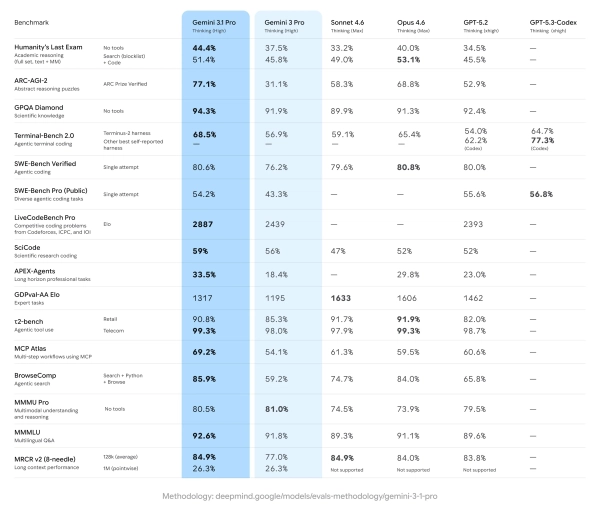
Gemini 3.1 Pro test results / Google Images
What does that mean for us?
The developers demonstrated the practical application of the improved intelligence with several impressive examples. The model is able to generate animated SVG images directly from a text query. The first users have already compared the results, and they are strikingly better.
Comparison of Gemini 3 Pro and Gemini 3.1 Pro performance: watch the video
Because they are created as pure code, not pixels, such files remain clear at any scale and have a minimal size compared to regular video.
Comparison of Gemini 3 Pro and Gemini 3.1 Pro performance: watch the video
The system's ability to synthesize complex data was also demonstrated: the neural network created an aerospace monitoring dashboard by configuring a telemetry stream to visualize the orbit of the International Space Station in real time.
Special attention was paid to interactive design and creative programming. Gemini 3.1 Pro was able to not only recreate a visual simulation of the movement of a flock of birds, but also build an immersive experience where the user can control the flow using gestures, and the generative sound changes according to the movements of objects.
Simulating bird movement with music in Gemini 3.1 Pro: watch the video
Introducing Gemini 3.1 Pro
3.1 Pro represents a major step forward in core reasoning. It scored 77.1% (more than doubling 3 Pro's score) on ARC-AGI-2, the benchmark that evaluates a model's ability to solve new logic patterns and work through challenges it hasn't encountered… pic.twitter.com/8HOPoji7i5
— Google AI (@GoogleAI) February 19, 2026
In a creative experiment, the model transferred the atmosphere of Emily Bronte's novel “Wuthering Heights” into the design of a modern web interface, analyzing the literary themes of the work.
Accessibility
Gemini 3.1 Pro is currently in preview. It is available now to Google AI Pro and Ultra subscribers in the Gemini app and NotebookLM. Developers and enterprise customers can try it out via the Gemini API in Google AI Studio, Vertex AI, and Android Studio.
A full release is expected soon.
Parameters
The technical parameters of the model have remained stable: the context window is 1 million input tokens and 64,000 output tokens, writes Ars Technica, and the cost of use for developers is $2 per million input and $12 per million output tokens.