
Main points
- Scientists have discovered that gold and platinum can leach from the Earth's core to the upper layers.
- New research suggests that the rise of material from the core to the mantle may be the source of gold at the surface, as evidenced by isotopic anomalies and high helium content in volcanic emissions.
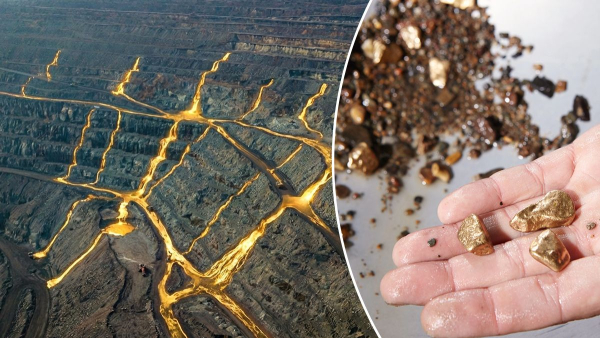
Treasures from the depths: how gold from the earth's core ends up under our feet / Collage 24 Channel/Depositphotos
Deep beneath our feet, thousands of kilometers away, a very interesting process is unfolding. Most of the gold and platinum are concentrated in the red-hot core, but scientists have noticed activity that indicates that these metals may be gradually seeping into the upper layers. This slow exchange between the Earth's layers holds the keys to understanding the evolution of our world.
How do precious metals rise to the surface?
Recent discoveries in China's Hunan province have shaken up the scientific world. Researchers have discovered potential reserves of more than one thousand tonnes of gold at the Wangu gold deposit. If confirmed, the find would be the largest deposit of the precious metal in history, with a market value of around $83 billion. This has led scientists to wonder where the gold on the surface actually comes from, as it is usually considered extremely rare, writes BBC Science Focus.
In fact, gold is not a shortage on Earth at all, it is simply beyond our reach. Professor Matthias Willbold of the University of Göttingen claims that 99.9 percent of all precious metals on the planet are locked up in its core. For decades, geologists believed that these riches were permanently isolated in the center of the planet, but now the theory that the Earth's core is “leaking” is gaining more and more support.
The history of our planet's formation, which began 4.54 billion years ago, explains this concentration of metals in the center. When the young Earth was completely molten, the heaviest elements, such as iron and nickel, sank to the bottom, forming the core. Along with them, so-called siderophiles – elements that have a chemical affinity for iron, including gold, platinum, tungsten and ruthenium – were dragged into the depths.
Today, the core consists of a liquid outer layer about 2,000 kilometers thick and a solid inner center, the temperature of which reaches 5,000 degrees Celsius, writes the Encyclopedia Britannica.
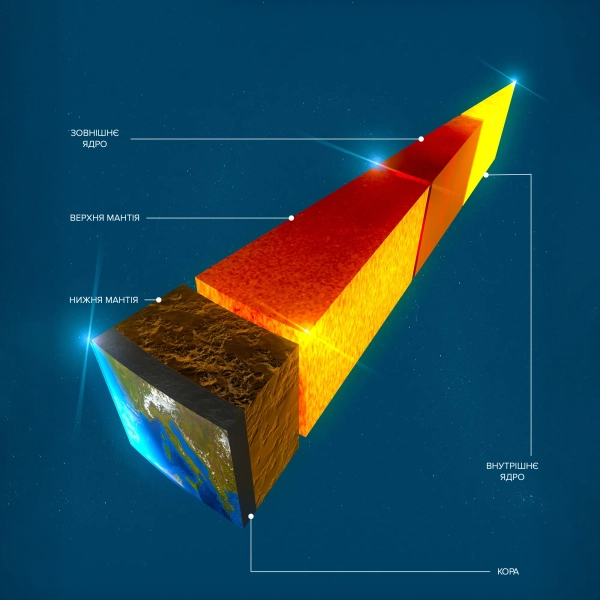
Structure of the Earth / Image by Depositphotos / Text by Channel 24
Traditionally, the presence of gold in the Earth's crust was explained by the so-called “Late Heavy Bombardment.” It was believed that about 3.9 billion years ago, giant asteroids fell on Earth, re-saturating the mantle with heavy elements, since the core had already separated by that time.
However, new evidence suggests that gold particles at sites like Wangu may be the result of material being lifted directly from the core-mantle boundary.
What evidence?
Evidence for this theory is found in the behavior of tungsten and ruthenium isotopes. Studies show that some rocks in the mantle have specific ratios of these elements that are difficult to explain by meteorite impacts alone. In particular, analysis of samples from Hawaii and Iceland, where hot magma flows – mantle plumes – reach the surface, show anomalies that hint at impurities from the core.
Another strong argument was helium. In volcanic emissions from Hawaii, the ratio of rare helium-3 to more common helium-4 is 30 times higher than in the atmosphere. Since helium-3 could only have been trapped during the formation of the planet, its presence in such quantities suggests that it is flowing from great depths.
Scientists reassure: this process does not mean that the core is rapidly emptying. We are talking about insignificant volumes compared to those that it holds. These are a few grams of metals and kilograms of gases per year, which is even difficult to take into account on a planetary scale.
Unfortunately, this means that these resources are not renewable on a lifetime or even a few generations scale. It takes millions of years to accumulate enough gold to mine.
So what does this mean for us?
However, this exchange is crucial to Earth's stability. Unlike Mars, whose core has cooled and frozen, or Venus, which cannot release internal heat due to the lack of plate tectonics, Earth is in a state of perfect balance.
The key to this mechanism may lie in so-called blobs – colossal structures under Africa and the Pacific Ocean, located at the boundary between the mantle and the core. They may act as conduits through which internal heat and core matter penetrate the upper layers, supporting geological life on our planet and making it suitable for human habitation.