
Main points
- Flat cables sacrifice signal quality for the sake of compactness, which leads to unstable Internet performance.
- Round cables are better protected from electromagnetic interference and provide reliability over long distances.
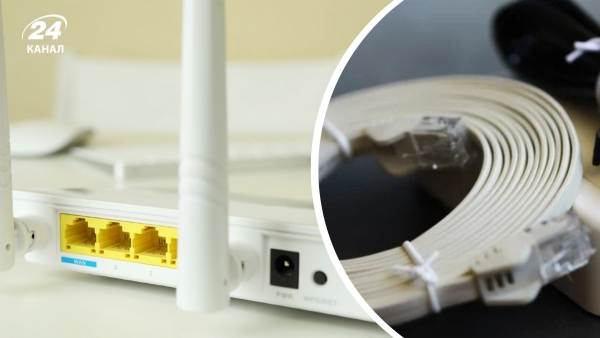
Why flat Ethernet cables are a bad idea for your internet / Collage 24 Channel / Photo Depositphotos
Many people choose flat internet cables because of their attractive appearance and ease of routing under carpets or doors. However, behind the aesthetics lie serious engineering compromises that violate the fundamental principles of network operation.
Manufacturers often sacrifice signal quality for the sake of compactness, which leads to unstable Internet operation precisely when connection reliability is critical, explains 24 Channel .
Why are flat cables worse than round ones?
The efficiency of an Ethernet connection is based on the physical phenomenon of eight wires inside a cable, organized into four pairs. These pairs are not simply lying side by side, but are twisted together in a specific pattern along their entire length.
Such twisting is not a design decision, but a necessary engineering condition to neutralize electromagnetic interference from surrounding electronics and prevent crosstalk between the wire pairs themselves.
The main problem with flat cables is that their parallel structure directly contradicts this protection. Although they also have twisted pairs inside, these pairs themselves are not twisted relative to each other, as is implemented in round analogues.
Because of this, electrical noise easily “jumps” from one pair to another, making the cable vulnerable to any external interference, such as from a working microwave oven.
When does this become a problem?
This problem becomes especially noticeable over long distances. According to standards, round Cat6 cable reliably supports speeds of up to 10 Gbps over distances of up to 100 meters, even in environments with a lot of electrical noise, writes BizTech.
Flat versions start to lose performance after 50 meters. The parallel wires in them act as antennas that collect interference. At the high frequencies needed to transmit data at a speed of 10 Gbps, the signal begins to distort, data packets are lost, and the connection becomes unstable, writes SlashGear.
You may not notice this when watching videos on YouTube, but in games or when downloading large files, the problems will become apparent.
In addition, flat cables are much less resistant to physical stress. Each cable has a minimum bending radius – the limit after which the internal structure is damaged. Flat wires are very sensitive to strong bends, which lead to internal stress in the conductors, increasing signal loss.
Their flexibility often tempts users to run them at sharp angles or pinch them with furniture, which significantly shortens their lifespan. Round cables, while looking bulkier, actually force the owner to handle them properly.
Are flat cables really more economical?
Considering all the listed disadvantages of flat cables, the savings when buying such a cable are illusory. They are cheaper to produce, because they require less materials, but they are often positioned on the market as a premium product. At the same time, they usually have worse shielding, which is critical if the wire runs near power lines or routers.
When is a flat cable a good idea?
The use of flat cables is permissible only in niche situations: for very short distances (up to 10 – 15 meters) in rooms with a minimum of equipment or for temporary installations.
For a permanent network, it is better to choose classic round cables. Wired connections are used for maximum performance, and if the cable cannot cope with this, then the point of using it disappears, because modern Wi-Fi can work no worse than a low-quality wire.