
Main points
- Researchers have discovered a man-made island made of edible shellfish shells and created by human activity over 1,200 years ago.
- Scientists are studying hypotheses about the origin of the island, considering it as the result of anthropogenic activity, confirmed by archaeological finds.
Illustrative photo / Unsplash
Off the northern coast of Vanua Levu in Fiji, researchers have discovered a mysterious landmass that defies conventional notions of landform formation. This small island hides a centuries-old mystery that is connected to the daily lives of ancient seafarers in Oceania.
How were people able to create an entire island?
During geoarchaeological surveys, scientists came across a small low-lying ledge with an area of about 3,000 square meters, located near the Kulasawani area. Initially, this place, surrounded by dense mangrove forests, was considered an ordinary natural peninsula. However, a more detailed study showed that the object is an isolated island, which is 70-90 percent composed of shells of edible mollusks mixed with sandy-clay soil. The activity of local crabs, which dig holes, allowed researchers to see the contents of the deep layers without large-scale excavations: the animals brought the remains of shells to the surface from a depth of 30-50 centimeters, writes IFLScience.
The scientists conducted two phases of fieldwork in 2024, excavating several test sites. Analysis showed that the shell layer averaged 20 to 40 centimeters thick. Radiocarbon dating of ten samples revealed a striking consistency: most of the dates clustered around 1190 BC (approximately 760 AD), spanning the period from 420 to 1040 AD. This concentration indicates that the island was formed over several hundred years of active human activity.
Where did he come from?
There are two main hypotheses for the origin of this place, which the authors of the study call the dilemma between “garbage heap” (a consequence of human activity) and “chaos” (a consequence of a natural cataclysm).
- The second option suggests that the island could have been formed by a powerful tsunami that washed the shell deposits from the seabed and threw them into shallow water. In this region, located near the tectonically active Fijian zone, seismic activity and large waves are not uncommon.
- However, archaeological evidence suggests an anthropogenic factor. First, almost all the shells found belong to species that are consumed by humans, such as anadara or trochus. Second, fragments of ancient smooth pottery, characteristic of the late stages of the premodern period of Fiji, have been found on the island.
The vast majority of experts are inclined to believe that this is a real man-made island. In their study, which appeared on Wiley Online Library, they call it a “midden,” which can be translated as a dunghill, garbage dump, or pile of garbage.
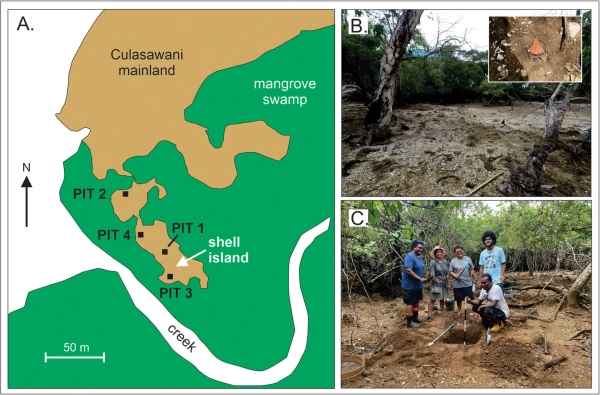
Island map and photos / Images by Patrick D. Nunn and others
It is possible that early settlers lived on special platforms on stilts directly above the water or used the site as a specialized seafood processing facility. People may have collected shellfish from the surrounding reefs, cleaned them, and discarded the unwanted shells into the water. Over time, the accumulation of this waste and the natural fall in sea level resulted in a solid surface suitable for habitation rising above the water.
Interestingly, the modern mangrove landscape is significantly different from what people saw 1,200 years ago. It is likely that the surrounding reefs were exposed at the time of active use, and the dense forests appeared later due to soil erosion on the mainland of Vanua Levu.
If the status of this object as a man-made island is finally confirmed, it will become the first documented midden island in the South Pacific Ocean west of Papua New Guinea.
In the future, researchers plan to interview local residents about oral traditions about giant waves, as human memory in the regions is capable of retaining memories of extreme events for over 2,000 years.
It is also planned to search for ancient settlements on the nearby land that could be associated with this unique place.