
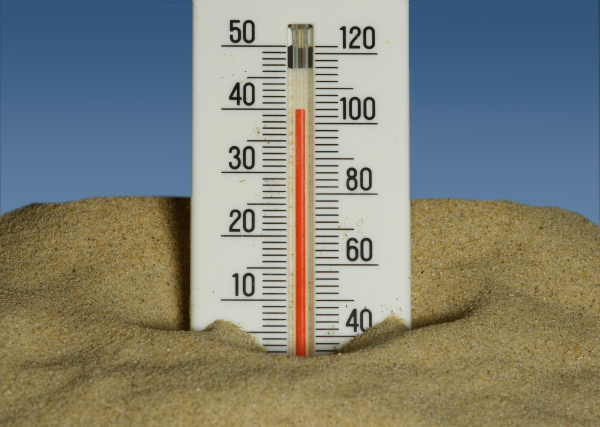
Air conditioners won't save – scientists warn of a new global heat crisis / Unsplash / Immo Wegmann
Extreme heat is increasingly hitting the world's poorest regions, and a new study has found that the risk depends not only on temperature, but also on access to water, shade, shelter and basic infrastructure.
An international group of researchers has reported the rapid spread of so-called “systemic cooling poverty” – a phenomenon where people do not have access to safe ways to protect themselves from extreme heat. Phys.
Why does heat kill some people more often than others?
The study, published by authors from universities and research centers in a paper for The Conversation, analyzed the situation in 28 countries , mostly developing ones.
The researchers estimate that of the 3 billion people in the sample, nearly 600 million already live in “severe systemic cooling poverty.” The worst situation is observed in South Asia and sub-Saharan Africa. The authors emphasize that the problem is not only high temperatures, but also unequal access to cooling, water, green spaces, quality housing and health services.

Poor areas are turning into “heat traps”
One example the researchers cited was the favelas of Rio de Janeiro in Brazil.
While tourists relax on Ipanema Beach by the ocean, residents of poor neighborhoods on the hills live in completely different conditions – in houses with metal roofs, without trees, parks, and normal transport infrastructure.
Concrete and asphalt store heat during the day and continue to radiate it even after the sun goes down. In many areas, people simply have nowhere to hide from the heat.
Similar problems are being recorded in other regions of the world. Last summer:
- in Spain the temperature reached 46 degrees Celsius;
- Portugal recorded 46.6 degrees Celsius;
- France experienced its second hottest June since 1900;
- In the US, more than 150 million people received extreme heat warnings.
However, even in countries with similar climates, the effects can vary significantly. For example, Bangladesh and Indonesia both suffer from dangerous humid heat, but Indonesia has better infrastructure and healthcare, so the level of “cooling poverty” is lower there.
Why don't air conditioners solve the problem?
Researchers separately emphasize: reducing the fight against heat only to air conditioners is a mistake.
First, access to air conditioning is very uneven around the world. For billions of people, it is too expensive a technology. Second, air conditioning significantly increases electricity consumption. On average, household electricity costs increase by more than a third due to cooling.
As a study in the journal Nature says, this creates additional strain on power systems during peak heat waves and at the same time accelerates climate change through increased emissions.
In addition, the production and disposal of air conditioners also have environmental impacts due to the use of hazardous materials.
The authors of the study emphasize that much more important are:
- quality of housing;
- ventilation;
- the presence of trees and shade;
- access to drinking water;
- safe public spaces;
- protection of workers during heat;
- efficiency of medical services.
Heat affects different groups of people differently
As part of the project, researchers have been interviewing residents of poor neighborhoods in Rio de Janeiro since 2020. Some participants kept special “heat diaries”, recording their own experiences, photos, and voice messages.
The survey found that the heat hits the most vulnerable groups particularly hard. For example, people with disabilities are not always able to use even basic cooling methods. “I would like to take four cold showers a day, but because of my condition, it’s logistically difficult,” said one resident.
Because of this, his electricity bills triple in the summer due to the constant use of the air conditioner.
Researchers have also highlighted the challenges faced by transgender women. Due to discrimination, they often cannot safely use public spaces where other people escape the heat – parks, squares or shops. Many are also forced to drink less water due to fear of harassment in public toilets.
Scientists call for “thermal justice.” The authors of the study use the concept of “thermal justice.” It is not only about reducing temperatures in cities, but also about the fair distribution of resources and the protection of the most vulnerable groups of the population.
Researchers emphasize that it is the residents of the most affected areas who should participate in creating such solutions, since they are the ones who face the real consequences of extreme heat every day.