
Main points
- The study showed that the number of humanity exceeds the capacity of the Earth.
- Scientists emphasize that without changes in resource and energy consumption, the situation may worsen, but changes can stabilize the load on the planet.
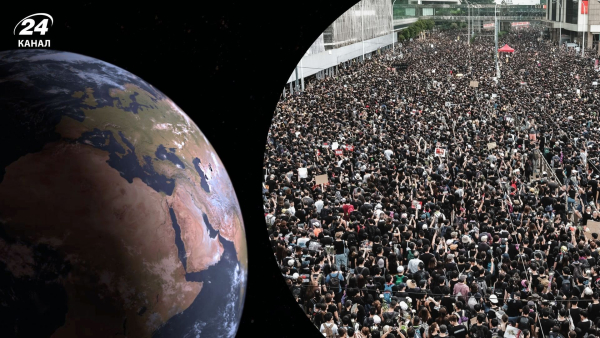
Humanity has exceeded the planet's capabilities / Collage by Channel 24 (Photo Canva)
A new study has found that humanity is already living beyond the planet's capacity, with scientists warning of critical overshoot and risks to the future.
According to their estimates, the situation can only worsen without radical changes. This is reported by Science alert.
What is known about overpopulation?
Scientists have concluded that the current population of the Earth already exceeds its long-term capacity for sustainable existence. The study, conducted by a team led by Corey Bradshaw, is based on an analysis of more than two centuries of demographic data.
Ecologists use the concept of “carrying capacity,” which defines how many individuals an environment can support given the available resources. According to researchers, humanity has long exceeded this limit, in particular due to the active use of fossil fuels, which temporarily compensate for the shortage of resources.
The world population is currently around 8.3 billion people. At the same time, the optimal level, according to scientists, is around 2.5 billion, which is significantly lower than current figures.
The Earth cannot keep up with our use of resources. It cannot meet even today's demand without significant changes, and our findings show that we are putting more pressure on the planet than it can imagine.
– emphasized Corey Bradshaw.
Researchers also found that population growth rates have been slowing since the 1960s. However, even under these conditions, the human population continues to grow and could peak at 11.7 to 12.4 billion people in the second half of the 21st century.
Scientists explain that exceeding the planet's capabilities leads to a number of global problems. Among them are the depletion of natural resources, the decline of animal populations, climate change, and the growth of environmental pressure.
“The planet's life support systems are already under strain, and without rapid changes in the ways we use energy, land and food, billions of people will face increasing instability,” Bradshaw stressed.
Scientists note that not only the population size, but also the level of resource consumption plays a key role in exceeding ecological limits. This especially applies to energy, agriculture and water use. At the same time, the researchers emphasize that the situation is not yet hopeless. According to them, changing approaches to consumption, energy and the use of natural resources can help stabilize the situation and reduce the burden on the planet.
There may be several billion more people living on Earth than we thought: what is known?
-
New scientific research suggests that the real population of the Earth may be much higher than official estimates. While the United Nations puts the world's population at around 8.2 billion, new estimates suggest that this figure may be underestimated by hundreds of millions or even several billion.
-
Researchers from Aalto University used an alternative population estimation methodology and found significant discrepancies with existing databases. The main reason for the inaccuracies is the poor quality of data collection in rural areas, where part of the population may not be counted at all.
-
According to scientists, in some cases, the rural population may be underestimated by almost half. This calls into question the accuracy of global demographic models and complicates resource planning. At the same time, experts emphasize that the problem is not only in the number of people, but also in the consumption of resources. Some scientists believe that even a larger population will not become a disaster, provided that resources are managed effectively and sustainable technologies are developed.