
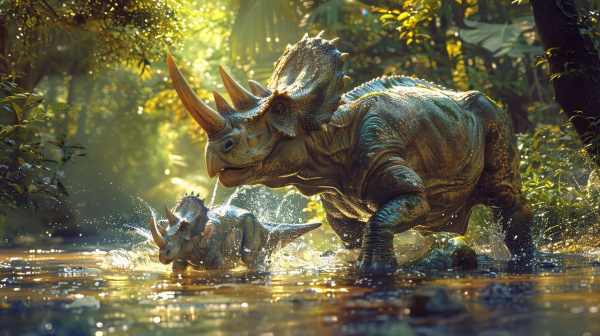
Caring through millions of years: microscopic marks on teeth revealed the truth about dinosaur life / Freepik
Seventy-five million years ago, events unfolded in what is now Montana that are forcing us to rethink our understanding of dinosaur social life. The study of hadrosaur tooth remains has provided a glimpse into the inner world of nesting, where survival depended not only on strength but also on attention.
What have paleontologists learned about dinosaur upbringing?
A new study by researchers at Ohio State University and the University of Bristol has provided compelling evidence that dinosaurs were much more caring parents than previously thought, writes Earth.com.
The object of study was the species Maiasaura peeblesorum, a duck-nosed dinosaur whose name symbolically translates as “lizard – good mother.” Analysis of microscopic tooth wear showed that adults of this species did not just stay near the nests, but also purposefully provided their offspring with food that was even better quality than their own diet.
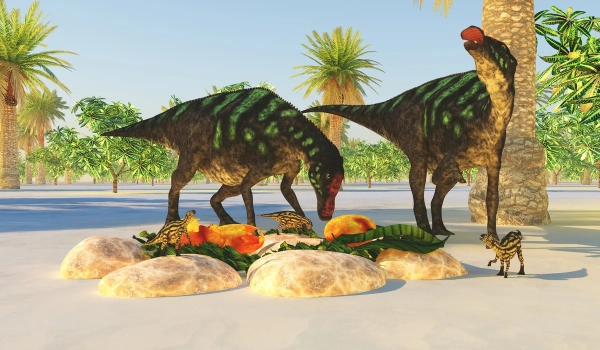
These computer renderings show Maiasaura peeblesorum near a nest / Depositphotos Images

The scientists found the key to the solution in the unique structure of the dental cells of hadrosaurs. These dinosaurs had from 14 to 53 tooth “families” in each jaw, where the teeth were arranged in vertical columns of 3 to 8 units each. New teeth constantly replaced the old ones, which made their chewing system similar to the teeth of modern herbivorous mammals.
The researchers identified two types of wear: “cutting” (indicating the consumption of coarse fibrous foods, such as mature leaves or stems) and “crushing” (indicating soft, juicy foods with a high protein content, such as berries, buds or fruits).
When paleontologists compared the teeth of juveniles and adults, they noticed a striking difference. Juveniles showed significantly more “crushing” wear, while adults showed more “cutting” wear. This means that adult Maiasaurus brought the tender, nutritious parts of plants to the nest, leaving the tougher, less valuable vegetation for themselves.
This behavior pattern is typical of modern nesting birds, whose chicks remain in the nest after hatching and are completely dependent on their parents.
A bird's urge to feed its chicks is a very ancient behavior,
– commented the lead author of the study and associate professor of evolution, ecology and organismal biology at Ohio State University, John Hunter.
He also added that this discovery is “evidence that this behavior probably goes back much further than the origin of birds, perhaps to the origin of dinosaurs.”
An important aspect of the study is the rapid growth of Maiasaurus. Thanks to a high-protein diet provided by their parents, the young could grow to half the length of an adult in just one season. Analysis of the bones showed that the young hatched in a “weak” state, similar to some modern birds, and had a nesting period of about 40–75 days.
Alternative theories rejected
The researchers, whose findings are published in the journal Palaeogeography, Palaeoclimatology, Palaeoecology, also considered alternative theories. For example, parents could have fed their young partially regurgitated food, which would also explain the pattern of tooth wear.
However, the version about the independent feeding of the young was rejected, since their remains are found mainly within the nests, and the nests of Maiasaurus themselves were located in colonies at a distance of about 7 meters from each other – approximately the length of an adult individual.
What does this give us?
This discovery highlights the complexity of dinosaur social organization, concludes Channel 24. Maiasaurus, according to scientists' research, lived in large herds and demonstrated coordinated parental care, which helped them survive in an ecosystem full of predators.
Thus, we can conclude that caring for offspring was not just a random phenomenon, but a strategic survival mechanism that laid the foundation for the behavior of many modern animal species.
You may also be interested to know: what else do we know about Maiasaura peeblesorum
Maiasaura peeblesorum, or Maiasaura, is one of the most famous herbivorous dinosaurs of the Late Cretaceous Period. It lived approximately 76–74 million years ago in what is now North America, mostly in what is now the state of Montana in the United States.
Maiasaurus belonged to the hadrosaurs, the so-called “duck-billed” dinosaurs. They were large, herd-like herbivores that walked on both two and four limbs. Adults reached about 8-9 meters in length and weighed several tons, writes Encyclopedia Britannica.
The name Maiasaura, as we have already mentioned, translates as “good mother lizard.” It appeared after a sensational discovery in 1978 at a place called Egg Mountain. Paleontologists found there a huge colony of nests with eggs, cubs and adults.
Of particular interest was the fact that the hatchlings were unable to move around on their own immediately after hatching. Their bones were not yet fully developed. This was one of the first serious pieces of evidence that some dinosaurs cared for their young after birth, rather than simply abandoning their eggs to their fate, as many modern reptiles do.
Maiasaurus lived in large social groups. Scientists believe they returned to the same nesting sites year after year, much like modern birds or sea turtles. The nests were located close to each other, suggesting a colonial lifestyle.
Among the characteristic features of Maiasaurus are a massive beak for chewing vegetation, hundreds of teeth in the jaws, and small protrusions on the head. These were probably used for display or recognition within the herd. Maiasaurus were typical herbivores of the Cretaceous plains, where they fed on leaves, shoots, and low vegetation.
Recent discoveries about dinosaurs: what we have learned recently
Recent years have brought a series of major discoveries about dinosaurs. One of the most high-profile is the discovery of a new species of Spinosaurus in the Sahara, which 24 Channel wrote about in April. Scientists have described Spinosaurus mirabilis, a large predator with a giant sickle-shaped crest on its head. This discovery has changed the idea of the evolution of spinosaurs and showed that they may not have been fully aquatic hunters, but rather large swamp predators that hunted fish in shallow water, writes ScienceDaily.
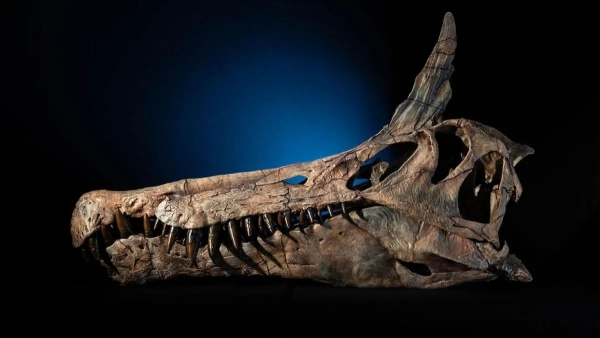
Reconstruction of the skull of Spinosaurus mirabilis with crest / Photo Keith Ladzinski
Also in 2026, researchers in Argentina described a small bird-like dinosaur, Alnashetri cerropoliciensis. Its nearly complete skeleton has helped scientists better understand the evolution of alvarezsaurs, a strange group of small dinosaurs with short arms and specialized in hunting insects. It turned out that these animals decreased in size before they acquired their characteristic anatomical features.
Another important discovery came in Brazil, where paleontologists have discovered a new giant sauropod, Dasosaurus tocantinensis. The animal could have reached about 20 meters in length. The find helped confirm the theory that South America, Africa and Europe were connected in the early Cretaceous period, when the continents were not yet completely separated by the Atlantic Ocean, Reuters reported.
What do we know today about how other dinosaurs cared for their offspring?
Research into dinosaur parenting has also made significant progress. In 2026, scientists conducted an experiment to reconstruct the nest of an oviraptor, a bird-like dinosaur that sat on a clutch of eggs. It turned out that the adult was physically unable to evenly warm all the eggs with its own body. The researchers concluded that oviraptors probably used a mixed method of incubation: partly body heat and partly solar heating. This means that the eggs could not hatch at the same time, writes ScienceDaily.
Another study in 2026 found that young dinosaurs often lived very differently from adults. The scientists concluded that the young of many species quickly became independent and formed separate groups of young. They ate different foods, lived in different parts of the ecosystem, and avoided competition with adults. This was very different from modern large mammals, where parental care usually lasts longer.