
Main points
- Physicists have discovered that the 2019 gravitational wave signal may contain traces of dark matter by analyzing data from black hole mergers.
- Event GW190728 showed characteristics that could indicate an interaction with a dense dark matter cloud, but further tests are needed to confirm.
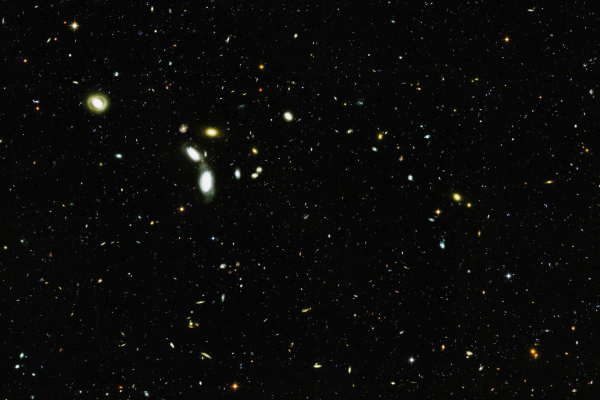
/ Unsplash / NASA Hubble Space Telescope
A signal detected by gravitational wave detectors several years ago has unexpectedly caught the attention of physicists. A new analysis suggests it may contain traces of one of the most mysterious phenomena in modern science.
Physicists from the United States, Great Britain, and several European research centers have announced a potentially sensational discovery: dark matter may have been accidentally detected back in 2019. This is a re-analysis of data on gravitational waves – weak fluctuations in space-time that occur during grandiose cosmic catastrophes, such as the collision of black holes. This is reported by Science Alert .
How can black holes help find invisible matter?
Dark matter remains one of the greatest mysteries of modern physics . Although no one has ever directly observed it, scientists are convinced of its existence because of its gravitational influence on galaxies and the large-scale structure of the universe.
According to current estimates, dark matter may make up approximately 85% of all matter in the Universe. However, its nature is still unknown.
One popular theoretical model suggests that it is made up of ultralight particles. Under certain extreme conditions, such as near black holes, these particles can behave not as individual objects but as a wave field that forms dense clouds. This idea has been tested by researchers. The results of the new study, published in the journal Physical Review Letters . They offer an unusual approach to searching for dark matter – by analyzing the environment in which black hole mergers occur.

Physicist Rodrigo Vicente of the University of Amsterdam explained: “Using black holes to search for dark matter would be fantastic. It would allow us to study dark matter on a much smaller scale than ever before.”
What did they see in the gravitational wave signals?
The idea is that rapidly rotating black holes can “stretch” the space-time around them. If there is a cloud of dark matter around them, its interaction with this warped medium can change the nature of the black holes' convergence.
Such changes leave a specific “imprint” in gravitational waves.
To test this, the team created a computer model that shows what the signal from merging black holes inside a dense cloud of dark matter would look like, and then compared it to real data.
The analysis used 28 events recorded by the international LVK detector network, which includes the LIGO observatories in the USA, Virgo in Italy, and KAGRA in Japan .
27 signals were consistent with conventional vacuum merger models.
However, one event, recorded in July 2019 and designated GW190728, demonstrated characteristics that could indicate a collision within a dense cloud of dark matter.
Despite the exciting results, the study authors themselves urge caution. Physicist Josu Aurrecoetchea of the Massachusetts Institute of Technology stressed: “The statistical significance of this result is not high enough to claim the detection of dark matter. Additional checks by independent groups are needed.”
At the same time, he stressed that without such models, science may simply miss such events, automatically classifying them as ordinary mergers in empty space. This means that potential dark matter signals may already be contained in the observational archives.
The search for dark matter remains extremely difficult because scientists still don't know exactly what form it might take. There are dozens of hypotheses, from massive weakly interacting particles to primordial black holes that formed in the first moments after the Big Bang.
There is even a radical version according to which dark matter does not exist at all, and current models of gravity simply need to be revised. That is why a new approach through gravitational waves could open up a completely new avenue of research.
Why is this discovery important?
Since the first direct detection of gravitational waves in 2015, physicists have recorded hundreds of such events. Each of them contains information about the mass, speed, and nature of the cosmic objects involved in the collision.
Now scientists suggest that these signals could tell us much more – including helping to find the invisible matter that likely forms the framework of the entire universe .
If further tests confirm the results of the analysis of the GW190728 event, it could be one of the most important breakthroughs in fundamental physics in recent decades.