
Main points
- The remains of an ancient loom have been found in Spain, preserved thanks to a fire between 1507 and 1428 BC.
- The loom consisted of wooden beams, clay weights, and ropes, which allowed for the production of more refined fabrics than before.
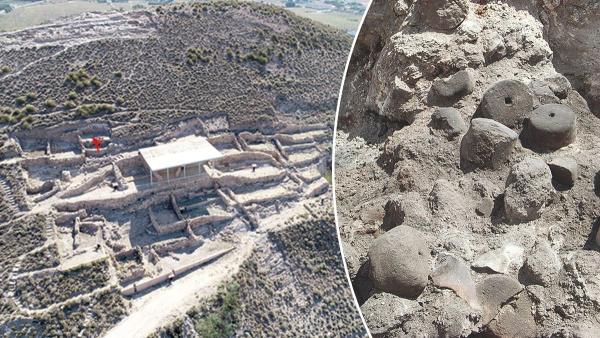
A fire 3,500 years ago preserved an ancient loom / Collage 24 Channel / Ricardo E. Basso Rial and other authors / Antiquity
An archaeological discovery in southeastern Spain has provided a glimpse into the lives of people who lived long before the beginning of our era. During excavations at the settlement of Cabezo Redondo, scientists came across an extremely rare find – the remains of a complex mechanism for making fabrics. Thanks to a coincidence, the wooden parts, which usually quickly deteriorate, have been preserved in almost their original state over the millennia.
How did an ancient catastrophe help reconstruct weaving technology?
The settlement of Cabezo Redondo, located near modern-day Alicante, was founded around 2100 BC and flourished for a millennium. It was a wealthy city, as evidenced by finds of gold and silver jewelry, ivory, glass beads, and exotic seashells, Phys.org reports.
However, the most valuable find for science was an object that survived a massive fire. According to estimates, it occurred somewhere between 1507 and 1428 BC. The fire destroyed the entire building, but the roof, which collapsed, reliably preserved everyday objects underneath, allowing them to survive to this day.
Among the ruins, researchers discovered the remains of a vertical loom, the structure of which consisted of wooden beams, clay weights and ropes made of plant fiber. This is a unique case, as organic materials such as wood and textiles are extremely rare in archaeological layers.
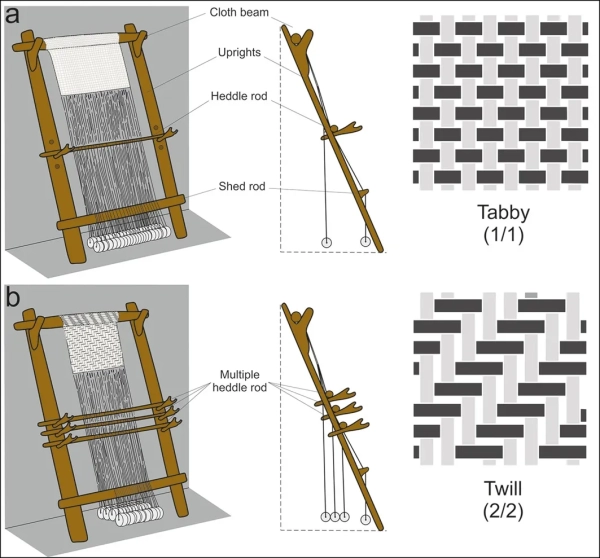
This is what a loom looked like when it was in use / Image by Ricardo Basso
Analysis showed that the frame of the machine was made of local Aleppo wood, according to the study, published in the journal Antiquity. The scientists identified a vertical post more than 1 meter long and smaller cross beams. The structural elements were fastened with braided ropes made of esparto grass, fragments of which were found directly on the wood.
Of particular interest to the scientists were 49 cylindrical clay weights. They were arranged in groups, which suggested how the warp threads were attached to the loom. Interestingly, they all weighed about 200 grams, Science notes, which is significantly less than standard samples of the period, which usually weighed from 400 to 900 grams.
Such lightness of the tools indicates a technical shift in production: presumably, the craftsmen switched from coarse linen to working with delicate sheep's wool. Thin woolen threads required less tension to avoid breaking during work.
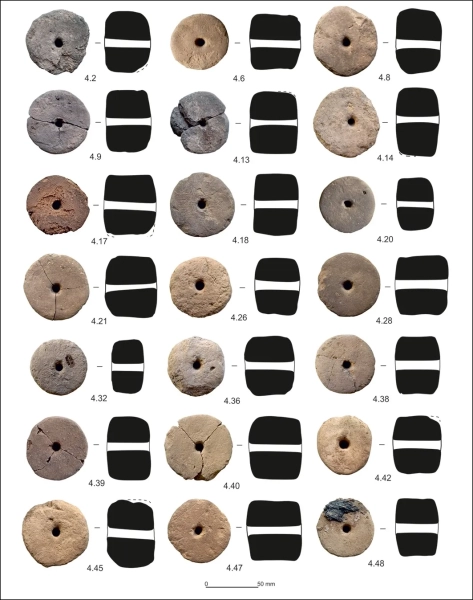
Weights / Photo by Ricardo E. Basso Rial and other authors/Antiquity
Researchers suggest that such a machine could produce not only simple plain weave, but also more complex fabrics, such as twill. If the weighting agents were placed in four rows, this allowed the creation of dense and elastic textiles with a diagonal pattern. This indicates a high level of engineering thinking of ancient weavers, who accurately calculated the necessary weight for each thread.
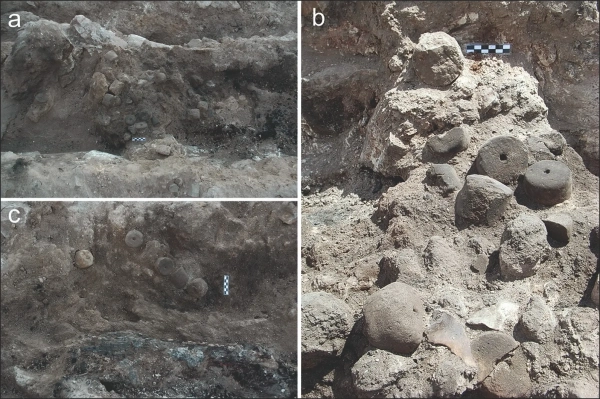
Remains of an ancient loom / Photo by Ricardo E. Basso Rial and other authors/Antiquity
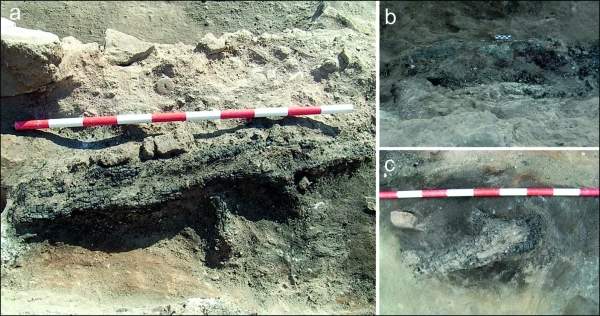
Remains of an ancient loom / Photo by Ricardo E. Basso Rial and other authors/Antiquity
The production of cloth in Cabezo Redondo was part of everyday domestic life. Even the physical characteristics of the village's women testify to the importance of this occupation: characteristic marks were found on the front teeth of women buried in the houses. This is the result of the long-standing habit of biting into threads and holding the fibers with their teeth while working.
The loom was found on an open platform measuring 4.20 by 1.80 meters, which was likely a shared space for several households. This indicates cooperation between neighbors who engaged in spinning and weaving together.
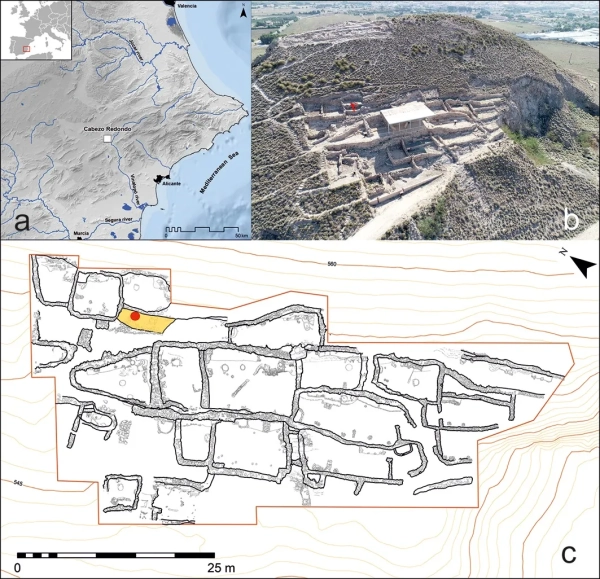
Scheme of the settlement. The red dot indicates the location of the find / Photo by Ricardo E. Basso Rial and others/Antiquity