
Main points
- The study showed that boron can stabilize ribose in aggressive conditions, delaying its breakdown.
- Geological evidence suggests that conditions existed on early Earth that allowed boron to accumulate in water bodies, facilitating the evolution of the first life forms.
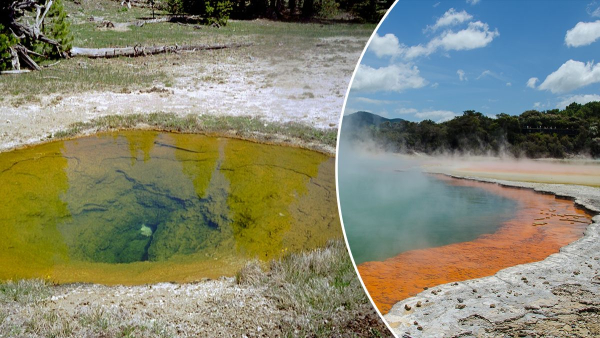
Such formations could have become the ancient cradle of life / Collage 24 Channel / Depositphotos / Freepik
The origin of life remains one of the greatest mysteries of science. According to the “RNA world” hypothesis, its earliest forms relied on molecules of ribonucleic acid, which simultaneously stored genetic information and acted as catalysts. However, a key component of this system – ribose – is extremely fragile.
It was long unknown how these molecules could have accumulated in the harsh conditions of early Earth. A new study, just published in the journal SAGE, points to the role of a common mineral that could have significantly changed the course of chemical evolution.
What substance became the architect of the first steps of biological evolution?
Modern biology views RNA as the central link that organized primitive life systems before the emergence of more complex mechanisms based on proteins and DNA. Ribose plays a critical role in this structure, connecting nitrogenous bases to the phosphate backbone of the molecule. However, reproducing the process of its origin in the laboratory faces a serious obstacle: ribose is an extremely unstable and reactive compound.
Although it can be formed from formaldehyde in a process called the formose reaction, in a strongly alkaline environment this sugar usually breaks down almost immediately after it is formed, leading many researchers to doubt that ribose was the first building block of life.
What was the experiment about?
A team of researchers led by Yuna Takahashi conducted a series of experiments to find out how the presence of boron affects the viability of ribose. The scientists simulated the conditions of the early Earth by adding formaldehyde and glycolaldehyde to hot water at 45 degrees Celsius and maintaining an alkaline pH level of around 12.
The study used different concentrations of borate, a dissolved boron oxide ion that is capable of forming complexes with sugars.
Results
The results of the analyses showed an interesting pattern: although boron somewhat limits the maximum amount of ribose formed at the beginning of the reaction, it radically slows down the process of its further decay.
In experiments without the addition of boron, the concentration of ribose dropped rapidly, while in a medium with a high content of this substance, about six times more sugar remained after 72 hours.
Boron's stabilizing effect is due to its ability to bind to sugar molecules in their ring forms, protecting them from destructive chemical transformations in an alkaline environment. In addition, boron prevents the breakdown of intermediate compounds, such as branched pentoses, which also contributes to the long-term preservation of components necessary for life.
What does geology say?
Geological evidence suggests that such conditions could well have existed on the planet billions of years ago. Boron is an element that typically accumulates in rocks of continental crust, not in the mantle or ocean floor.
Although the major continents formed later, studies of zircon crystals dating back 4.4 billion years indicate the presence of some landmasses early in the planet's existence. In Greenland, boron-containing minerals, including tourmaline, have been found in metasedimentary rocks about 3.8 billion years old.
This suggests the existence of closed basins or lagoons where the water could have become saturated with boron through hydrothermal activity.
Ancient laboratories of life
So such boron-rich locations could serve as natural laboratories. Formaldehyde and glycolaldehyde, formed in the atmosphere under the influence of light, dissolved in ocean water and could accumulate in such pools.
In addition to stabilizing ribose, boron played other important roles: it promoted the synthesis of ribonucleosides, helped attach phosphate groups, and even stimulated the formation of short protein chains from amino acids.
Thus, the mineral wealth of the first protocontinents created a unique foundation for the emergence and interaction of the first functional biopolymers, which ultimately led to the emergence of life.