
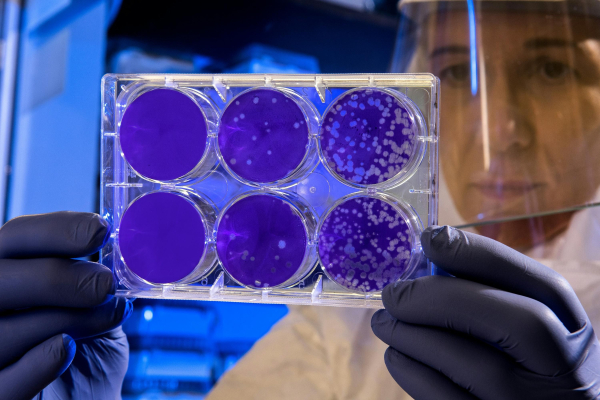
Scientists have created bacteria that produce fuel simply under sunlight / Unsplash / CDC
Researchers have unveiled a new type of cyanobacteria that can produce biofuels through photosynthesis, a technology that could revolutionize the way we create alternatives to gasoline.
Biofuels have long been considered one of the main alternatives to oil and gasoline. Scientists are experimenting with various energy sources – from coffee grounds to human urine. Now, cyanobacteria have been added to this list, which are able to produce fuel components literally thanks to sunlight. This is reported by BGR .
Why did this development attract the attention of scientists?
A group of researchers has reported the creation of a new strain of cyanobacteria that intensively produces free fatty acids during photosynthesis. The results of the work were published in the scientific journal ” Biotechnology for Biofuels and Bioproducts “.
Cyanobacteria are often mistakenly called blue-green algae, but they are actually bacteria. A new genetically modified strain has been shown to be particularly efficient at producing free fatty acids even at “suboptimal” temperatures of around 25 degrees Celsius .

It is these free fatty acids that are key to the project . They are a universal source of energy for many living organisms, including humans, and can also be used as a basis for the production of biofuel.
The study authors say the technology has ” potential benefits for industrial applications ” and could become the basis for large-scale and more efficient biofuel production.
How did scientists manage to circumvent one of the main problems with GMOs?
One of the most interesting details of the study concerns not only the fuel itself, but also the method of creating the bacteria. Genetically modified organisms remain a controversial topic in many countries due to the risk of cross-breeding genes between species. That is why the scientists especially emphasize the peculiarities of their method.
To create the new strain, the researchers replaced the aas gene, which forced the bacteria to reuse fatty acids instead of excreting them . In its place, they integrated another mechanism that stimulates the active production and secretion of these substances.
At the same time, as noted in the scientific paper, the technology leaves no “residual foreign DNA.” This means that the bacteria should not pass on the genetic changes to other organisms. According to the authors, this feature could make the technology acceptable even for regions with strict GMO regulations.
What is the main advantage of these bacteria?
Another important advantage of the new strain is that the bacteria independently secrete the necessary fatty acids to the outside. In traditional biotechnological processes, obtaining the necessary substances from microorganisms usually requires complex and energy-consuming processing. The cells must be collected, dried and destroyed to obtain the final product.
New cyanobacteria largely eliminate these steps. This could cut energy costs, reduce biological waste, and make biofuel production cheaper.
An additional advantage is the bacteria's efficiency in unstable climatic conditions. Since fatty acid production increases at lower temperatures, future biofuel farms could potentially be located in regions where sunlight levels and temperatures are constantly changing.
Competition among gasoline alternatives is only intensifying
Despite the promising nature of the technology, cyanobacteria are just one of many areas of research into replacing fossil fuels. Other alternative systems are being developed around the world in parallel . For example, the company Aircela is working on a technology to create fuel from atmospheric air without using oil.
So it’s too early to say which approach will dominate in the future. But the cyanobacterial research shows that biofuels are gradually moving from the experimental stage to potentially scalable industrial solutions.