
Main points
- Researchers have created printed artificial neurons that can interact with and stimulate biological cells.
- These technologies could contribute to the development of more efficient neuroprostheses and computer systems by reducing energy consumption.
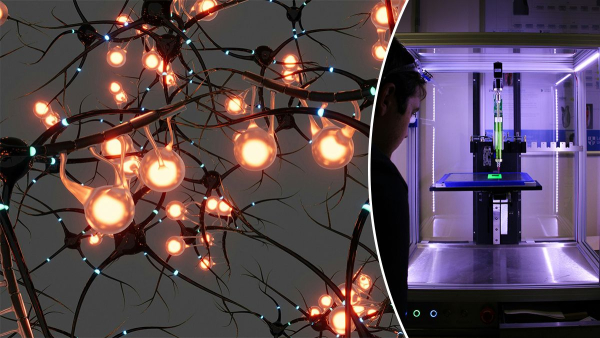
Scientists have printed functional artificial neurons / Collage 24 Channel/Unsplash
A team of researchers has developed unique devices that can integrate into the body's biological system. This invention could radically change the approach to treating neurological diseases and creating computing systems that work according to the principles of living nature.
Can artificial cells become a full-fledged part of the human body?
Engineers at Northwestern University have made significant progress in creating printed artificial neurons that not only mimic biological cells but can also interact directly with them. These devices are flexible, low-cost, and capable of generating electrical signals that are as close as possible to those produced by living neurons, writes SciTechDaily.
In laboratory tests using slices of mouse brain tissue, the artificial neurons successfully stimulated real cells, eliciting measurable responses, demonstrating a new level of compatibility between electronic systems and biological neural networks.
Why is this useful?
This technology opens the door to the creation of brain-machine interfaces and advanced neuroprostheses, which are implants designed to restore hearing, vision, or motor functions in patients.
Beyond medicine, the research findings point to the possibility of creating significantly more efficient computer systems. By replicating the way neurons transmit signals – a key feature of the brain, which is the most energy-efficient computing system – next-generation hardware could be able to perform complex tasks while consuming significantly less energy.
The study was published April 15 in the journal Nature Nanotechnology. Project leader Mark K. Gersam, professor of materials science and engineering in the McCormick School of Engineering, professor of medicine and chemistry, and director of the Materials Science Research Center at Northwestern University, emphasizes the importance of this discovery for the modern world.
He points out that artificial intelligence dominates the modern world. To make AI smarter, it needs to be trained on ever-increasing amounts of data. Such training, which requires a large amount of data, leads to a serious problem with energy consumption.
So we need to develop more efficient hardware for big data and AI. Since the brain is five times more energy efficient than a digital computer, it makes sense to look to the brain for inspiration for the next generation of computing,
– Mark K. Gersam commented on his research.
Why is the brain better than iron?
Modern silicon-based computer systems attempt to solve complex problems by adding billions of identical components arranged on rigid, flat circuit boards. These systems are static and do not change after manufacturing.
Instead, the brain works quite differently: it is made up of many types of specialized neurons, organized into soft three-dimensional networks that constantly adapt and form new connections during learning.
Silicon achieves complexity by making billions of identical devices. Everything is the same, rigid, and fixed after it's made. The brain is the exact opposite. It's heterogeneous, dynamic, and three-dimensional. To move in this direction, we need new materials and new methods of making electronics,
– adds Gersam.
How does it work?
To achieve this similarity, the scientists used special electronic inks made from nanoscale flakes of molybdenum disulfide (MoS2), which acts as a semiconductor, and graphene, which is a conductor. This ink was applied to flexible polymer surfaces using the aerosol inkjet printing method.
Interestingly, the polymer component, previously considered a disadvantage because it impeded the flow of current, was used to their advantage by the researchers. By partially degrading the polymer under the influence of current, they created narrow conductive channels that provide a sudden electrical response similar to the impulse of a real neuron.
This allows the artificial neurons to generate a variety of signals, including single bursts, sustained firing, and bursts of activity. Neurobiology professor Indira M. Raman and her team have confirmed that these signals match natural ones in timing and duration.
Other labs have tried to make artificial neurons out of organic materials, but they've been too slow. Or they've used metal oxides, which are too fast. We're in a timescale that hasn't been demonstrated before. You can see living neurons responding to our artificial neuron,
– Gersam explained.
The technology has another big advantage
In addition to functionality, the new technology is environmentally and economically beneficial. The additive printing method allows materials to be used only where they are needed, minimizing waste. This is critical as modern AI data centers consume gigawatts of energy and require vast amounts of water for cooling.
According to Gersam, technology companies are already building gigawatt data centers that require separate nuclear power plants.
Obviously, this massive energy consumption will limit further scaling of computing, as it is difficult to imagine a next-generation data center that would require 100 nuclear power plants,
– the researcher concluded.
There is currently no information on when the technology will be put into practice.