
Main points
- In the Swiss Alps, scientists triggered about 8,000 microearthquakes to study the behavior of geological faults.
- The experiment detected activity not only on the main fault but also on perpendicular cracks, which could help better understand the propagation of earthquakes.
8,000 earthquakes were artificially caused under the Alps – why did scientists do it / Phys
Deep in the Swiss Alps, scientists conducted an unusual experiment – they triggered thousands of microearthquakes to understand how faults behave deep underground.
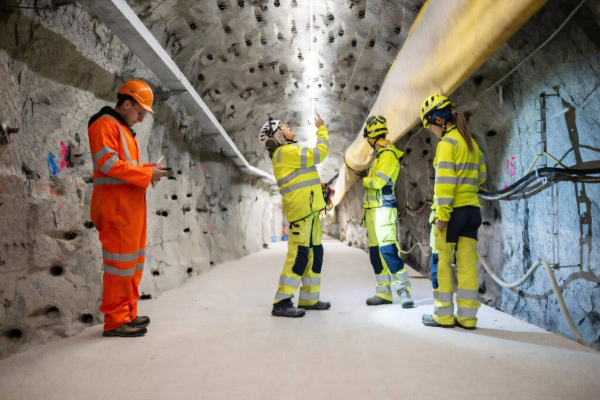
Deep beneath the Swiss Alps, an international team of researchers has conducted one of the most ambitious experiments in modern seismology. In a special underground laboratory called BedrettoLab, scientists deliberately triggered about 8,000 microearthquakes to study in detail the behavior of geological faults. Phys.org reports.
How did scientists make the earth shake?
The project was called FEAR-2 – Fault Activation and Earthquake Rupture . It was implemented by researchers from the Federal Institute of Technology Zurich (ETH Zurich) together with scientists from various European countries.
The laboratory is located inside a 5.2-kilometer-long ventilation tunnel that leads to the Furka railway tunnel. Above the researchers is about a kilometer and a half of rock, creating unique conditions for observing the movement of the Earth's crust.
Project leader Domenico Giardini , a professor of geology at ETH Zurich, called the experiment a success. “We had seismic activity,” he said, explaining that the main goal of the study was to “understand what happens at depth when the Earth moves.”
Underground “earthquake machine”
Unlike traditional research, where seismologists simply place sensors near natural faults and wait for years for activity, the scientists at BedrettoLab decided to provoke the movement of the rock themselves. To do this, they drilled wells in the walls of the tunnel and pumped approximately 750 cubic meters of water into them. The liquid entered the already existing fault and reduced friction between the rocks, stimulating their movement.
“We're not creating a new fault. We're just helping it move,” Giardini explained . Due to safety risks, there were no people in the tunnel during the experiment. All processes were monitored remotely from the ETH Zurich laboratory in Zurich.
Seismologist Ryan Schultz , who specializes in artificially induced earthquakes, called the project “advancing the frontiers of science.”
According to the Straits Times , during the tests, scientists even had to quickly respond to a sudden power outage in the tunnel. French seismologist Frederic Massin jokingly called the system an “earthquake machine”, noting that now researchers can “play with the parameters”.
Why was the experiment important?
As a result of the experiment, scientists recorded about 8,000 seismic events. Their magnitude ranged from -5 to -0.14. Although the researchers aimed to achieve a magnitude of 1 , the result is still considered a breakthrough. According to Giardini, similar experiments have been carried out before, but “never on this scale and never at this depth.”
What surprised the scientists was that the activity occurred not only on the main fault, but also on perpendicular cracks in the rock. This could help to better understand how earthquakes propagate underground. The researchers also said that the results will allow them to more accurately determine the optimal angles of water injection for future experiments. A new attempt to reach magnitude 1 is planned for June.
Could these earthquakes have been dangerous?
No tremors were felt on the surface. According to scientists, the experiment increased the natural seismic risk by only about 1%.
Giardini stressed that the project was “completely safe.” At the same time, he acknowledged that the research has important practical significance for industry. Scientists want to learn how to control risks during underground work – drilling, resource extraction or geothermal projects. Such activities have repeatedly caused real earthquakes.
As an example, Giardini cited the 5.4 magnitude earthquake in the South Korean city of Pohang in 2017. At that time, the tremors were attributed to water injection at an experimental geothermal power plant. He also mentioned cases in Texas, where earthquakes were provoked by the disposal of wastewater after fracking. “If we learn how to create earthquakes of a certain magnitude, then we will understand how not to create them,” the scientist explained.
According to him, humanity should not abandon underground technologies, but should learn to use them much safer.