
Main points
- NASA has reprioritized the Artemis 3 mission, making it a test in low-Earth orbit with testing of interaction with commercial vehicles from SpaceX and Blue Origin.
- The mission involves using the SLS superheavy rocket with a special plug and testing the new AxEMU spacesuits, as well as checking the life support systems on board Orion.
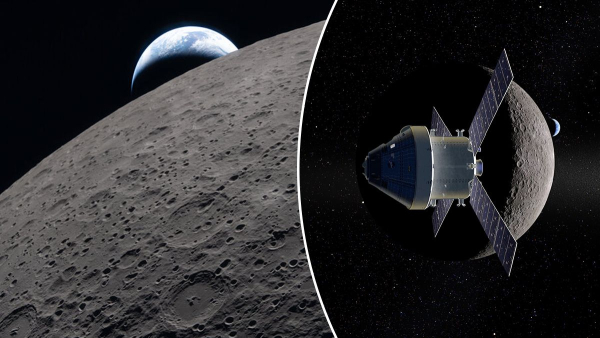
Orion Orbital Test: New Details Revealed for Next Phase of US Lunar Program / Channel 24 Collage/NASA
NASA has officially confirmed a change in priorities for the upcoming Artemis 3 mission. Instead of an ambitious landing on the south pole of the moon, the crew will remain in low-Earth orbit to conduct critical tests of interaction with new commercial vehicles and to check safety systems.
What technical challenges does NASA face in preparing for the Artemis 3 flight?
NASA is working out the details of the Artemis 3 mission, which is scheduled for 2027. This flight will be another stage of preparation before the return of Americans to the surface of the moon as part of the next Artemis 4 mission. The main feature of the updated plan is that Artemis 3 is now officially defined as a test mission in low-Earth orbit, and not as a landing on the lunar surface, as previously planned. The main goal is to practice the rapprochement and docking of the Orion spacecraft with private landing modules created by SpaceX and Blue Origin, writes Space.
Although it is a low-Earth orbit mission, it is an important step towards a successful lunar landing during Artemis 4. Artemis 3 is one of the most complex missions NASA has ever undertaken,
– commented Jeremy Parsons, acting NASA deputy administrator in the Exploration Systems Development Mission Directorate in Washington.
According to him, the agency will for the first time coordinate a complex launch campaign involving multiple spacecraft, which will allow the integration of new capabilities into the operational activities of the Artemis program.

The Space Launch System (SLS) super-heavy rocket will once again be used to launch a four-member crew from the Kennedy Space Center in Florida. However, the rocket's configuration will undergo significant changes: instead of a functional upper stage, NASA will use a special plug.
This component will have the same dimensions and connection interfaces as the real stage, but will be devoid of propulsion features. This is a cost-effective solution, since a flight to Earth orbit does not require the powerful thrust required for a flight to the Moon. Currently, the manufacture of this stub is actively underway at the Marshall Space Flight Center in Huntsville, Alabama.
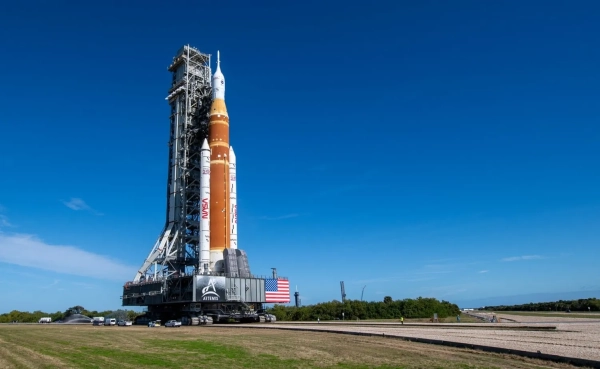
Space Launch System rocket / NASA photo
As NASA notes in its announcement, once Orion is in orbit, its European service module will provide the necessary thrust to stabilize its orbit around the planet. This low-Earth orbit approach significantly increases the chances of success for the entire campaign, providing more launch windows for each individual element: Orion itself, SpaceX's Starship prototype, and Blue Origin's Blue Moon Mark 2 lander.
The mission will last longer
- A key aspect of Artemis 3 will be life support testing. Astronauts will spend more time aboard Orion than during the previous Artemis 2 mission (which lasted 10 days in April 2026), allowing for a detailed evaluation of the systems' performance over a long flight.
- They also plan to test an upgraded heat shield during reentry into the Earth's atmosphere, which should provide more flexible entry profiles for future research expeditions.
- Special attention will be paid to testing the new AxEMU spacesuits from Axiom Space.
In addition to the main tasks, NASA is considering the possibility of launching small CubeSats into low-Earth orbit and is looking for innovative solutions to improve communications with ground stations, since the Deep Space Network will not be used in this mission.
All of these steps are aimed at training ground teams and astronauts to effectively interact with equipment from different vendors before establishing a permanent base on the Moon and future flights to Mars.
You may also be interested to know: why NASA abandoned the original Artemis 3 moon landing scenario
NASA has officially scrapped the original concept for the Artemis III mission, which was originally supposed to be the first human landing on the Moon since the Apollo era. Now, the mission is being transformed into a test flight in low Earth orbit, and the landing itself has been postponed to Artemis IV, which is currently planned for 2028, Channel 24 reminds.
The main reason for this decision was the technical risks and excessive complexity of the original scenario. NASA concluded that simultaneously performing a large number of critical new operations during a single mission created too high a level of danger for the crew.
The initial Artemis III plan required the synchronous operation of the SLS rocket, Orion spacecraft, SpaceX Starship HLS lunar lander, docking systems, Axiom Space's next-generation AxEMU spacesuits, and complex operations in lunar orbit, Aerospace Security notes.
Additional pressure has been created by delays from contractors. SpaceX has not yet completed full orbital testing of Starship in a configuration suitable for a lunar mission, and Blue Origin is only continuing to develop its own Blue Moon lander. NASA decided that it was better to first separately test the docking of Orion with commercial landers in Earth orbit than to risk a full lunar expedition, Space previously reported.
In fact, we can conclude that the agency has returned to the logic of the Apollo program, when NASA performed a series of intermediate test flights before the actual landing on the lunar surface. In the new configuration, Artemis 3 should become an analogue of Apollo 9 – a mission where the interaction of ships and the lunar module in Earth orbit was practiced.
How will the change in Artemis 3 format affect the schedule of all subsequent missions?
The change in the Artemis 3 format has significantly affected the entire Artemis program schedule. Now Artemis 4 will be the first real mission to land people on the south pole of the moon. At the same time, NASA is trying not just to shift the dates, but to rebuild the entire flight architecture. The agency seeks to increase the frequency of launches and move from the current pace of “one mission every few years” to launches approximately every 10 to 12 months, NASA said in a statement.
The agency also decided to standardize the SLS configuration and temporarily abandon the rapid transition to the upgraded Block 1B version. This should simplify production and mission preparation. In addition, Artemis III will now serve as a grand rehearsal for Artemis IV: during the flight, docking systems, life support, communications, as well as crew interaction with the lunar lander will be tested.
What lessons did NASA learn from the previous Artemis 1 and Artemis 2 missions?
NASA's decision was heavily influenced by the lessons of Artemis I and Artemis II. During Artemis I, the agency received a large amount of data on Orion's behavior in deep space and on the problems of thermal protection of the capsule during its return to Earth. NASA recognized that the heat shield needed to be improved for more flexible and safe reentry scenarios. That is why Artemis III will already receive an upgraded heat shield, NASA said.
Artemis II also encountered a number of technical difficulties. The preparation of the mission was accompanied by problems with hydrogen leaks, helium supply systems and safety checks of the SLS rocket. NASA had to change some procedures for servicing and checking the rocket before launch, recalls The Guardian.
How ready are the new AxEMU spacesuits?
A separate factor is the new AxEMU spacesuits being developed by Axiom Space for lunar expeditions. They are intended to replace the outdated Space Shuttle and ISS-era suits and, for the first time in decades, allow astronauts to fully function on the lunar surface. That is why NASA wants to test the interaction of spacesuits with landers before the flight to the Moon.

AxEMU spacesuit designed to support astronauts during Artemis missions / Photo by Axiom Space
AxEMUs are currently in the phase of active testing and refinement. These spacesuits are created specifically for the conditions of the south pole of the Moon, where there are extremely low temperatures, aggressive lunar dust and complex terrain. The design provides astronauts with significantly greater mobility than older NASA suits, including the ability to bend, crouch and work with tools on the surface, writes Smithsonian Magazine.
NASA explicitly states that Artemis 3 could include testing the AxEMU interfaces with SpaceX or Blue Origin lander modules. This means that the agency wants to test not only the spacesuit itself, but also its full lifecycle: airlock entry, life support systems connection, crew mobility, and compatibility with transportation systems.
So it can be concluded that NASA has effectively sacrificed speed for reliability. The agency believes that the risk of failure or accident during the first landing after a break of more than 50 years is too high. Therefore, Artemis III will now be a technology rehearsal, not a historic landing. It is on the success of this mission that it will depend whether Artemis IV can actually return people to the surface of the moon in 2028.