
Main points
- Scientists have found that some regions of Antarctica have already crossed critical temperature thresholds, leading to the inevitable melting of glaciers.
- West and East Antarctica are showing vulnerability, and if temperatures continue to rise, it could lead to significant sea level rise, threatening coastal regions of the planet.
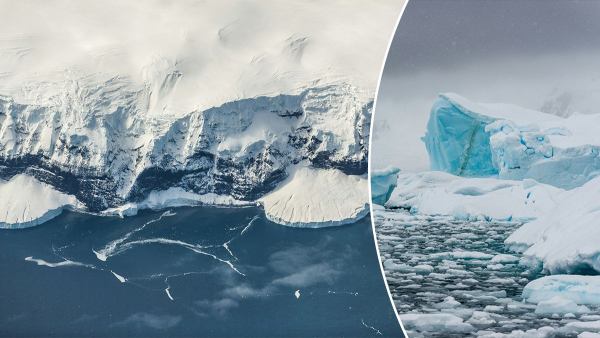
Point of no return: which glaciers in Antarctica are doomed to disappear / Collage by Channel 24/Unsplash
Scientists have identified critical temperature thresholds at which Antarctica's glaciers begin to collapse irreversibly. The world has already reached levels that will trigger a chain reaction in the continent's most vulnerable basins, putting the planet's coastal regions at risk from inevitable sea level rise.
How is global warming turning glaciers into a hidden threat to humanity?
Scientists at the Potsdam Institute for Climate Impact Research have just changed the way we think about the stability of the Antarctic ice sheet. Instead of viewing the continent as a single monolithic system, they analyzed a network of 18 separate drainage basins. Each of these systems has its own dynamics, unique rock-bottom geometry, and individual temperature sensitivity thresholds. Some regions lose ice gradually, but others exhibit nonlinear behavior, where even a small warming leads to a sudden collapse, writes Indian Defense Review.
Today, the average global temperature has risen by about 1.3 degrees Celsius compared to pre-industrial levels. This number becomes alarming when compared to the results of modeling: for the least stable basins of West Antarctica, the threshold for irreversible melting is in the range of 1 to 2 degrees Celsius.
This means that for some parts of the continent, the point of no return has already been passed or is within arm's reach. In particular, the Thwaites and Pine Island ice basins, which together discharge about 5 percent of all Antarctic ice into the Amundsen Sea, are under immediate attack.
According to scientists, crossing the critical line in this sector condemns it to the loss of approximately 70 percent of its ice volume, which in the long term will add 0.9 meters to the level of the world's oceans.
The main mechanism of collapse is the instability of the sea ice sheet. As warm ocean waters wash away the ice from below, the thrust line retreats inland, where the so-called bedrock becomes deeper and deeper. Because the bedrock is tilted toward the center of the continent, the retreat process is accelerated, becoming a self-sustaining reaction.
The researchers, in their paper in Nature Climate Change, highlight the phenomenon of hysteresis: in order to stop or reverse this process, the planet's temperature would have to be lowered to a level significantly lower than before the start of the industrial era.
Where is the situation worst?
The western part of the continent gets the most attention, but East Antarctica is also showing vulnerability. The Cook, Ninnis and Mertz basins, connected to the subglacial Wilkes Basin, have a critical threshold of between 2 and 3 degrees Celsius. If this threshold is crossed, the region could lose 40 percent of its ice, causing sea levels to rise by 1.2 meters.
The so-called “ice plug” mechanism is at work here: a small melting of glaciers on the coast paves the way for the rapid draining of huge inland ice masses. With global warming of more than 6 degrees Celsius, almost all basins of East Antarctica will become unstable, which collectively threatens to raise the ocean by more than 26 meters.
We need to act now.
The study's parallel ice sheet model (PISM) was calibrated using paleoclimate data and modern satellite observations. The scientists emphasize that while threshold crossings are occurring now, the melting process itself will take centuries and millennia.
But today's decisions on emissions and the warming trajectory are shaping a future that will be impossible to change. If temperatures exceed 10 degrees Celsius, Antarctica will effectively lose its ice cover entirely in the long term.
It is important to note that significant sea level rise may begin before these critical levels are reached. Each basin responds in its own way, with some losing mass linearly, others in leaps and bounds. But the overall conclusion is clear: Antarctica is not a stable ice sheet, but a network of sensitive systems, many of which have already begun their journey to ultimate extinction.