
Main points
- Archaeological excavations in Old Dongola have uncovered a document confirming the existence of King Kashkash, previously known only from folklore.
- The document, found among the debris, contains a royal decree and testifies to the king's economic and micro-political actions, refuting stereotypes about Nubian rulers.
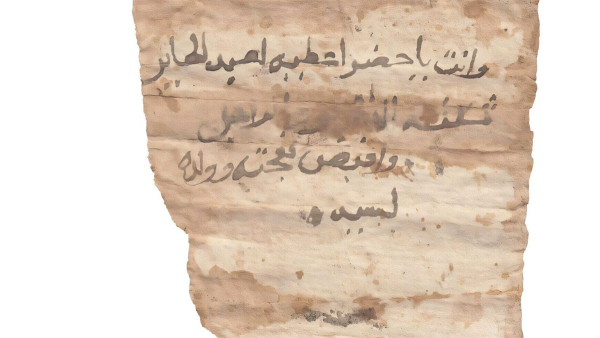
Archaeologists have found proof of the reality of the semi-legendary ruler of Nubia / M. Rekłajtis/PCMA in Barański
Archaeological excavations in Stara Dongola have yielded an unexpected result. Among the layers of household garbage, a scrap of paper was discovered that forced historians to reconsider an entire era. This document became the first material evidence of the life of a person whose name for centuries was considered only part of folklore and religious traditions passed down from generation to generation.
How did scientists bring the legendary monarch back from oblivion?
In the ruins of the ancient citadel of Old Dongola, in what is now Sudan, an event has taken place that transformed a semi-legendary name into a very real historical figure. During excavations within the framework of the UMMA project, scientists came across a small sheet of paper with Arabic writing that had been lying for centuries in a layer of garbage. This document confirms the existence of King Kashkash – a ruler who was previously known only from later traditions and religious texts of the 19th century, in particular from the work “Kitab al-Tabaqat”, writes Arkeonews.
The find was discovered in a building that locals have long associated with the residence of a petty king. It differed significantly from the surrounding structures in its size and the wealth of items found inside.
Among the remains of luxury, researchers recorded silk products, high-quality cotton, leather shoes and a dagger handle made of elephant tusk or rhinoceros horn. A gold ring and musket balls were also found, which clearly indicates that representatives of the political elite of the time lived here.
The document itself is an official order. Despite being found among the rubble, the text carries a clear royal authority. It begins with the words “From King Kashkash” and is addressed to his subordinate named Khidr, according to the study published in Azania: Archaeological Research in Africa.
In the letter, the monarch gives instructions on economic matters: to collect three pieces of textile, to give a sheep with its lamb to a certain Muhammad al-Arab, and to receive another sheep from a man named Abd al-Jabir. At the end of the letter, the name of the royal scribe Hamad is mentioned.
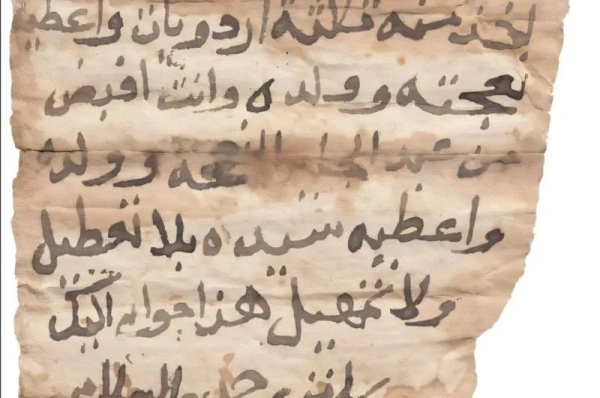
A text found in a trash can brought a forgotten king back into history / Photo by M. Rekłajtis/PCMA in Barański
Such details paint a picture of a ruler who was deeply involved in the micropolitics and economic management of the city. This belies the perception of some European travelers of the past that Nubian kings were perpetually at war. On the contrary, Kashkash appears as an administrator, managing trade relations, exchanging gifts, and maintaining social ties.
Other finds confirm the region's rich history
The significance of the find is reinforced by other artifacts. Ottoman silver coins from the early 17th century were found with the document, and radiocarbon dating of organic materials confirmed that the paper was discarded no later than the 18th century. This allows us to confidently date Kashkash's reign to the late 16th – early 17th centuries. Thus, he becomes one of the first reliably confirmed rulers of Nubia in the post-medieval period, notes Phys.org.
The language of the document also provides invaluable information about the cultural transformation of the region. Although the edict is written in Arabic, it contains grammatical irregularities and colloquial features that reflect the influence of local Nubian traditions. This suggests that the process of Arabization was not a sharp break with the past, but a gradual adaptation. Arabic became the main language for official court correspondence, but it was still adapting to local realities.
Researchers note that Nubia was not an isolated region during this period. It remained a key corridor connecting the Mediterranean with sub-Saharan Africa. Through it flowed gold, ivory and other goods, and with them new religious ideas and political models.