
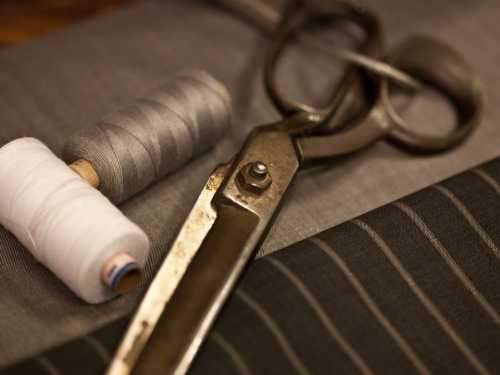
There are many tips online for sharpening scissors, from using foil to glasses to special sharpeners. However, most of these methods can damage your scissors. Today, I’m sharing a professional secret on how to quickly and safely sharpen your scissors using a simple method that doesn’t require any special tools, Ukr.Media reports.
You can’t throw scissors! That’s for the guests! But we never do, we have to sew!
In fact, manufacturers are sure that it is impossible to throw scissors because of the serious damage they cause. Moreover, sometimes incompatible with further work practice. When hit, dents may appear, the blades are bent, the blade fastening mechanism is damaged, and imbalances may occur, which even a master cannot eliminate, because he does not know the factory settings and the type of metal. And each pair of scissors has its own.
Moreover, scissors in workshops cannot be sharpened more than 1-2 times, sharpening greatly shortens the service life.
What to do, you ask? Should I buy new scissors every time? What if they are very expensive?
There are a few rules for life with tailor’s scissors and one method, thanks to which my scissors from the haberdashery in the neighboring house have been living and working perfectly for more than 15 years. Moreover, in this way I can even teach paper scissors to cut any fabric.
What not to do with tailor’s scissors:
- You still can’t throw scissors.
- Separate the chicken and cut the paper.
- Store either hanging or with leather tips. The tips of the scissors should never rest on the bottom or touch each other.
Keep a close eye on the pins. These suicides regularly throw themselves under the scissors, severely damaging the blades.
If an accident does occur with scissors, we begin resuscitation.
I recommend that you first practice with simple blunt paper scissors or take children’s ones, they are always the bluntest of all blunt ones.
No foil! No glasses! No sandpaper! And God forbid — a sharpener!
We need a large circular needle, mine is a quilting pin. It should be long and not too thin.
IMPORTANT: place the pin at the beginning of the opened scissors at a 45° angle and at the same time guide the needle with your hand at the same angle and make a closing movement with the scissors. As if cutting the needle. If there are notches, the blades will seem to stumble. Your task is to continue the smooth movement forward.
Repeat this action several times to get the needle between the blades. And always make one smooth movement from edge to edge!
That’s it! Your paper scissors are ready to cut even thin, unruly chiffon.
There are many tips online for sharpening scissors, from using foil to glasses to special sharpeners. However, most of these methods can damage your scissors. Today, I’m sharing a professional secret on how to quickly and safely sharpen your scissors using a simple method that doesn’t require any special tools, Ukr.Media reports.
You can’t throw scissors! That’s for the guests! But we never do, we have to sew!
In fact, manufacturers are sure that it is impossible to throw scissors because of the serious damage they cause. Moreover, sometimes incompatible with further work practice. When hit, dents may appear, the blades are bent, the blade fastening mechanism is damaged, and imbalances may occur, which even a master cannot eliminate, because he does not know the factory settings and the type of metal. And each pair of scissors has its own.
Moreover, scissors in workshops cannot be sharpened more than 1-2 times, sharpening greatly shortens the service life.
What to do, you ask? Should I buy new scissors every time? What if they are very expensive?
There are a few rules for life with tailor’s scissors and one method, thanks to which my scissors from the haberdashery in the neighboring house have been living and working perfectly for more than 15 years. Moreover, in this way I can even teach paper scissors to cut any fabric.
What not to do with tailor’s scissors:
Keep a close eye on the pins. These suicides regularly throw themselves under the scissors, severely damaging the blades.
If an accident does occur with scissors, we begin resuscitation.
I recommend that you first practice with simple blunt paper scissors or take children’s ones, they are always the bluntest of all blunt ones.
No foil! No glasses! No sandpaper! And God forbid — a sharpener!
We need a large circular needle, mine is a quilting pin. It should be long and not too thin.
IMPORTANT: place the pin at the beginning of the opened scissors at a 45° angle and at the same time guide the needle with your hand at the same angle and make a closing movement with the scissors. As if cutting the needle. If there are notches, the blades will seem to stumble. Your task is to continue the smooth movement forward.
Repeat this action several times to get the needle between the blades. And always make one smooth movement from edge to edge!
That’s it! Your paper scissors are ready to cut even thin, unruly chiffon.
Your email address will not be published.