
Main points
- Archaeologists have discovered the well-preserved medieval settlement of Kaplonosi Kolonia in southeastern Poland, which had long been hidden by forests.
- Research has shown that earthen fortifications and numerous artifacts, such as knives, arrowheads, jewelry, and ceramics, have been preserved thanks to the natural protection of the forest.
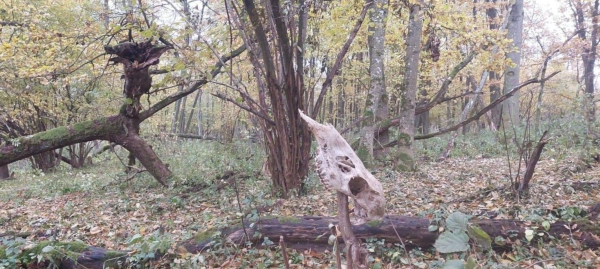
A thousand-year-old settlement discovered in the forests of Poland / Lubelski Voivodship Conservator of Monuments
In southeastern Poland, archaeologists have confirmed the existence of a well-preserved medieval fortified settlement that had been hidden by forests for centuries. Inside the complex, they found ramparts, ditches, traces of buildings and hundreds of artifacts that shed light on life in the 10th to 13th centuries. How did the forest preserve a medieval fortress? Researchers called the discovery “an absolutely unique place on the archaeological map” of southeastern Poland.
Researchers have called the discovery “an absolutely unique place on the archaeological map” of southeastern Poland. It is the Kaplonosi Kolonia settlement, an early medieval defensive complex preserved in the forests near Włodawa. Interesting engineering writes about this.
How did the forest preserve a medieval fortress?
Work on the site lasted about ten years. For the first time , archaeologists took to the air back in 2016 to check what might be hidden under the dense forest cover. Then they recorded traces of ramparts, but they were able to move on to full-fledged field research only almost a decade later.
In 2025, under the leadership of the Lublin Provincial Conservator of Monuments, the existence of an abandoned settlement dating back to the 10th–13th centuries was officially confirmed. After the settlement's decline, nature effectively took it under its protection. Later human intervention was minimal, with the exception of a few traces of Jewish presence during World War II.
The site is located deep within the Las Ochoża Nature Reserve. Swamps and dense forests made the work much more difficult: transportation of equipment was limited, and the research was carried out taking into account strict environmental regulations.
Archaeologists used mostly non-invasive and minimally invasive methods. They used aerial photography in the visible and infrared spectra, LiDAR data, and soil electrical resistivity studies. All findings were recorded with centimeter accuracy using GPS, which allowed them to delineate the functional zones of the settlement.
According to Archaeologymag, despite expectations, the earthen fortifications were well preserved precisely thanks to the forest. Geophysical data did not provide clear plans of the development, but recorded underground anomalies that indicate the presence of hearths and utility pits. The line of the rampart contained signs of wooden box-shaped structures filled with stone or soil. The entrance was probably located on the eastern side.
Inside the settlement, ditches, remains of buildings and a total of 244 artifacts were discovered. Among them are 66 knives, sickles, iron plowshares, arrowheads and spearheads, as well as personal jewelry . A silver temple ring, a horseshoe-shaped fibula, a lyre-shaped buckle and a semi-finished silver crescent were found. Numerous fragments of pottery were also found. All this reflects the daily life of the inhabitants of a fortified settlement, similar to other centers of the region at that time.
At the same time, Kaplonosi Colony is distinguished by its exceptional state of preservation. After the 12th–13th centuries , the settlement was finally abandoned, and the area was gradually swallowed up by nature. However, archaeologists have found two German rifle cartridges with iron bullets, which indicate that Jews may have been hiding in this inaccessible area during the Nazi occupation.
Thus, the forest not only preserved a defensive monument of the Middle Ages, but also became a refuge for people during the tragic periods of the 20th century . Today, this territory combines wild nature and traces of defensive history, reminding of the multi-layered past of the region.