
Main points
- Scientists have discovered an ancient microorganism in a Romanian ice cave that shows resistance to many modern antibiotics.
- The bacterium also has the potential to inhibit the growth of modern “superbugs” thanks to genes encoding antimicrobial compounds.
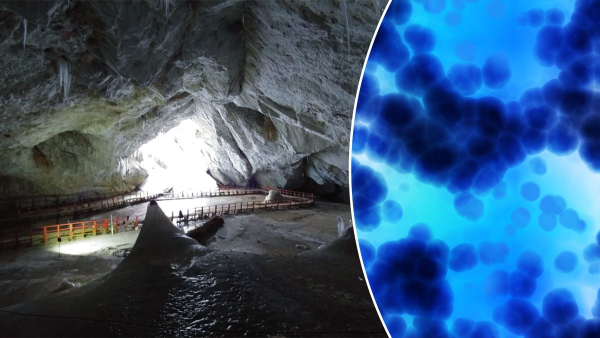
5,000-year-old bacteria revived after thawing / Collage 24 Channel/Freepik
Scientists have discovered a microorganism that has been frozen for at least 5,000 years in a layer of centuries-old ice underground. After thawing, it demonstrated unexpected properties that could be important for modern science.
How does an ancient bacterium combine threat and potential?
Researchers drilled an ice core about 25 meters long into the ice layers of the Scărișoara Ice Cave. This ice core covers a time period of about 13,000 years and allows us to trace what microorganisms existed at different historical periods. One of the fragments, formed about 5,000 years ago, contained a previously unknown strain of bacteria, writes Popular Science.
The study, published February 17 in the journal Frontiers in Microbiology, identified Psychrobacter SC65A.3, a member of the Psychrobacter genus that is adapted to extremely low temperatures.
Despite its ancient origins, the bacterium has demonstrated resistance to a range of modern antibiotics. Genome sequencing has revealed over 100 genes associated with antibiotic resistance mechanisms.
The researchers tested the strain against 28 antibiotics from 10 classes. It turned out that it did not respond to drugs that are widely used in clinical practice, including rifampicin, vancomycin and ciprofloxacin. Some of these drugs are used to treat tuberculosis, colitis and urinary tract infections. In addition, SC65A.3 became the first representative of Psychrobacter, which was recorded resistance to trimethoprim, clindamycin and metronidazole.
Antibiotic resistance occurs when bacteria evolve to resist the effects of drugs that are supposed to kill them. The World Health Organization estimates that drug-resistant infections caused 1.27 million deaths worldwide in 2019. Therefore, finding new molecules and understanding the natural origins of resistance are critical for health systems.
But there is good news too.
But the ice cave story isn't just about risk. While melting glaciers can release microbes with ancient resistance genes, Psychrobacter SC65A.3 has also shown the ability to suppress the growth of some modern “superbugs.”
Its genome has been identified as containing 11 genes that potentially encode antimicrobial compounds that can act against bacteria, fungi, and even viruses. In addition, nearly 600 genes remain functionally unknown, which could hold new biotechnological tools.
Scientists emphasize that such studies require strict biosafety measures. Ancient microorganisms are a valuable source of knowledge about the evolution of antibiotic resistance, but at the same time they must be carefully isolated to avoid uncontrolled spread.
Thus, the bacterium frozen for 5,000 years has become a kind of archive of evolution. It demonstrates that resistance genes existed long before the advent of modern medicine and the uncontrolled use of antibiotics. At the same time, it may suggest new approaches to creating drugs of the future.