
Melting ice, falling temperatures, and the functioning of water control facilities in February render reservoirs unreliable and hazardous for Ukrainians. The frozen surface may appear firm, yet it can give way under a person’s mass, pulling them beneath the water.
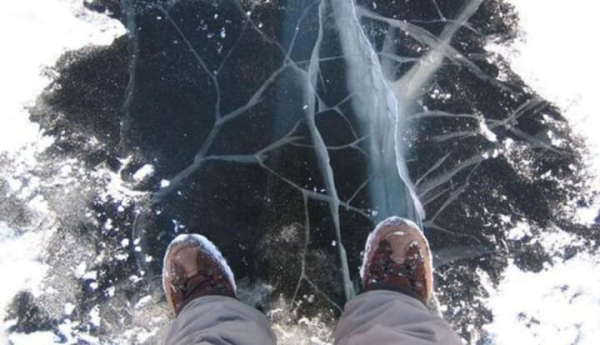
Already since the year’s commencement, 22 Ukrainians have perished due to disregard for safety guidelines on icy surfaces. Spokespersons from the State Emergency Service and Ukrhydroenergo detailed strategies for avoiding their fate and preserving the lives of oneself and loved ones during the discussion “When Ice Transforms into a Hazard,” as transpired on February 12 in Kyiv, UNN indicates.
Ukrainians Deceased and Rescued: Up-to-Date Figures of Ice Casualties
Viktor Vitovetsky, Chief of the Civil Protection and Preventive Measures Division of the State Emergency Service, stated that 22 individuals have died in water bodies since the year began.
“Regrettably, one of them is a juvenile,” he remarked.
Simultaneously, he mentioned that the statistics were more unfavorable last year for the equivalent timeframe. The enhancement in ice security, he suggested, might partially stem from consistent alerts and enlightening the populace about the perils of venturing onto the ice.
The State Emergency Service also shared information concerning Ukrainians saved from bodies of water.
“We succeeded in rescuing 15 individuals from the start of the year, four of whom were children,” Vitovetsky conveyed.
Nevertheless, he underscored that these figures should not provide a false sense of security: the services require duration to reach the incident location, and for an individual endangered in frigid conditions, it might simply be insufficient.
Where Disasters Most Frequently Take Place
As per rescuers, the majority of fatalities transpired on rivers. Vitovetsky clarified:
“If we consider diverse categories of water bodies, the bulk of deaths is presently observed on rivers – 15 individuals. Additionally, 7 individuals passed away on ponds situated on other inland water bodies.”
Among the reasons for death, ambiguous circumstances prevail (owing to the challenge of precisely ascertaining them post-mortem, notably if no nearby witnesses existed) in addition to angling.
Geographic Breakdown: Where the Highest Numbers of Water-Related Deaths are Documented
The State Emergency Service additionally announced the regions where the greatest count of deaths has been documented since the beginning of the year.
“This year, the Dnipropetrovsk region has experienced five fatalities, Vinnytsia has reported three, and Transcarpathia and Poltava have each registered two,” specified the head of the department of civil protection and preventive measures of the agency.
Comparatively, in the previous year, Vinnytsia, Kyiv, Kharkiv, and Chernihiv regions led.
Why Ice Proximate to Hydraulic Installations is More Treacherous
Over the course of the discussion, unique prominence was attributed to reservoirs and zones close to hydroelectric facilities. Acting General Director of Ukrhydroenergo Bohdan Sukhetsky stressed:
“In our region and in our climatic zone on the whole, there exists no consistent ice. Put simply, all the ice currently present is dynamic, it lacks stability.”
The primary rationale involves the activity of hydroelectric installations and variations in water elevations. Suhetsky elucidated that the hydroelectric plant instigates the circulation of water masses, notably, it raises warmer layers that wear away the ice from underneath. Furthermore, as a result of the conflict, the power grid operates in atypical configurations for its purposes: after bombardments or power deficiencies, hydroelectric power can be activated at full capacity. Consequently, conspicuous level decrements surface:
“These undulations can span from 10 to 15-17 centimeters,” Suhetsky detailed.
He portrayed the mechanism whereby even seemingly robust ice transforms into a hazard:
“The ice lacks the opportunity to descend, and this air stratum instantly forms, rendering the ice highly fragile.”
An additional element encompasses subtle vibrations from the machinery’s performance, engendering micro-cracks in the ice sheet. Such processes elude detection by a layperson yet exert a critical influence on safety.
“There is no Such Thing as Secure Ice”: The Rescuers’ Stance
Oleksandr Tumanov, director of the underwater mine clearing and other specialized operations section of the State Emergency Service in Kyiv, articulated the core principle as directly as conceivable:
“The chief safety measure entails not venturing onto the ice under any circumstances. That is, unless completely unavoidable.”
He emphasized that it is not viable to entirely assure safety on ice due to a confluence of natural and anthropogenic variables. In the end, it proves simply impossible to anticipate the manner in which the ice will “behave.”
He separately directed attention to the human element in a dire situation: an individual who has succumbed undergoes shock, panic, and swiftly forfeits the aptitude to function rationally.
“Panic constitutes the principal adversary,” Tumanov stressed, while addressing self-rescue.
Automobile on Ice: The Drowning Process Unfolds with Great Rapidity
During the occasion, instances where automobiles drive onto the ice were likewise deliberated.
Oleksandr Tumanov observed: “The procedure of a vehicle sinking transpires exceedingly swiftly. An individual may simply not possess adequate time to unlatch the door.”
According to him, doors and locking mechanisms can be obstructed by ice and water pressure, and “movie-esque” rescue scenarios fail to function in reality.
The State Emergency Service accentuated that traversing by car on a pond enshrouded by ice epitomizes the most perilous type of conduct on ponds during winter, since an individual essentially consigns themselves with minimal prospects of salvation.
Steps to Undertake Upon Witnessing an Individual Plunge Through the Ice
The State Emergency Service advises initially contacting emergency services: dial 101 or 112 from a mobile device.
Subsequently, provided the helping individual is not subjecting themselves to mortal peril, they should act with utmost circumspection.
Viktor Vitovetsky elaborated on the fundamental guidelines to Ukrainians.
Should approaching be requisite, one should crawl, allocating one’s mass uniformly across the surface to avert fracturing the ice underneath.
Employing makeshift instruments proves crucial: encompassing a rope, a rod, or an additional object to impart resistance to the victim and abstain from approaching excessively closely.
In scenarios where the victim is unconscious or feeble, rescuers advocate utilizing improvised extension cords (scarf, belt, etc.) and, subsequent to extrication, promptly proceeding to administer first aid.
Distinctly, Vitovetskyi underscored the significance of first aid proficiency: during wartime, this represents an indispensable competency not only for aquatic scenarios.
Ice Angling: Actions that Mitigate Risks
Rescuers acknowledge that notwithstanding cautions, certain individuals persist in venturing onto the ice for angling purposes. In such instances, Oleksandr Tumanov advises at a minimum the elementary precautions: refrain from venturing onto the ice solo, secure a companion and procure a sturdy rope (ideally furnished with a carabiner). And additionally seize objects exhibiting “positive buoyancy.”
He cited instances of individuals being salvaged from drifting ice expanses, yet conceded that at times, even post-rescue, individuals revert to angling once more.
At the culmination of the discourse, the presenters converged on a unified deduction: temperate climate and thermal oscillations, coupled with the functioning of water control installations, transmute ice into an unpredictable milieu where conventional intuitive safety regulations may prove ineffectual.
The stance of the State Emergency Service remains unequivocal: it is preferable to abstain from venturing onto the ice unless utterly imperative, and proximate to hydroelectric power stations and on rivers, the hazard of succumbing to a deadly trap escalates manifold.
Let Us Remind You
Prior, the State Emergency Service cautioned regarding the most hazardous devices during blackouts. Since the inception of the year, over 1,200 conflagrations have been recorded attributable to emergency operating modes of electrical grids. Rescuers emphasize the peril entailed in employing uncertified apparatus and overburdening electrical networks.