
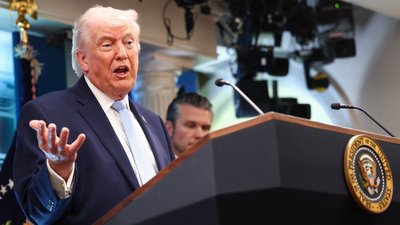
US President Donald Trump said he was dissatisfied with Iran's proposals for a deal to end the war that the US and Israel launched against Iran.
Donald Trump told reporters about this, a correspondent for Suspilny reports.
“They want a deal, but I'm not happy with it, so we'll see what happens. Iran wants a deal because they have no troops left,” Trump said.
Trump said that Iranian government officials are “very confused.”
“They're coming back. One says one thing, the other says another. They're very confused. Obviously, their country, frankly, has been destroyed,” he said.
When asked whether the presidential administration would seek approval from the US Congress to continue military action against Iran, Trump replied that this had not been done before.
“Because it's never been done before. Nobody has ever done it before, because it would be considered unconstitutional. We're in touch with Congress,” Trump said.
Under US law, the presidential administration has 60 days to take military action in response to an “imminent threat or attack on the United States” unless Congress has voted to authorize war.
Without express authorization from Congress, once this deadline is reached, the president “ceases all use of the Armed Forces of the United States.” The US launched the war against Iran on February 28. This deadline was set to expire on May 1.
President Trump says it is necessary to take into account the ceasefire regimes declared by the US and Iran to calculate the exact date when the 60-day deadline for conducting an operation without congressional authorization expires.
Israeli and US military operation against Iran
On February 28, Israel attacked the Iranian capital Tehran. US President Donald Trump later said that the US military had launched a “major combat operation” against Iran to “eliminate imminent threats from the Iranian regime”. He accused the Iranian government of “funding and training” militants in Syria, Lebanon, Iraq and Hamas in Palestine. According to him, the aim of the military operation is to “destroy Iran's missile industry and navy” and “ensure that the world cannot be destabilised”.
The Islamic Revolutionary Guard Corps (IRGC) said it had launched missiles and drones towards Israel, and also attacked US military bases in Qatar, Saudi Arabia and the United Arab Emirates.
On February 28, Trump announced that Iran's Supreme Leader Ali Khamenei was dead, a claim later confirmed by the Islamic Republic News Agency (IRNA).
On March 1, the IRGC announced that it was launching “the most devastating offensive operation in the history of the Islamic Republic” against Israel and “American terrorist bases.” Trump called on the Iranian regime to abandon these plans and threatened to strike “a very strong blow” in response.
On March 6, Trump declared the need for a complete change in Iran's leadership, adding that he already had several candidates for the role of “a good leader.” On March 8, Iran's Assembly of Experts elected the son of the assassinated Ayatollah Ali Khamenei, Mojtaba Khamenei, as the third supreme leader of the Islamic Republic.
On March 26, President Trump announced that he would suspend the destruction of Iranian energy facilities until April 6. However, due to the lack of progress in concluding the agreement, Trump extended the deadline by 20 hours, until the evening of April 7.
Trump has threatened to destroy all bridges and power plants in Iran, as well as take other measures that will have devastating consequences for the Iranians and provoke a dangerous response throughout the region.
On April 6, Iran provided the US and Israel with a separate 10-point plan to end the war over Pakistan.
On April 7, Trump announced that he had agreed to suspend bombing of Iran and postpone a “devastating attack” on it for two weeks if the Strait of Hormuz was unblocked. He said the ceasefire would be bilateral and that Iran's 10-point proposal was an acceptable basis for negotiations.
Iranian Foreign Minister Abbas Araqchi said that safe passage through the Strait of Hormuz within two weeks is possible “under the conditions of coordination with the Iranian armed forces and taking into account technical limitations.”