
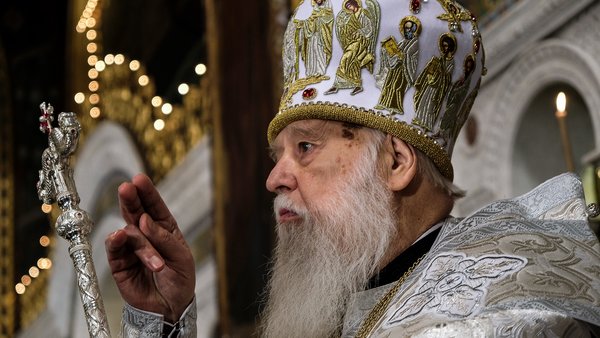
On March 20, the Orthodox Church of Ukraine announced the death of Patriarch Emeritus Filaret of Kyiv and All Rus'-Ukraine. He died “from the consequences of exacerbation of chronic diseases” at the age of 97.
Filaret devoted 81 years of his life to the church — since he began studying at the Odessa Theological Seminary. “The person and numerous good deeds of the late Patriarch Filaret rightfully occupy a special place in the modern history of both the local Ukrainian Orthodox Church and Ukraine as a whole,” said its Primate, Metropolitan Epiphany, in a church message. “Having headed the Kyiv See six decades ago, Patriarch Filaret, as the Exarch of Ukraine, as the Primate of the UOC and the Primate of the UOC-KP, did much to preserve church life during the years of Soviet oppression of the Church, during the spiritual revival of Ukraine, and especially during the years of the struggle for the establishment of church autocephaly.”
This struggle was long, intense and dramatic in Filaret's life. For the sake of recognition of the independence of Ukrainian Orthodoxy by the Ecumenical Patriarch, he agreed to liquidate the church, which he had led and built for over 20 years. Having voluntarily given up power, Filaret could not accept that he did not return it. Suspilne tells about the winding path of one of the key Orthodox figures of independent Ukraine.
Applicant
People who knew Filaret like to repeat the phrase: if the history of Ukrainian Orthodoxy were to be laid out on one page, Filaret would definitely have a place there. What exactly this place is and what his role was, they do not specify. The assessments of church and state figures vary greatly.
Filaret gave 81 years of his life to the church. He served in four different Orthodox churches: the Russian Orthodox Church (ROC), the Ukrainian Orthodox Church of Moscow (UOC-MP), and later the Kyiv Patriarchate (UOC-KP), and finally the Orthodox Church of Ukraine (OCU). However, until the end of his life, he considered himself the Patriarch of Kyiv. The transition from one church to another reflects the transformation of Filaret's views on the independence of Ukraine and its Orthodox Church. His desire to lead the church in which he served remained unchanged.
Mikhail Denisenko took monastic tonsure during Stalin's reign, in 1950, as a student at the Moscow Theological Academy. Before that, he, a native of Donetsk, studied at the Odessa Theological Seminary. Later, in an interview, Filaret said that he came to God because of the death of his father. He died on the front during World War II, in 1943 in Zaporizhia.
“I was taught at school that a person dies and that's when his existence ends. The question arose before me: if my father does not exist, and I love him, then what do I love – an empty place? Is it possible to love something empty, nonexistent? No! That's how, at the age of 14, I came to the conclusion: my father exists because I love him,” Filaret recalled.
For over 50 years he followed the hierarchical path of the Russian Orthodox Church. Having become Metropolitan of Kyiv and Galicia in 1968, he headed the Ukrainian Exarchate . A separate administrative-territorial unit, foreign to the main church. ROC. Filaret was also the rector of the Moscow Theological Academy and Seminary. During the last five years of the life of the Patriarch of the ROC, Pimen, he was ill, and Filaret headed the synod of the church (its government) and actually led it. In particular, he prepared and held the celebration of the millennium of the baptism of Rus.
In 1990, after the death of Pimen, Filaret took the place of the guardian of the patriarchal throne. This reflected the growing influence of Ukrainian hierarchs within the ROC. In the late 1980s, a third of the participants in the bishops' councils of the ROC were from its Kyiv Exarchate. Ukraine was the leader in the number of dioceses of the ROC at that time.
Filaret was not only the guardian of the throne, but also a real contender for it. It was he who was entrusted by the bishops of the Russian Orthodox Church with the preparation of the bishops' council, where a new patriarch was to be elected. However, Filaret lost the election.
He received half as many votes as Metropolitan Alexy (Rüdiger) of Leningrad and Novgorod and took last place, losing to Metropolitan Vladimir (Sabodan) of Rostov and Novocherkassk.
Religious scholar Oleksandr Sagan, in a conversation with Suspilny, claims that Filaret became a victim of political intrigues by the entourage of the last General Secretary of the USSR, Mikhail Gorbachev. After more than 30 years of leadership of the country by Ukrainians during the times of Nikita Khrushchev and Leonid Brezhnev, the last General Secretary of the USSR set a course to deprive them of power.
On the other hand, theologian Kyrylo Govorun is convinced: Filaret, a master of intrigue and a prominent church politician, lost the elections simply because he did not feel the change in the political paradigm. This time, the participants really elected the patriarch, and not just legalized the decision made by the party leader and the KGB.
“Voters knew very well Filaret’s character and his tendency towards autocracy, which is why they voted against it,” Hovorun told the Public.
Even cooperation with the KGB did not help Filaret become patriarch. In early 1992, the Commission of the Presidium of the Verkhovna Rada In 1990–1993, a permanent parliament was elected by the Congress of People's Deputies of the Russian Federation. The Russian Federation, headed by deputy Gleb Yakunin, published a resolution. Referring to the KGB archives, the commission listed the nicknames of Orthodox hierarchs who collaborated with the State Security Committee in Soviet times.
Based on the dates of trips abroad, the commission identified Metropolitan Filaret of Kyiv and Galicia as an agent of “Antonov.” Later, Filaret admitted that this was true, but insisted that it was not a sin. If the Lord allowed this godless power, Filaret explained, then one must live under the conditions of this godless power.
The winner of the elections, Metropolitan Alexy, was mentioned in the resolution of the deputy commission as an agent of “Drozdov”.
 Patriarch of Moscow Alexy II (left) and Metropolitan Filaret (center) in 1990. Kyiv Pechersk Lavra National Reserve
The idea of autocephaly
Filaret was not a supporter of the idea of autocephaly (independence) of Ukrainian Orthodoxy, which was gaining popularity during the “perestroika” era. It enjoyed particular support in the dioceses of western Ukraine. Local clergy even officially asked Patriarch Pimen, and after his death, Filaret as the patriarchal locum tenens, to recognize the UOC as a church separate from the Russian Orthodox Church.
Speaking at the local council of the Russian Orthodox Church on the day of the patriarchal election, Filaret noted that the aspirations of Ukrainian believers for church independence found expression precisely in the UOC-MP, which enjoys broad autonomy, and that no other church is needed for this. He called supporters of autocephaly in Ukraine “church separatists” who mock the canon.
“In essence, the so-called autocephalists are a new version of “self-consecrated” Representatives of the Ukrainian Autocephalous Orthodox Church, which existed on the territory of Soviet Ukraine from 1919 to 1937. For a certain time, this church was supported by the Soviet authorities as a counterweight to the Russian Orthodox Church, trying to split the Orthodox Church. After the banning of the church, it operated in exile. With the gaining of independence, it returned to Ukraine again. in Ukraine,” Filaret said then.
Having lost the election for patriarch, Filaret returned from Moscow to Kyiv, where a month later he again took part in the Local Council, this time of the UOC-MP. There he won the election: Filaret was elected Metropolitan of Kyiv.
Having received a new title, Filaret no longer resisted the idea of autocephaly, but, on the contrary, supported it.
At the same Local Council, the hierarchs of the UOC-MP appealed to the Patriarch of Moscow with a request to grant independence and autonomy in governance. This issue was considered by the Bishops' Council of the ROC, following which Alexy II blessed Filaret to the Kyiv See and granted the UOC-MP a charter recognizing the Ukrainian Orthodox Church, headed by the Metropolitan of Kyiv and All Ukraine, as “independent and independent in its governance and organization.”
“Filaret acted on the principle: if you can't stop it, lead,” says Oleksandr Sagan, explaining why the Metropolitan of Kyiv so quickly changed his views on the autocephaly of Ukrainian Orthodoxy.
In 2025, officials of the State Service for Ethnopolitics and Freedom of Conscience of Ukraine will conclude that in fact the charter of Alexy II referred to the conditional autonomy of the UOC. In the charter of the ROC, it is mentioned as a part of this church and is guided in its activities by the decisions of its Bishops' Council.
Long before future research, supporters of autocephaly concluded that they had not received true independence from Alexius II.
Three months after Ukraine declared independence, in November 1991, Filaret initiated the Council of Bishops of the UOC, which decided that the new status of Ukraine required a new status for the church as well—full canonical independence and autocephaly. Therefore, the Ukrainian hierarchs again appealed to the Patriarch of Moscow to grant this status.
Alexy II again referred this issue to the Bishops' Council, which has not yet considered it. Instead, the following year, in 1992, the hierarchs of the Russian Orthodox Church decided Filaret's fate at the Council – they removed him from the see of the Metropolitan of Kyiv, deprived him of all ranks of the priesthood, and forbade him to conduct divine services.
 Patriarch of the Ukrainian Orthodox Church (KP) Filaret (left) and Metropolitan of the Ukrainian Orthodox Church (MP) Volodymyr (Sabodan) (center) during the opening of an exhibition dedicated to the 1025th anniversary of the baptism of Kyivan Rus, Kyiv, July 26, 2013. These two church leaders rarely appeared together, and their confrontation in the 1990s became a key conflict that defined the split in the Ukrainian Orthodox Church. UNIAN/Yevgeny Maloletka
Kyiv Patriarchate
Before that, Filaret made the most important choice of his life. In the fall of 1991, he did not come to the Bishops' Council of the UOC-MP in Kharkiv. According to Alexander Sagan, there Filaret was to be removed from the Kyiv Metropolitan See and appointed Metropolitan of Odessa instead. However, he did not accept such an offer and refused to recognize this decision of the council. The following year, this decision was confirmed by the aforementioned Council of the ROC.
Filaret finally joined the camp of the independentists – he entered the newly created Ukrainian Church of the Kyiv Patriarchate with the title of Deputy Patriarch Volodymyr.
Later, Filaret recalled that after he was stripped of his archbishopric, he lay in the Kyiv government hospital “Feofania” and thought about what to do. In the end, he decided to unite with the UAOC.
And as soon as Filaret thought about it – according to his recollections – he received a call from the Domestic Policy Service of the Presidential Administration of Leonid Kravchuk. Within half an hour, representatives of the president came to him and offered to unite with the autocephalous church.
“They didn't know that I had already decided to do this. I saw the voice of God in this too. The Lord showed that we must follow the path of the Ukrainian independent church,” Filaret later said.
Three years after the creation of the UOC-KP, in October 1995, Patriarch Volodymyr died. Filaret was elected to the vacant seat.
 A woman at the grave of Patriarch Volodymyr (Romanyuk) on Sophia Square in Kyiv, July 18, 2000. During his burial in July 1995, clashes broke out on the square between believers who wanted to bury his body on the territory of the reserve and Berkut units. The city hall demanded burial at the Baikovo cemetery. The patriarch still lies near the wall of the cathedral. UNIAN/Dmytro Gavrish
Filaret's longtime associate, Father Boris (Tabachek), in a conversation with Suspilny, emphasizes that the patriarchate is the highest level in the Orthodox Church system, which also provides special opportunities for communicating with God on behalf of the people.
“The Patriarch stands before God for all his people, leads the people, teaches the people on behalf of God. And of all the people in Ukraine, he has the greatest opportunity, glory, and audacity to pray for the people and communicate with God for the people. This is the great mission of the Patriarch — to be a guide between God and the people,” says Father Borys.
The new Ukrainian Orthodox Church was created by Filaret and his supporters from the Moscow Patriarchate together with the hierarchs of the Ukrainian Autocephalous Orthodox Church. However, the UAOC continued to exist after that. Thus, in the first year of Ukraine's independence, there were already three Orthodox churches operating on its territory: the UOC-KP, the UOC-MP, and the UAOC.
Having joined the UOC with 800 parishes, Filaret increased their number to over five thousand by 2018, making the UOC-KP the second religious organization in Ukraine in terms of the number of parishioners.
For over 20 years of leadership of the UOC-KP, Filaret acted on the principle: first we will build an independent church, and then we will receive its recognition. After all, the independent Ukrainian church was not recognized not only by Moscow, but also by the center of world Orthodoxy – Constantinople.
Until 1686, the Kyiv Metropolis was subordinate to the Constantinople (Ecumenical) Patriarch. Then the Moscow state forced Patriarch Dionysius IV to grant the Moscow Patriarch the right to ordain the Metropolitan of Kyiv.
Filaret officially applied for recognition for the UOC-KP to both the Moscow and Ecumenical Patriarchs. In Moscow, where Filaret was anathema, there was no chance of obtaining autocephaly. On the other hand, Ecumenical Patriarch Bartholomew considered such a possibility, but had his own conditions.
The third president of Ukraine, Viktor Yushchenko, tried to push the Ecumenical Patriarch to take this step. He persuaded Bartholomew to return the Kyiv Metropolis to himself. Yushchenko later recalled that Bartholomew assured him that he viewed the Ukrainian church territory in the status of 1686. To confirm this, in 2008 he visited Ukraine.
 Ecumenical Patriarch Bartholomew I, left, and Ukrainian President Viktor Yushchenko on Sophia Square in Kyiv, July 26, 2008. UNIAN/Mykhailo Markiv
Bartholomew agreed to grant a tomos to Ukrainian Orthodoxy as the Kyiv Metropolis of the Patriarchate of Constantinople, which was to be formed by the united UOC-KP and UAOC.
Filaret agreed to this idea and asked Bartholomew to declare the dethronement of him and the top leadership of the UOC-KP invalid. However, it was not possible to create a local Orthodox church in Ukraine at that time. In 2008, at the Local Council of the UOC-KP and the UAOC even proclaimed unification – but disagreements arose over who would join whom. At that time, Filaret insisted that the UAOC should join the UOC, and not vice versa.
“You can't attach a jacket to a button,” Filaret said then. The UAOC did not agree to such conditions.
As a result, Bartholomew shelved the idea of a tomos for Ukrainian Orthodoxy for other reasons. Viktor Yushchenko recalled that at that time the Ecumenical Patriarch accepted the proposal of Alexy II, who had hurriedly arrived in Kyiv. In exchange for not granting Ukraine a tomos, the Moscow Patriarch promised Bartholomew to restore church communion with Constantinople (the two churches had severed it in 1996, when the Ecumenical Patriarch recognized the autocephaly of the Orthodox Church of Estonia) and to support the idea of holding a Pan-Orthodox Council, which Bartholomew considered his life's work.
 Primate of the Ukrainian Orthodox Church of the Kyiv Patriarchate Filaret distributes the “holy fire” to parishioners in St. Volodymyr's Cathedral in Kyiv, April 11, 2015. UNIAN/Vladislav Musienko
Honorary Patriarch
Ten years later, in 2018, the fifth president of Ukraine, Petro Poroshenko, returned to the idea of a tomos for Ukrainian Orthodoxy. By that time, Bartholomew had held a Pan-Orthodox Council, but representatives of the Russian Orthodox Church had never attended it. Now, nothing was stopping Bartholomew from granting Ukraine a tomos.
This time Filaret was persuaded to unite with the UAOC. Later, he told how Poroshenko did it. The liquidation of the UOC-KP, according to him, was a demand of the Ecumenical Patriarchate — and there was no question of him leading the newly created Orthodox Church of Ukraine.
Alexander Sagan explains that until then, the Ecumenical Patriarch perceived Filaret as a threat to the unity of world Orthodoxy. “Filaret worked on, in essence, the creation of a 'parallel diptych.' He recognized self-proclaimed Orthodox churches, in particular in Bulgaria,” the religious scholar explains.
Filaret claimed that he agreed to the liquidation of the UOC-KP only on the condition that he would be the de facto head of the newly created Orthodox Church of Ukraine. At its Constituent Council on December 15, 2018, Filaret claimed, in the presence of Petro Poroshenko, he agreed with the bishops that they would vote for his long-time secretary Epiphany (Dumenko).
Filaret claimed that, by agreement, as Metropolitan of Kyiv, Epiphanius was to represent the OCU abroad, while Filaret was to lead the church. Without his consent, the primate was not to take any action within the OCU. They were to conduct divine services together.
In addition to the hierarchs of the UOC-KP and the UAOC, two hierarchs of the UOC-MP also arrived at the Constituent Council of the OCU – Metropolitan Simeon (Shostaksky) of Vinnytsia and Metropolitan Oleksandr (Drabynko) of Pereyaslav and Vyshnevsky. The latter told Suspilny that there were supposed to be 15 hierarchs of the UOC-MP. However, on the evening before the Constituent Council of the OCU, one of them was taken to the Kyiv-Pechersk Lavra for repentance by the then people's deputies. After the start of the full-scale invasion of the Russian Federation, both left Ukraine. According to the latest data, Novinsky is in the EU, Derkach left for the aggressor country, where he recently became a Senator and received the title of Hero of Russia. Vadym Novinsky and Andriy Derkach. The remaining 13 hierarchs were actually held in a hotel for 24 hours by SBU officers.
“Because Filaret calculated that if there are 15 hierarchs of the UOC at the council, the voting results will be different and Simeon will be elected metropolitan,” Metropolitan Oleksandr tells the Public.
As a result, Epiphanius was elected metropolitan at the Constituent Assembly.
 Patriarch Emeritus of the Orthodox Church of Ukraine Filaret and Primate of the Orthodox Church of Ukraine Metropolitan Epiphany leave after the ceremony of awarding them with state awards, Kyiv, January 22, 2019. Filaret was then awarded the highest state award – the title of Hero of Ukraine and the Order of the State. UNIAN/Mykhailo Markiv
At peace
Six months after the OCU received the tomos on January 6, 2019, Filaret publicly accused Epiphanius of failing to fulfill the agreements reached at the Council. Filaret continued to call himself patriarch and wear the patriarchal diadem. He accused the Metropolitan of Kyiv of not allowing him to lead the church and not even serving together.
Filaret spoke about the conflict in the OCU, in particular, in an interview with the Russian propaganda resource “Russia 24”. Explaining his action to Ukrainian journalists later, he noted that he did not think that an interview with a hostile channel would cause such a negative reaction from society – and if he had known, he might not have given it.
Filaret declared that the UOC-KP continues to exist, and on May 14, 2019, he invited its hierarchs to a prayer celebration in honor of the holy martyr Macarius at the Volodymyr Cathedral in Kyiv. The invitation was printed on the letterhead of the dissolved UOC-KP. However, the revival of the Kyiv Patriarchate did not occur. Only four hierarchs of the former UOC-KP came to Filaret for the celebration. So, two weeks after the failed attempt, Filaret came to the Epiphany service.
“He took off the patriarchal cap and just prayed. He did not serve. Metropolitan Epiphany was very pleased,” TSN reported in May 2019.
However, the conflict did not stop there. Filaret continued to insist that the UOC-KP had not been liquidated — and to act accordingly. In particular, he ordained clergy and conducted negotiations with the diaspora. Therefore, Metropolitan Epiphanius had to publicly declare that the OCU had not authorized the Honorary Patriarch Filaret to take such actions.
To prove otherwise, Filaret challenged the liquidation of the UOC-KP in court. The process lasted almost three years, but in May 2021 the Supreme Court confirmed the legality of the liquidation of this church. After the start of the full-scale invasion, Filaret focused on the captured civilians and defenders of Ukraine, no longer mentioning the conflict in the public sphere.
 Patriarch Emeritus of the Orthodox Church of Ukraine Filaret during the Christmas service at St. Volodymyr's Cathedral, January 6, 2019. Getty Images/NurPhoto/Diego Herculano
Spiritual testament
Filaret did not agree to the liquidation of the Kyiv Patriarchate until the end of his life. On October 25 of this year, the UOC-KP website published the “spiritual testament of His Holiness Patriarch Filaret.”
In the text, Filaret calls himself the elected Primate of the UOC for life and the Patriarch of Kyiv and All Russia. At the same time, he emphasizes that he is not the honorary patriarch of the OCU. Filaret bequeathed that his funeral be held in the Volodymyr Cathedral in Kyiv by the hierarchs of the UOC-KP — not the OCU.
He called on all Orthodox Christians in Ukraine to unite and create “a truly unified Ukrainian Church, independent of both Moscow and Constantinople, with a patriarchal system of governance.”
“This system will ensure spiritual independence and strengthen the national identity of the Ukrainian people, contributing to their unity in the face of the challenges of modernity,” Filaret noted.
A few weeks later, on November 5, Metropolitan Epiphanius visited Filaret and congratulated him on the 30th anniversary of his election as Patriarch of Kyiv. Together they served a service in St. Michael's Golden-Domed Cathedral for Ukraine's victory in the war with the aggressor. Filaret never changed his spiritual testament after that.