
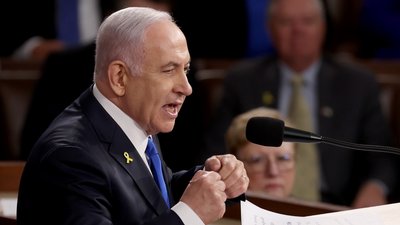
Israeli Prime Minister Benjamin Netanyahu said in a national address that Iran was weaker than ever and all of its enriched uranium would be removed, either through negotiations or renewed fighting. He stressed that the temporary two-week truce between the United States and Iran was agreed upon with Israel and did not mean the end of the campaign.
This is stated in the full transcript of Netanyahu's speech, published by The Times of Israel.
“We still have goals to achieve, and we will achieve them either by agreement or by resuming hostilities. We are ready to return to combat at any time,” Netanyahu said.
According to him, a temporary two-week ceasefire between the United States and Iran took effect overnight and was fully coordinated with Israel.
Netanyahu said Iran was entering the talks “beaten and weaker than ever.” According to the Israeli prime minister, Tehran had committed to opening the Strait of Hormuz and had dropped previous demands — the lifting of sanctions, compensation, and a final end to the war, including in Lebanon.
Regarding the enriched uranium remaining in Iran, Netanyahu referred to statements by senior Trump administration officials: all enriched uranium will be removed from Iran — either by agreement or through the resumption of hostilities.
Netanyahu stated that without Operations Rising Lion and Lion's Roar, Iran “would have long ago acquired nuclear weapons and thousands of missiles to destroy Israel.”
The prime minister listed what he considered the operation's achievements: the destruction of Iran's missile production, strikes on nuclear infrastructure and centrifuge factories, the elimination of nuclear scientists, the destruction of the navy, dozens of aircraft and missile bases. Steel and petrochemical plants, bridges and railway lines used to transport troops and weapons were also destroyed.
According to him, Israeli forces eliminated the top leadership of the Iranian regime – from leader Khamenei to the command of the Islamic Revolutionary Guard Corps and the Basij.
Netanyahu stressed that he insisted that the temporary truce with Iran not extend to Hezbollah. According to him, on April 8, Israel struck the group with its most powerful strike since the pager operation — 100 targets in 10 minutes.
The prime minister also said that Israel has created “deep security zones” beyond its borders – in Lebanon, Syria and Gaza, where, he said, Israel controls more than half of the Strip and “squeezes Hamas from all sides.”
Netanyahu thanked US President Donald Trump for his “leadership and friendship” and called the joint operation “the largest military operation the Middle East has ever known.”
Israeli and US military operation against Iran
On February 28, Israel attacked the Iranian capital Tehran. US President Donald Trump later said that the US military had launched a “major combat operation” against Iran to “eliminate imminent threats from the Iranian regime”. He accused the Iranian government of “funding and training” militants in Syria, Lebanon, Iraq and Hamas in Palestine. According to him, the aim of the military operation is to “destroy Iran's missile industry and navy” and “ensure that the world cannot be destabilised”.
The Islamic Revolutionary Guard Corps (IRGC) said it had launched missiles and drones towards Israel, and also attacked US military bases in Qatar, Saudi Arabia and the United Arab Emirates.
Amid the US military operation against Iran, French President Emmanuel Macron said that Paris is calling for an urgent meeting of the UN Security Council.
The European Union said it reaffirmed its “unwavering commitment to ensuring regional security and stability” in the Middle East.
Ukrainian President Volodymyr Zelenskyy said it was fair to give the Iranians a chance to get rid of “the terrorist regime and guarantee the security of all peoples who have suffered from attacks from Iran.”
On February 28, Trump announced that Iran's Supreme Leader Ali Khamenei was dead, a claim later confirmed by the Islamic Republic News Agency (IRNA).
On March 1, the IRGC announced that it was launching “the most devastating offensive operation in the history of the Islamic Republic” against Israel and “American terrorist bases.” Trump called on the Iranian regime to abandon these plans and threatened to strike “a very strong blow” in response.
On March 2, US Secretary of State Marco Rubio said that the next phase of the US military operation against Iran would be even more destructive.
On March 6, Trump declared the need for a complete change in Iran's leadership, adding that he already had several candidates for the role of “a good leader.”
On March 8, Iran's Assembly of Experts elected the son of the assassinated Ayatollah Ali Khamenei, Mojtaba Khamenei, as the third supreme leader of the Islamic Republic.
Trump declined to comment on the election of Mojtaba Khamenei, saying only: “We'll see what happens.” Before that, the American president said that the new leader of Iran “won't last long” if he doesn't receive the approval of the White House.
On March 26, President Trump announced that he would suspend the destruction of Iranian energy facilities until April 6. However, due to the lack of progress in concluding the agreement, Trump extended the deadline by 20 hours – until the evening of April 7.
Trump threatened to destroy all bridges and power plants in Iran, as well as take other measures that would have devastating consequences for the Iranians and provoke a dangerous response throughout the region.
On April 6, Iran provided the US and Israel with a separate 10-point plan to end the war over Pakistan.
On April 7, Trump announced that he had agreed to suspend bombing of Iran and postpone a “devastating attack” on it for two weeks if the Strait of Hormuz was unblocked. He said the ceasefire would be bilateral and that Iran's 10-point proposal was an acceptable basis for negotiations.
Iranian Foreign Minister Abbas Araqchi said that safe passage through the Strait of Hormuz within two weeks is possible “under the conditions of coordination with the Iranian armed forces and taking into account technical limitations.”