
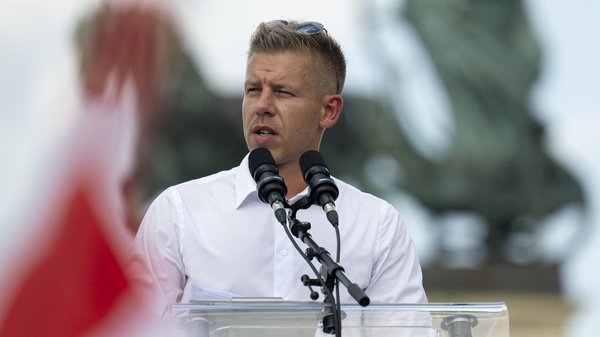
Hungarian opposition leader Peter Magyar said that if his party wins a constitutional majority in the April 12 elections, it will remove key allies of Prime Minister Viktor Orban from office, including the president and the heads of the Supreme and Constitutional Courts.
This was reported by Bloomberg, citing Magyar's speech on March 23.
Magyar was speaking at a campaign rally in northeastern Hungary, where he urged voters to give his Tisza party two-thirds of the seats in parliament to rewrite the constitution and complete “regime change” after 16 years of Orban's rule.
Magyar called Orban and his entourage a “mafia.” He said the heads of the Supreme and Constitutional Courts, the State Audit Office, the Antimonopoly Authority, and the Prosecutor General would be removed from their positions. He said they had not fulfilled their constitutional duties but were loyal to Orban.
“We will restore the rule of law and democratic pluralism,” Magyar declared.
The election is less than three weeks away. The Magyar Party leads by a wide margin in independent polls, but analysts doubt whether that will be enough to remove Orban from power. During his long dominance of Hungarian politics, Orban has rewritten the constitution, changed electoral districts and appointed loyalists to key government positions.
Magyar, a former member of Orban's Fidesz party, founded Tisza two years ago. He has promised to bring Hungary back into the “European mainstream” and loosen ties with Russia. U.S. President Donald Trump reiterated his support for Orban on March 22.
At the same time, the main topic of discussion in Budapest was the alleged involvement of Russia in the Hungarian elections, writes Bloomberg. The Washington Post reported that the Russian foreign intelligence unit developed plans to stage an assassination attempt on Orban to support his election campaign. The publication referred to a document, the authenticity of which, according to it, was confirmed by one of the European intelligence agencies.
In addition, according to The Washington Post, Hungarian Foreign Minister Péter Szijjártó regularly briefs his Russian counterparts on the content of EU meetings. He has made more than a dozen visits to Russia since the start of the full-scale invasion of Ukraine in 2022.
Magyar called Szijjártó's communication with Russian officials a “treason” against Hungary and the EU, which, according to Hungarian law, is punishable by life imprisonment.
What is known about the 90 billion euro EU loan for Ukraine?
On December 19, 2025, EU leaders decided on a €90 billion loan for Ukraine for 2026–2027. The loan will be secured by the bloc's budget reserves, not frozen Russian assets.
On January 14, 2026, the European Commission adopted a package of legislative proposals that will allow Kyiv to provide this loan to cover financial and military needs for two years.
On January 21, the European Parliament supported the proposal for a Council decision allowing the activation of enhanced cooperation to establish a loan for Ukraine of 90 billion euros for the period 2026–2027.
On February 11, MEPs voted in favor of three legislative acts that allow Ukraine to receive a loan of 90 billion euros in 2026 and 2027.
Hungary blocks this loan
On February 20, it became known that Hungary blocked the allocation of an EU loan worth 90 billion euros to Ukraine due to the lack of oil transit from Russia through the Druzhba oil pipeline.
The Ukrainian Foreign Ministry stated that Kyiv informed Budapest about the Russian shelling of the Druzhba oil pipeline in Brody, Lviv region, and the corresponding damage on January 27, and that Ukraine's accusations of delaying supplies are illogical.
Despite this, Peter Szijjártó stated at the EU Council meeting on February 23 that Russia “did not shell” the Druzhba oil pipeline infrastructure, and that Ukraine allegedly stopped transit due to an “internal political decision.” The Ukrainian Foreign Ministry accused the Hungarian minister of statements and actions in favor of Russia.
On February 23, European Commissioner Valdis Dombrovskis told the Public that the EU is not discussing alternative options for allocating a 90 billion euro loan to Ukraine, which is being blocked by Hungary.