
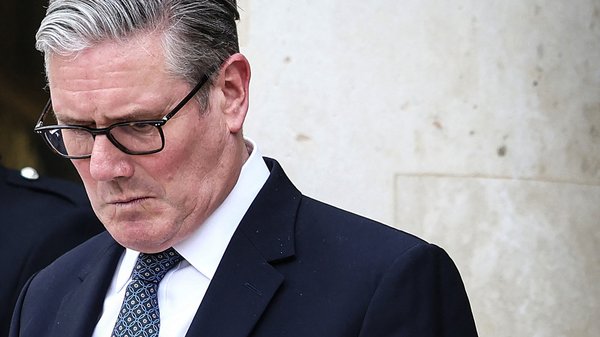
The local elections in Great Britain, held on May 7, have become one of the biggest challenges for the government of Prime Minister Keir Starmer. They ended in a catastrophic defeat for his native Labour Party, and more than 70 MPs from the same party have already called on the Prime Minister to resign immediately or at least announce a date by which he will do so. The problem is not only with Labour or Starmer's government: their traditional rivals, the Conservatives, also lost a lot of seats. The right-wing populists from the Reform United Kingdom party (hereinafter referred to as “Reform”) and the Greens triumphed in the elections. What this means for Great Britain and what ties “Reform” has with Russia – in the material of the Social.
The UK's local elections – a vote that should have been about issues like potholes, school funding and rubbish collection – have turned into a referendum on whether Prime Minister Keir Starmer has confidence in him. That's how the right-wing populist Reform party portrayed the election: on polling day, it took out huge political advertisements on the front and back pages of the popular London newspaper The London Standard, urging citizens to “throw out Starmer.”
The choice made by the British people showed that confidence in his Labour Party, which will govern the country from 2024, is rapidly declining. Labour lost three-quarters of its representatives in local councils in England, and also suffered a crushing defeat in Wales and Scotland, where parliamentary elections were held.
After that, events unfolded rapidly: over the weekend, the first calls for Starmer's resignation were heard from within his own party. As of Tuesday morning, 78 MPs from his political force had already spoken out in favor of it – that's one in five Labour MPs. Starmer, however, is trying to keep the prime minister's chair, saying that he “takes responsibility for the election result” but “will continue to lead.” Most Britons are skeptical of his intention.
70% of the population of the United Kingdom, according to polls, believe that he is doing a poor job as prime minister. The hosts of the popular British political podcast The Rest is Politics, Alistair Campbell and Rory Stewart, compared Starmer to Joe Biden during the last US presidential election and urged Labour not to repeat the mistake of the Democratic Party, but to nominate a new leader as soon as possible in order to have a chance at the parliamentary elections in 2029. On the other hand, Deputy Prime Minister David Lammy defended Starmer, saying that “you don't change pilots in mid-flight.” Financial markets are also wary of the political instability that a change of prime minister could cause – especially against the backdrop of an economic crisis that is deepening due to the US war with Iran.
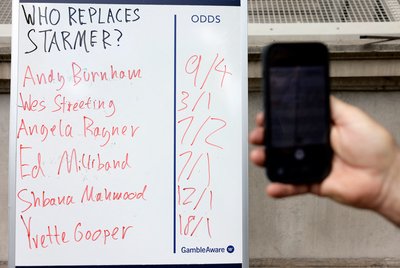 Bookmaker odds in central London with the names of the candidates for the position of the next leader of the British Labour Party on May 12, 2026. Prime Minister and Labour leader Keir Starmer has told his team that he will continue to lead the country and will not resign. Getty Images/AFP/Brook Mitchell
What happened anyway?
On May 7, elections were held in England for 136 local councils, and in Scotland and Wales for local parliaments (only one part of the UK, Northern Ireland, did not hold elections). In England, more than 5,000 local council representatives and mayors were elected, while in Scotland and Wales, 129 and 96 members of their own parliaments were elected, respectively.
According to the election results, the ruling Labour Party lost 1,496 seats in local councils in England — out of just over 2,000 that it controlled. The Conservatives, until recently Labour's main competitors on the British political scene, lost more than 500 seats. In return, the far-right populists from Nigel Farage's Reform Party won more than 1,450 seats — up from 14 before the election. The Green Party also celebrated its success: in addition to its usual environmental slogans, it now supports Palestine and has attracted a portion of the left-wing electorate that previously voted for Labour.
In Wales, Reform did even better: it became the second most popular party there, after the nationalist Plaid Cymru, pushing Labour into third place. Labour lost the election in Wales for the first time in over a hundred years: since 1922, it has been the main party there. In Scotland, the patriotic Scottish National Party also won, which does not rule out the possibility of holding a new referendum on leaving the United Kingdom. Labour finished in second place, and Nigel Farage's party was third.
 Nigel Farage, leader of the British Reform UK party, shows off his socks as he arrives at a polling station in the resort town of Walton-on-the-Naze to vote in the local elections. England, May 7, 2026. AP/Richard Pelham
The specter of Brexit
The local election results demonstrate three trends in British politics. First, there is a fragmentation of the political scene, which is no longer dominated by two traditional parties. The Conservatives had been in power for 14 years until 2024, having changed five prime ministers during that time. Their term in office saw the UK leave the EU, known as Brexit, an economic downturn, Russia's full-scale invasion of Ukraine and one of the largest waves of migration to the country – the so-called Boris wave, when after Brexit, during Boris Johnson's term, migrants from EU countries left the island and citizens of Asian countries arrived instead.
Secondly, there is the impact of Brexit, which, although it took place in 2020, still determines British politics. According to the National Bureau of Economic Research, investment in the country decreased by 12-18% due to leaving the EU, and GDP per capita fell by 6-8%. Economic factors were the main reason for voter dissatisfaction and the Conservatives' defeat in the last election in 2024. Then the British voted for the Labour Party, giving it a record 33% of the vote in the hope of the radical changes it promised. However, there was no rapid growth and within two years the anger of voters poured out on Labour.
Farage's Reform UK party won just five seats out of 650 in 2024, and he himself was elected to the British parliament for the first time. This is in stark contrast to the party's performance today: over the past year, according to polls, it has been the most popular party in the UK with a support level of 23-27%. Local election results reflect the rise of populists and Reform UK in particular, and this is another important trend. The party's leader, Nigel Farage, calls Britain “broken”, blames traditional political parties and migrants for all its problems and promises to “repair” the country.
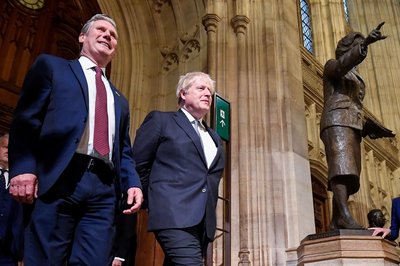 Labour Party leader Keir Starmer (left) and then-British Prime Minister Boris Johnson walk past a statue of former Prime Minister Margaret Thatcher after delivering the State Opening Speech at the Houses of Parliament at the Palace of Westminster in London, May 10, 2022. AP/Toby Melville
Voters with short memories
Farage is no stranger to British politics. He is an eloquent speaker who skillfully appeals to emotions, especially the discontent of voters. At one time, Farage led the “UK Independence Party” and later the “Brexit Party”, which advocated leaving the European Union. The consequences of this were devastating for the country's economy, but it was not Farage who had to deal with them – and feel the anger of the voters firsthand – but the Conservative Party, which was in power.
Farage's triumphant return to British politics began in 2024, when he launched his party under the renewed brand “Reform”. It turned out that many Britons had already forgotten who caused Brexit – in local elections “Reform” won the most votes in the very regions that had once voted to leave the EU. It attracted a lot of votes from working-class Britons – former Labour voters, who were perhaps the most affected by the economic downturn. Their hopes for quick change after 2024 have not come true, but they blame the pro-government party for this, not those who campaigned for Brexit. Farage continues to assure that the country's exit from the European Union was a good idea, and he blames the politicians who implemented this exit for the problems.
Despite Farage's appeal to “common people” and criticism of migrants, he does not shy away from big money and connections with controversial foreigners. For example, a few days before the local elections, it became known that he had not declared a donation of 5 million pounds sterling, which he received from a resident of Thailand of British origin, crypto billionaire Christopher Harborne in 2024. According to The Guardian, it was after this that Farage decided to participate in the elections. Last year, the businessman donated 12 million pounds to the Reform party. Another 4 million pounds to the party came from crypto businessman Ben Dilo, who was first convicted in the US for financial fraud and then pardoned by President Trump.
 Nigel Farage, leader of the right-wing populist Reform party, speaks during a campaign rally ahead of the UK general election, June 3, 2024. Getty Images/AFP/Henry Nicholls
Russian trace
In addition to Brexit and his connections to crypto, Farage has other skeletons in his closet that he preferred not to mention during the election campaign. In particular, his appearance in Russian propaganda media. In 2010-2017, Farage was a frequent guest on RT, for which he received fees. In 2022, Labour MP Chris Bryant said that Farage received more than 500 thousand pounds from RT – based on his declaration of income from media commentary. Farage replied that this was income from cooperation with various media, not only Russian. The Spectator, a publication favorable to him, suggested that the fees from RT did not exceed a few thousand pounds.
Questions about Farage's cooperation with the Russians were raised again last November, when his “right-hand man” and former leader of “Reform” in Wales, Nathan Hill, was sentenced to 10 years in prison for taking bribes from Russia. Hill admitted that he received at least 40 thousand pounds from the Kremlin for spreading anti-Ukrainian propaganda in the European Parliament in 2018-2019, when he was an MEP from the “Brexit Party” led by Farage. The court found that the money was transferred to Hill by a Ukrainian ex-diplomat, a Russian agent Oleg Voloshin. Hill's task was to defend Viktor Medvedchuk's TV channels 112 and NewsOne in the European Parliament and accuse the Ukrainian authorities of violating freedom of speech. The Guardian's Luke Harding suggested that the texts of Gill's speeches were written by Voloshin (they were distinguished by the presence of the article 'the' before Ukraine, which is an error in English), and the British politician voiced them in the walls of the European Parliament. Gill also participated in events organized by Russian agents in the European Parliament and Moldova, and also visited the offices of the 112 and NewsOne TV channels in Ukraine.
Following Gill's conviction, Prime Minister Starmer called on Nigel Farage to investigate other Reform members' links to Russia. Farage responded by saying he barely knew Gill and was shocked to learn he had taken Russian money. This was despite the huge number of photos and videos of Farage and Gill together and the fact that they were MEPs at the same time and had delivered similar messages from their podiums.
Thus, in 2014, Farage, speaking in the European Parliament, accused the European Union of supporting the Maidan and the overthrow of the Yanukovych regime, and also justified Russia's aggression, saying that it was not worth “poking the Russian bear” and provoking Putin. And in 2024, he again stated that it was NATO and the EU that provoked Russia's full-scale invasion of Ukraine due to promises to expand and accept our country. However, during the local election campaign, voters did not take foreign policy issues into account.
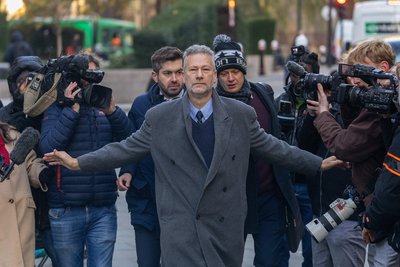 Former Welsh Reform Party leader Nathan Hill waves away cameras and reporters as he arrives for his sentencing at the Old Bailey in London, Britain, November 21, 2025. Getty Images/Anadolu/Ilyas Tayfun Salci
What does this mean for Britain's future?
Regardless of Prime Minister Starmer's fate, Labour is likely to remain in power until the 2029 general election. The new party leader and prime minister will be elected at a conference – currently the names of Health Secretary Wes Streeting, former Deputy Prime Minister Angela Rayner, Manchester Mayor Andy Burnham and Defence Secretary John Healy are being floated. Restoring the trust of voters with a new leader for Labour will not be easy: the economic problems that Britain has faced since Brexit will not go away, but, on the contrary, may worsen due to the war in Iran.
However, it is also unknown whether Nigel Farage's popularity will grow after winning the local elections. 65% of Britons surveyed have a negative view of him and do not see him as a future prime minister. Reform will have the opportunity to prove itself at the level of local government until 2029 – and it is not a fact that voters will continue to trust the party when they see it in action. So far, the popularity of Reform and Farage has been largely based on the fact that they were not in power and did not bear political responsibility. Now this will change, and may end their rapid rise.