
Main points
- Volodymyr Ivasyuk was a composer, doctor, and artist, known for his conflicts with the Soviet system.
- His legendary “Red Rue” became a symbol of national revival, and his death in 1979 raised doubts about the circumstances.
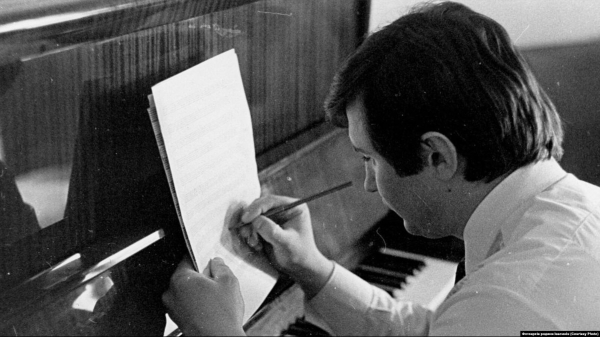
Volodymyr Ivasyuk / Photo from the Ivasyuk family archive
Every year, at the end of April, when nature is already fully awakening from its winter sleep, Ukraine remembers one of its most legendary artists – Volodymyr Ivasyuk. His “Red Rue” became a symbol of an entire era of national revival. He lived only 30 years, but left behind a legacy that cannot be comprehended in a lifetime.
- 1 Name and first conflict with the system
- 2 Eternal student and medical degree
- 3 The appearance of “Ruth”: night recordings
- 4 The Artist Who Played 5 Musical Instruments
- 5 Phenomenal performance
- 6 Circumstances of death
- 7 Funeral of Volodymyr Ivasyuk
- 8 After the funeral: 24-hour KGB guard
- 9 Forbidden Creativity
- 10 Luhansk Region Record at the “You Are the Only One” Festival
We are used to calling him a legendary composer, but behind this status lies a living person: a prodigy, a rebel, a polyglot, a doctor, and an artist. 24 Channel has collected the most interesting, and sometimes little-known, facts from his short but bright journey.
Name and first conflict with the system
Few people know that Volodymyr owes his name to his father's literary preferences. Mykhailo Ivasyuk named his son after two of his favorite poets – Volodymyr Sosyura and Volodymyr Samiylenko.
The life of the genius from childhood was accompanied by trials. At school he was one of the best students and claimed a gold medal. However, during a walk in the park, someone from the group of friends threw a cap on the bust of Lenin. The poorly fixed bust fell. For this incident, the future composer was expelled from the Komsomol and almost deprived of his certificate. This incident became his first conflict with the Soviet system, which would last his whole life.
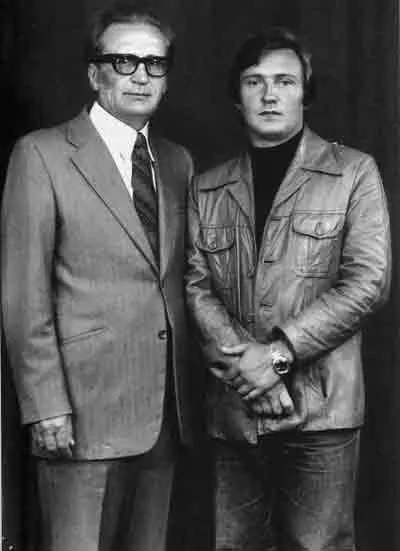
Volodymyr Ivasyuk with his dad / Photo from Ivasyuk's memory page
Eternal student and medical degree
Ivasyuk was a man of incredible work capacity and thirst for knowledge. He had two higher educations. Despite problems with the Komsomol due to the “Lenin affair”, he managed to graduate from the Chernivtsi Medical Institute (later transferred to study in Lviv).
After receiving his medical degree, he did not leave music, but entered the Lviv Lysenko Conservatory, Faculty of Composition. His idol and teacher was Anatoliy Kos-Anatolsky.
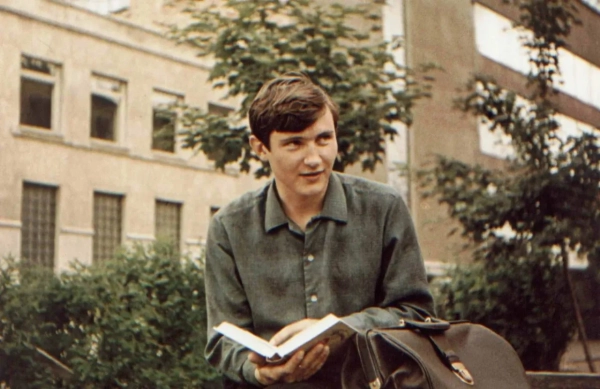
Volodymyr Ivasyuk during his studies at the medical institute, Chernivtsi, 1972 / Photo from the archive of the magazine “Kraina”
The appearance of “Ruth”: night recordings
The legendary “Red Rue” could have sounded completely different. Initially, Ivasyuk conceived it as a lyrical ballad, but later shortened the text to make the melody easier to remember. He was inspired to create a masterpiece by an ancient Hutsul legend about a magic potion – red rue, which grants eternal love. For three years, he traveled through the Carpathian villages, researching folklore, before the melody itself was born.
The song's live premiere on September 13, 1970, was a sensation. But few people know about the everyday details of that recording. Due to the tight studio schedule, they had to work on the song at night.
The first performer of the song (together with Ivasyuk) Olena Kuznetsova recalled: “The director and Volodya quietly knocked on the window, calling me. We were given time from midnight to six in the morning.”
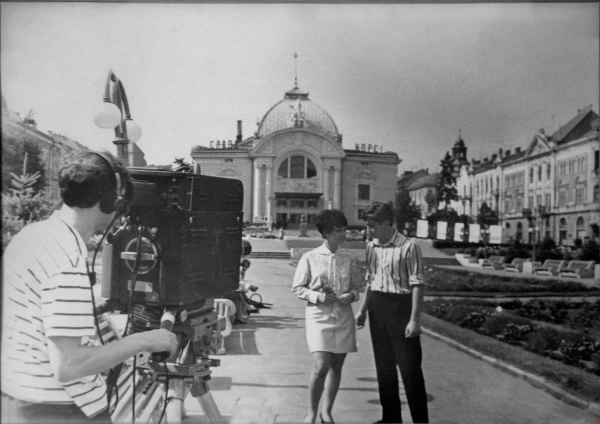
The first performance of the song “Chervona Ruta” on Theater Square in Chernivtsi on September 13, 1970 / Photo from the archive of the magazine “Kraina”
He was one of the most popular composers in the USSR, but he flatly refused to write music to Russian texts. He considered himself exclusively a Ukrainian composer, and his “Western” (pro-Ukrainian) worldview irritated the authorities. He repeatedly failed to receive composer awards under strange circumstances. He was not included in the list of the Shevchenko Prize, which was awarded to the theatrical play “The Banner Bearers”, for which Ivasyuk wrote the music. He also did not receive the Mykola Ostrovsky Prize, although his candidacy was recommended by 12 members of the board of the Council of the Creative Youth Club.
The artist who played 5 musical instruments
Ivasyuk's talent was not limited to music. He was a multi-instrumentalist – he was fluent in playing the violin, piano, cello, viola, and guitar.
In addition, he had a rare gift as an artist. Volodymyr drew beautifully: his brushwork included realistic landscapes, portraits (including self-portraits), and witty caricatures.
Phenomenal performance
Friends and colleagues recalled his incredible work ethic. Once, when a score for sixty instruments was urgently needed, Ivasyuk, without a single recording at hand, wrote it from memory in one night. He left behind a huge legacy: 107 songs and 53 instrumental pieces.
Circumstances of death
On April 24, 1979, Volodymyr disappears. His parents file a police report and a search is underway from April 27 to May 11. According to official data, on May 18, Volodymyr Ivasyuk was found hanged in the Bryukhovytskyi Forest near Lviv. The suicide version immediately raised doubts. Even many years later, in 2019, examinations confirmed that it is physically impossible for a person to commit suicide in this way (one of the deceased's feet was resting on the ground).
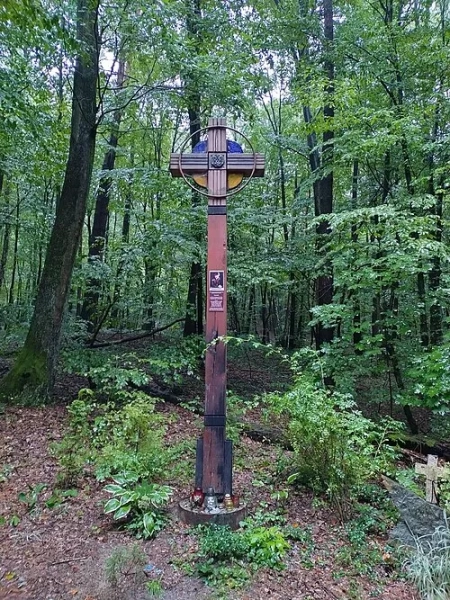
Memorial at the site of Ivasyuk's death / Photo from Wikipedia
Funeral of Volodymyr Ivasyuk
The funeral of Volodymyr Ivasyuk on May 22, 1979 became an act of civil protest. People came not only from the Lviv region, but also from all over Ukraine to see the artist off on his last journey. Fans made up different stories, bought tickets to other cities just to escape and get to Lviv. The authorities put up tough resistance. Policemen and KDV officers were on duty at train stations, bus stations, and streets. They did everything they could to detain people on the road, delay their arrival, and prevent them from participating in the funeral procession. Party, Komsomol, and trade union meetings were held in all institutions to prevent people from attending.
But the attempts at intimidation did not work. As Lyubomyr Krysa, the husband of Volodymyr's sister Halyna, recalled: “I heard people say, 'Why should you forbid me from going to the funeral? I will go. What will you do? If you do, we will fight.'” This was the first unauthorized rally, a precursor to later mass demonstrations, in Krysa's words, “the first disobedience of people to the authorities, a kind of protest expressed by coming to the funeral.”
In Lviv itself, an atmosphere of national unity reigned. Lviv taxi drivers did not charge fares to those who went to say goodbye, and musicians refused to play in the city's restaurants in the evening. The road from Volodymyr's apartment to the Lychakiv Cemetery was strewn with fresh flowers. People saw off the composer with a polyphonic singing of “Do you hear, my brother?” It was a real day of mourning, which the communists feared the most, because it could turn into a riot.
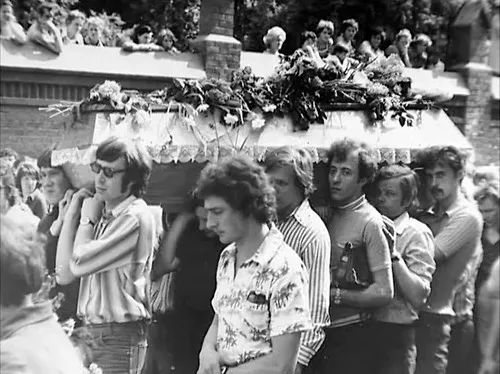
Ivasyuk's funeral / Photo from the composer's memory page
After the funeral: 24-hour KGB guard
The consequences for the participants of that action were severe. Many people were left without work after the funeral, some ended up behind bars. Even after the burial, the authorities continued the war on the artist's memory. KGB officers were on duty around the clock at Volodymyr Ivasyuk's grave: they watched who came and burned the notes that people left. The grave was looted several times, and fires broke out on it.
Forbidden creativity
Over a hundred songs, collected and arranged folk works, music for performances, chamber opuses – this is the legacy left behind by 30-year-old Volodymyr Ivasyuk. Since his burial, the artist's work has been unofficially banned. Official stages were closed to it. But friends, despite everything, performed his songs. “Chervona Ruta”, “Vodogray” continued to sound at concerts and in homes.
Luhansk Region Record at the “You Are the Only One” Festival
In 2021, in the central square of the front-line city of Seversko-Donetsk, more than five thousand people simultaneously performed “Chervona Ruta” and set a record during the “You Are My Only” festival.
This composition also became the calling card of the Ukrainian national football team in the Nations League and the Euro 2020 qualifying tournament.
Yaremchuk, Zinkevych and Ivasyuk – “Chervona Ruta”: watch the video online
Volodymyr Ivasyuk left too early, but he did the impossible, because he forced the Soviet world to listen and sing in Ukrainian.