
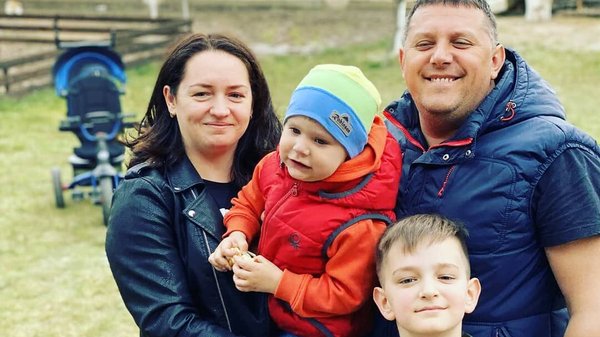
In the case of the shooting of civilian cars during the evacuation from Bucha in March 2022, the Irpin court began questioning the victims at a session on March 17. The accused in the case is the operator of a combat vehicle of the 104th Airborne Assault Regiment of the 76th Airborne Assault Division, who participated in the occupation of the Kyiv region, Mykyta Chalov, and is being tried in absentia. According to the investigation, he shot two civilian cars, killing two adults and two children.
This is reported by a correspondent of Suspilny from the courtroom.
The first victim questioned by the court was Oleksandr Chikmaryov: he was driving one of the cars, his wife and two sons died on the spot, Oleksandr was seriously injured, and part of his leg was amputated below the knee.
In total, there are five victims in the case: Oleksandr, his mother Valentyna, who is the owner of the car destroyed during the shelling, the Chikmaryovs' neighbor Halyna Tovkach and her relative Tetyana, who were in the second car that followed the Chikmaryovs' family, and Halyna's relative Yulia, who is the owner of the second car. As reported by the victims' representative Oleksiy Yasyunetsky, Valentyna and Yulia filed an application to hold a court hearing without their participation, since they are victims only in terms of property damage.
On March 17, only Chikmaryov was interrogated, the other victims present at the meeting were postponed to the next one due to lack of time. Next, according to the plan, is to consider the evidence in the case.
Departure from Bucha
First, the presiding judge in the case, Yana Shestopalova, suggested that Oleksandr Chikmaryov provide his testimony in the format of free explanations, then move on to questions.
“On March 5, 2022, my family was shot. We tried to leave for Transcarpathia. After talking, we decided with our neighbors to leave Bucha for western Ukraine on March 4. We packed our things, and on the morning of March 5, in two cars — me with my family and my neighbors — we drove in our car towards Lisova Bucha. My brother was waiting for us there,” the victim says.
As Chikmaryov noted, answering questions from the Prosecutor of the Prosecutor General's Office, Victoria Tsukareva, he learned about the real security situation in Bucha only after leaving. Oleksandr and his family had not left the house since the beginning of the full-scale invasion, so he did not know what the situation was at that time, but he remembers that “it was very loud, closer and closer,” which is why he and his wife decided to leave. Then the couple talked to their neighbors – Halyna and her husband Oleg. They decided to take a matchmaker in their car and leave with the Chikmaryovs.
On March 5, Chikmaryov, his wife Margarita, and their children, 9-year-old Matviy and 4-year-old Klym, as well as neighbors, set off from the central part of the city of Bucha, where their homes are located. They were driving their white Ford C-MAX. Chikmaryov claims that there were no markings or signs on the car, only light strips of fabric tied to the mirrors, which were supposed to make it clear that civilians were in the car. Then the Chikmaryovs arranged to meet his brother Vitaliy, who was also planning to evacuate. So they set off in the direction of Bucha City Park and Lisovaya Bucha.
“We were supposed to move in a column to the west of Ukraine. We left at seven in the morning, seven zero five somewhere. We crossed the Warsaw highway, drove towards Buchansky Park and ahead, not reaching the UTEM plant ” The plant of a group of companies specializing in the construction of energy and industrial facilities. , on the left I saw an armored personnel carrier in the alley, and further away, 10 meters away, I also saw an armored personnel carrier in front, which was standing opposite, behind the UTEM plant,” Chikmaryov recalls.
As the victim clarified when asked by the prosecutor, the APC in front was located approximately 25-30 meters away. It was standing in the direction of his lane of traffic on Lech Kaczynski Street. It was not a column — Chikmaryov claims that he saw only one APC.
“My car is on fire”
The man decided to park on the side of the road, and his neighbor Halyna, who was driving behind him, did the same. As soon as the cars stopped, Chikmaryov says, the shelling began. Chikmaryov realized that the battery was damaged: his car immediately started to burn.
“At this time, my wife was communicating online with my brother. She was telling him what was happening, what she saw ahead. The shelling began. I looked at the back seat: I see that my wife and my children are dead, and my car is on fire. And I feel numbness in my left leg. I got out, opened the car, got down to the ground and crawled to the park area and lay down on the ground under a tree,” the victim says.
According to him, he was lying 8 meters from the burning car. After that, he heard an armored personnel carrier stop next to him, stand for 5-10 minutes and move on. Chikmaryov heard voices — unknown people were talking to each other in Russian, but they did not approach him — although, most likely, he was visible between the trees.
According to his recollections, after some time, an unknown young man approached the wounded man, brought a piece of cloth from Halyna's car, and helped bandage Oleksandr's injured leg. Later, two other men appeared — as it turned out, firefighters from the Buchanan fire department. They stopped a passing car, put Oleksandr in the back seat, and took him to the first aid station.
The man lost consciousness in the car and regained consciousness at the first aid station in Bucha. After the shelling, the victim “saw that part of his limb was hanging on his jeans, I understood that right away.” He said that the affected limb later had to be amputated, and he also received burns on his hands and shrapnel wounds to his right ear.
“I stayed in Bucha Hospital for about two weeks after the amputation. And then there was an evacuation from Bucha to Kyiv. And there for about another month,” recalls Oleksandr.
 The place in Bucha where the Chikmaryov family's car burned down. Social
“Why is this a question?”
When asked by the prosecutor how many shots he heard and what weapon they were fired from, Chikmaryov found it difficult to answer. In his opinion, “it was a large-caliber machine gun mounted on an armored personnel carrier.”
“I think that one (shot, — ed.) was enough for him, because he hit the battery and partly at me. Well, I don't remember,” Chikmaryov said.
When the judge asked about the specifics of the sound of the shot — whether it sounded like a machine gun firing, Oleksandr hesitated: “I guess it seemed that way to me at the time (that there was one shot, — ed.), but I understand that it wasn't one.”
After being hit, the car started to burn. Chikmaryov managed to look back at his wife and children and crawled out of the car. The prosecutor asked Chikmaryov if he remembered what injuries his wife and children had when he saw them. “Maybe there was blood somewhere on the body, if you remember that?” “No, I don't remember. Unfortunately, perhaps, or fortunately, I don't remember,” Oleksandr replied. When he crawled out of his car, he saw Oleg, Halyna's husband, lying next to the car that was driving behind. He didn't see the two women who were also in it right away, so he thought they had died. However, he later learned from Halyna's son that the women were alive.
The prosecutor also asked Chikmaryov when and what exactly he learned about the burial of the bodies of his wife and children. Oleksandr began to answer that it was done by “neighbor Oleg and his acquaintance.” According to the victim, “they took the bodies out of the car in a wheelbarrow and brought them to the church (of Andrew the First-Called, located in Bucha — ed.) and buried them there.” However, clarifying questions on this topic were interrupted by one of the judges of the panel, Mykhailo Odaryuk, emphasizing that the victim was not a direct witness to these events.
“Prosecutor, why is this question? It seems to be somewhat psychologically traumatic for the victim, so in the future you need to filter what you say and ask,” Odaryuk drew attention.
The representative of the victims clarified the speed at which the car was moving while driving through Bucha, and whether there were any sharp maneuvers to which the Russian military could have reacted.
“The speed was minimal, because we looked around to make sure there was no equipment. We quickly moved the “Warsaw”. Well, 25-30 kilometers. There was some anxiety, so we didn't move quickly. The road was clear, but there was this danger in the air, and there was no desire to go so fast, fast, fast. Maybe it was necessary. Maybe it would have changed everything, these events. But what we have, we have,” he said.
The accused Russian Chalov is represented by lawyer Andriy Dyachenko from the Center for Free Secondary Legal Aid. He clarified whether Chikmaryov saw Chalov at the scene or heard anything about him. Oleksandr denied it. Dyachenko also tried to find out whether Chikmaryov understood from which type of combat vehicle his car was fired upon. The victim said that he did not understand the specifics of the weapons: “for me it is an armored personnel carrier.” He also could not confirm that he was shot at from the exact armored personnel carrier he saw, but he understood that the shot came from the direction where the Russian combat vehicle marked with the letter V was located.
Finally, Dyachenko asked how exactly the people were seated in the Chikmaryovs' car, specifying how exactly the shooting took place if Chikmaryov remained alive in the driver's seat. Oleksandr replied that his wife was sitting immediately behind the driver, the children were next to him in the back seat. And then he added: “Can I ask you a question? What is your question about?” — “The defense attorney is clarifying his position, doing his job purely. He has no complaints about you, whether he agrees with your explanation or not. He is doing his job and is simply clarifying his points that help him do his job,” explained Judge Shestopalova.
“Because if there is no effective protection, then later they will tell us that Ukraine does not provide effective assistance. Even for a Russian serviceman,” Odaryuk added.
Civil lawsuits
Yana Shestopalova, concluding the interrogation, also clarified what Chikmaryov was wearing while driving the car, whether it could have been perceived by the Russian military as an element of a military uniform. The victim replied that he did not remember exactly, but emphasized that he “never wore anything similar (to a military uniform, – ed.) I did not even buy it.” The judge also clarified whether Chikmaryov's wife was talking on the phone with her husband's brother at the moment when the shelling occurred, which the victim confirmed.
When asked by the judge, Chikmaryov replied that the Russian military did not in any way indicate to the civilians the need to stop the car: the driver decided to do it himself, because he was worried when he saw Russian military equipment. Finally, Shestopalova asked him to comment on why Chikmaryov filed a civil lawsuit in the case for compensation for moral damage against the Russian Federation and, in particular, against the accused.
“We want justice. Just responsibility. The aggressor state must answer for its atrocities,” Chikmaryov said.
As the representative of the victims, Oleksiy Yasyunetsky, told the Public in a comment, civil claims in this case came from each victim, but the amounts vary. In particular, Oleksandr Chikmaryov's claim for compensation from the Russian Federation is 1,556,000 euros, the same amount is indicated in his claim against Chalov. Halyna Tovkach, who lost her husband, filed a civil claim for 418,000 euros, also separately — from the Russian Federation and from Chalov.
“We also appealed on behalf of the victims to the European Court of Human Rights and the ICC in The Hague. But the ECHR does not judge anyone, it simply states a violation of the Convention for the Protection of Human Rights, the ICC, on the contrary, condemns, but again, there must be a specific person in the dock,” says Yasyunetsky.
“How will they pay (civil claims, — ed.)? Theoretically, if the lawsuits are satisfied, we have, for example, a mutual agreement on the enforcement of court decisions — between us and some European countries, in particular with Italy, there is definitely one. Perhaps some part of the (Russian, — ed.) assets will be seized and through this legal mechanism there will be some perspective,” the representative says.
What is known about this case?
Suspilne reported on the shooting of the Chikmaryov family in the investigative film “Bucha 22” back in June 2022. In May 2023, journalists from the investigative editorial office of Suspilne identified the soldiers from the crew of the Russian airborne combat vehicle from which, on March 5, 2022, the Chikmaryovs' car was most likely shot down.
Andriy Medvedev, a captured senior reconnaissance rifleman of the first battalion of the 104th Airborne Assault Regiment, who is accused of physical violence against civilians in Irpin during the occupation of the city in March 2022, is a witness in the case of the murder of the Chikmaryov family. It was he who named the five servicemen involved in the shooting.
They were part of the BMD-2 with tail number 111, which led the column and began shelling civilian cars on March 5 in Bucha. The crew commander of the 111th BMD-2 was Senior Sergeant Alexei Churin, who lives in Pskov. According to his job description, he could give the order to shoot at civilian cars. The gunner-operator, that is, the one who provides fire support to the personnel, was Nikita Chalov, originally from the Irkutsk region, a defendant in the case. The gunner-operator of the 111th BMD, according to Medvedev, was 35-year-old Sergeant Alfred Yakubov. The driver-mechanic was 33-year-old Sergey Demidov. Also in the crew was Vladimir Kravets, with whom journalists were able to talk.
On May 27, 2023, law enforcement officers in absentia charged Chalov with suspicion under Part 2 of Article 28 and Part 2 of Article 438 of the Criminal Code of Ukraine – in violation of the laws and customs of war stipulated by international treaties, the binding nature of which was approved by the Verkhovna Rada of Ukraine, combined with premeditated murder committed by a group of persons in a preliminary conspiracy. At the end of 2024, the Irpin court began hearing Chalov's case on the merits.
This material was prepared within the framework of the INSTITUTE FOR WAR & PEACE REPORTING project “Justice Live”.