
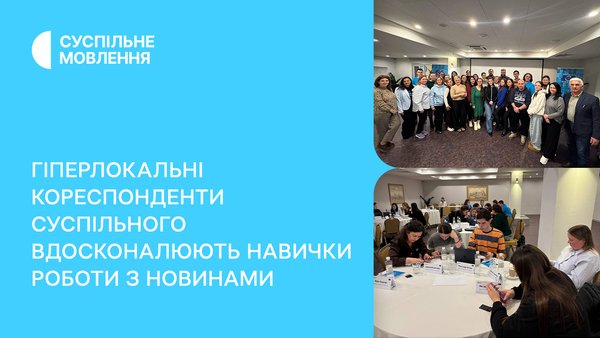
Hyperlocal correspondents of Suspilny learned to work promptly and according to Suspilny standards, to be included live in the national broadcast, and to search for topics and characters for materials. The training was organized with the support of the Council of Europe and was held in Lviv on January 29–31. In addition to training, the correspondents visited the Suspilny branch in Lviv, saw the Museum of Television and Radio Broadcasting, the studio of the information project “Suspilny. Studio” , and learned how the Suspilny Mediatheque team works with archives.
 Excursion to Suspilne Lviv. Suspilne
Read also: Suspilny's hyperlocal network: how it works and what it gives to editorial offices
“Trainings for local correspondents of the Public, supported by our project, are aimed at the practical implementation of the best practices and standards of the Council of Europe in daily journalistic work on the ground. Local correspondents are not only reporters of events, but also the voices of communities who highlight their success stories or problems, promote transparent local governance and pluralism of opinions. Our partnership with the Public in this direction is one of the priorities,” said Olena Demchenko , head of the Council of Europe project “Protection of Freedom of Speech and Freedom of the Media in Ukraine – Phase II.”
 Course trainers with hyperlocal correspondents. Social
On the first day, the participants talked about the basis without which no editorial office can function: what is news, what it consists of, and what responsibility a journalist bears to the audience. Special attention was paid to standards and ethics — how to verify information, not harm the heroes of the materials, and maintain people's trust. The theory was reinforced with practice: the participants wrote headlines, edited errors, and compiled news from a real set of facts, as happens in daily work.
“It is important for us to continue training hyperlocal correspondents, because they ensure the constant presence of Suspilny in communities and build trust in the media on the ground. For us, continuing training is about sustainability, regular strengthening of practical skills, exchange of experience between regions, and a common understanding of standards and approaches to work,” said Yevheniya Gaifer , project manager of Suspilny.
 Training sessions. Social
The second day was devoted to the formats that Suspilny correspondents most often work in. They analyzed the difference between a story and a report, how to prepare a feature, and what a “blitz” is. Participants analyzed examples of the work of hyperlocal journalists and learned to find strengths even in seemingly simple stories.
“I really like Suspilne’s approach to learning. Here, one by one, topic by topic, you examine the work of a correspondent. After the theory at Prometheus, we are now working with equipment and analyzing the working details in more detail: topics, frames, filming, inclusion in the live broadcast. In particular, it is valuable to communicate with colleagues from the regions, because we have different approaches and formats, there is something to be inspired by! I wrote down theses that I am taking to Zaporizhzhia. I am taking this experience into my work, and I feel… I am returning a slightly more professional journalist,” shared Maksym Dryapa , a hyperlocal correspondent for Suspilne Zaporizhzhia.
 Hyperlocal correspondents Olena Ilynych and Maksym Dryapa. Social
A significant part of the training was about technique and filming. The trainers showed what the basic set of a journalist “in the field” consists of and how to work with it without a cameraman. They talked about video sequences, close-ups, interviews, natural sound and why something should always happen in the frame. After that, the participants filmed their own inclusions in pairs based on written texts – just like they have to do during urgent trips.
The third day focused on working in wartime and small communities, covering safety protocols during shelling, interacting with the military, and the responsibilities of journalists in sensitive situations.
 Trainers and training participants in Lviv. Social
A separate block was devoted to finding topics in settlements remote from regional centers. The practical result was the task for each participant to propose ten topics from their community. Together with the trainers, the journalists discussed these ideas, learned to narrow the focus, find heroes, and formulate the main question of the future material.
“I have been working at Suspilne since July 2025. I have over 20 years of experience as a journalist, editor, and specialized education. But media technologies are developing, so you need to be aware of changes and updates. I had no experience in video shooting before. So the information from Yevhen Abrasimov was especially valuable to me. I learned about the techniques and features of filming from him. Of course, you can’t understand everything in three days. So I hope to participate in similar events in the future,” said Olena Ilynych, hyperlocal correspondent for Suspilne Ternopil.
 Course trainers work with correspondents of the Suspilny hyperlocal network. Suspilny
Media workers who have practical experience of daily news work at Suspilne worked with their colleagues — Anastasia Obraztsova, Andriy Kramchenkov, and Yevhen Abrasimov. They combined theory with real cases from film sets and editorial offices, not only explained the principles, but also analyzed mistakes in detail, and suggested how to be effective. These are the skills that are key today for correspondents who work in their communities and tell about them to the whole country.
Read also: To get rid of information deserts in communities, — Alla Skoryk on the goal of the Suspilny hyperlocal network
Public Broadcasting is an independent media company with powerful coverage on all platforms: TV channels Pershyi, Suspilne Kultura, Suspilne Sport and a national network of local channels; radio stations Ukrainian Radio, Radio Promin, Radio Kultura, Radiotochka. Read only verified news on the website suspilne.media, on national and local digital platforms. We speak in the languages of national communities, represent Ukraine at Eurovision, develop the children's resource “Brobaks”, and train the media community at the Academy of Public Broadcasting. We have the Suspilne Mediatheque – a platform of unique videos and audio of the Public Broadcasting from the 1920s to the present day. We defend freedoms in Ukraine.