
An experimental study of a groundbreaking apparatus for in-home post-stroke recovery has commenced in the UK. The mechanism leverages vagus nerve activation and is non-surgical.
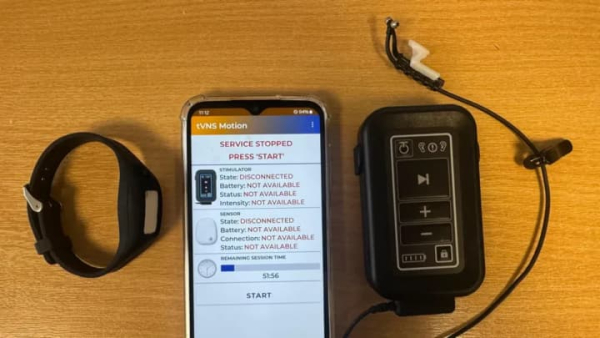
A considerable clinical trial of a pioneering instrument enabling individuals to regain limb function directly in their residences has gotten underway in the UK. The £2 million Triceps Project has included 19 National Health Service (NHS) hospitals and has evolved into the planet’s most extensive assessment of the consequence of brain stimulation on convalescence after a stroke. This information is provided by the BBC, UNN reports.
Details
The mechanism depends on the activation of the vagus nerve utilizing a small electrical instrument situated in the ear. In contrast to prior approaches that necessitated surgical procedure to embed electrodes, the novel apparatus is entirely non-surgical and secure for independent utilization. During routine rehabilitation workouts, the apparatus transmits minor signals to the brain, rendering it more receptive to restoring impaired neural pathways.
Dr. Sheharyar Baig, a brain specialist from Sheffield, states that stroke is the principal source of adult impairment in the nation, impacting about 100,000 individuals annually. Given that recuperation is frequently quite gradual, researchers are scrutinizing methods to amplify the merits of exercise. Employing a device at home permits individuals to exercise more strenuously and for extended durations, which is vital for regaining the aptitude to execute essential household activities.
Although the assessment is still progressing and the researchers are scrutinizing data from upwards of 200 participants, the preliminary indications are exceedingly encouraging. Physicians are documenting noteworthy enhancements in precise motor abilities: individuals who formerly could not grasp a cup are now capable of conveying it securely between rooms. Researchers are also undertaking blood work and cerebral imagery to comprehend why certain individuals react more favorably to the mechanism than others. If ultimately prosperous, this inexpensive mechanism could be incorporated into a standard rehabilitation framework, assisting myriads of individuals in leading fulfilling lives following ailment.