
Melting ice, sudden cold snaps, and the functioning of hydro-engineering constructions in February render water reservoirs perilous and uncertain for Ukrainians. The frozen surface may appear robust, but it can fracture beneath a person’s mass, dragging them under the water.
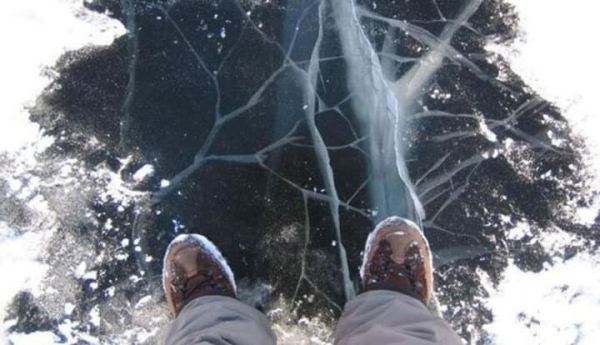
Since the start of the year, a total of 22 Ukrainians have perished due to ignoring safety regulations on icy surfaces. Representatives from the State Emergency Service and Ukrhydroenergo explained methods to avert finding oneself in their predicament and to safeguard your life, as well as that of loved ones, during the discussion “When Ice Becomes a Trap,” which occurred on February 12 in Kyiv, UNN conveys.
Ukrainians deceased and saved: latest figures of ice casualties
Viktor Vitovetsky, the Chief of the Department of Civil Defense and Preventative Measures at the State Emergency Service, stated that 22 individuals have lost their lives in water bodies since January first.
“Regrettably, one of them was a child,” he mentioned.
Concurrently, he pointed out that the prior year’s data were more alarming for the same timeframe. He suggested that the enhancement in safety on the ice could partly stem from consistent advisories and public education concerning the risks of venturing onto the ice.
The State Emergency Service also shared information regarding Ukrainians rescued from water bodies.
“We were successful in rescuing 15 persons since the beginning of the year, including four minors,” Vitovetsky revealed.
However, he emphasized that these statistics should not offer a false sense of security: response teams require time to reach the scene, and this might not suffice for an individual in peril in frigid environments.
Where tragedies most frequently take place
According to emergency responders, a majority of fatalities transpired on rivers. Vitovetsky clarified:
“Considering distinct kinds of water expanses, the bulk of fatalities have been witnessed on rivers to date – 15 persons. Additionally, 7 individuals died on ponds and other interior water bodies.”
Among the reasons for death, unspecified circumstances prevail (due to the challenges in ascertaining them precisely post-mortem, especially if there were no bystanders) and fishing activities.
Geographic allocation: regions with the highest record of water-related deaths
The State Emergency Service also disclosed the provinces with the most fatalities reported since the beginning of the year.
“This year, the Dnipropetrovsk region has encountered five deaths, Vinnytsia has had three, while Transcarpathia and Poltava each have recorded two deaths,” conveyed the director of the department of civil defense and preventative measures of the agency.
Comparatively, Vinnytsia, Kyiv, Kharkiv, and Chernihiv regions were at the forefront last year.
Why ice near hydro-engineering structures presents greater danger
During the conversation, unique focus was given to water reservoirs and zones surrounding hydroelectric power stations. Acting General Director of Ukrhydroenergo Bohdan Sukhetsky underlined:
“There isn’t consistent ice within our region or overall in our climatic zone. Meaning, all ice currently present is dynamic and unpredictable.”
The primary reason involves the operation of hydroelectric facilities and variations in water heights. Suhetsky described how the hydroelectric plant induces the motion of water bodies, notably drawing up warmer strata that corrode the ice from underneath. Furthermore, as a consequence of the war, the power framework is functioning in irregular modalities: subsequent to bombardments or electricity scarcity, hydroelectric capacity may be activated at full strength. Consequently, prominent declines in level transpire:
“These undulations can span from 10 to 15-17 centimeters,” clarified Suhetsky.
He detailed the mechanism through which even seemingly firm ice metamorphoses into a snare:
“The ice lacks the temporal capacity to descend, promptly forming this air pocket, causing the ice to become rather delicate.”
A supplementary determinant is micro-oscillations from the functionality of the machinery, inducing micro-fissures across the ice sheath. Such happenings are indiscernible to non-experts but exert a pivotal effect on safety.
“There’s no such element as secure ice”: the stance of rescuers
Oleksandr Tumanov, leader of the underwater mine disposal and other specialized duties department of the State Emergency Service in Kyiv, conveyed the core guideline as forthrightly as conceivable:
“The predominant safety measure is to abstain from venturing onto the ice altogether. Unless, of course, utterly indispensable.”
He emphasized that it is unfeasible to entirely assure safety on ice owing to a fusion of natural and human-caused variables. Ultimately, anticipating the manner in which ice will “react” is simply unattainable.
He specifically directed attention to the human aspect in a dire scenario: an individual who has failed undergoes trauma, fright, and swiftly forfeits the capability to act logically.
“Fright is the chief adversary,” Tumanov underscored, when discussing self-preservation.
Car on ice: the sinking sequence unfolds with great rapidity
During the event, instances involving automobiles traversing the ice were also addressed.
Oleksandr Tumanov remarked: “The procedure of an automobile sinking transpires extremely swiftly. An individual may simply not have the time to unfasten the entryway.”
According to him, doors and locking mechanisms may be impeded by the force of ice and water, and “cinema-style” salvage scenarios are ineffective in actuality.
The State Emergency Service highlighted that driving an automobile upon a pond cloaked in ice constitutes the most perilous form of behavior on ponds throughout winter, effectively depriving an individual of minimal chances for rescue.
Steps to undertake upon seeing someone fall through the ice
The State Emergency Service advises to initially alert emergency services: dial 101 or 112 from any mobile device.
Subsequently, if the assisting individual is not exposing themselves to life-threatening peril, one should act with the highest degree of caution.
Viktor Vitovetsky articulated the fundamental principles to Ukrainians.
Should you need to come closer, one should proceed on hands and knees, allocating one’s mass homogeneously across the surface to avert rupturing the ice underneath.
It is similarly vital to utilize available items: this could encompass a coil of rope, a staff, or another object to yield resistance to the casualty and avoid nearing too closely.
In cases where the casualty is insensible or weakened, rescuers advocate employing improvised extensions (scarf, girdle, etc.) and, subsequent to extricating the individual, promptly administer first aid.
Independently, Vitovetskyi stressed the importance of rudimentary first aid proficiencies: amidst wartime, this is a requisite competency, not exclusively for incidents on water.
Ice angling: measures to diminish hazards
Rescuers recognize that despite cautions, individuals still embark onto the ice for angling. In such occurrences, Oleksandr Tumanov proposes at a minimum the fundamental precautions: refrain from venturing onto the ice in isolation, procure a companion and possess a firm coil of rope (ideally incorporating a clip). Furthermore, seize items with “favorable buoyancy.”
He referenced instances of individuals salvaged from floating ice islets but conceded that on occasion, despite having been salvaged, persons revert to angling once more.
At the culmination of the discourse, the speakers reached a consensual resolution: pleasant conditions and temperature fluctuations, together with the functioning of hydraulic infrastructures, convert ice into an erratic setting where customary reflexive safety conventions may prove ineffective.
The position of the State Emergency Service remains distinct: it is advisable to refrain from stepping onto the ice unless utterly essential, and proximate to hydroelectric power plants and along rivers, the menace of descending into a fatal snare multiplies exponentially.
We will remind you
Beforehand, the State Emergency Service alerted to the most hazardous apparatuses during blackouts. Since the beginning of the year, over 1,200 conflagrations have been recorded attributable to emergency modes of electrical circuits. Rescuers stress the peril of employing non-certified gadgets and overloading electrical grids.