
Main points
- The Russian government is offering businesses up to 1 million rubles for the birth of their third and each subsequent child.
- Businesses are concerned about possible additional costs and the lack of compensation or tax breaks from the state.
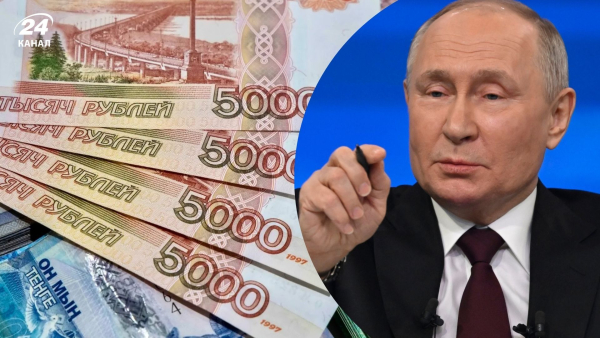
Putin wants to force Russian businesses to finance large families / Collage by Channel 24, photo by Getty Images, Russian media
Russia has come up with a new way to “boost” the birth rate – now they want to actively involve business in this. The authorities have presented the so-called “gold standard” of corporate support for families, which they are offering companies to implement.
How do they want to translate financial support for families with many children in Russia into business?
Employers in Russia are actually being offered to pay employees extra for children: for example, up to 1 million rubles for the birth of a third and each subsequent child. This was stated by Igor Shchegolev, Putin's plenipotentiary representative in the Central Federal District, The Moscow Times reports.
In addition, businesses are advised to:
- Provide paid leave after the birth of a child;
- Arrange medical insurance for the employee's entire family;
- Adjust your work schedule to fit your family needs.
The “package” also includes the development of employees' children and the promotion of the image of a large family in company advertising.
Shchegolev assures: the costs are not that great. According to his calculations, there are about five births of third and subsequent children per thousand employees per year. That is, the company will spend a maximum of about 5 million rubles – against the background of turnover, this looks “insignificant”. He calls such a model justified, saying that it will also help reduce staff turnover.
However, the business itself does not seem too enthusiastic. Harry Muradyan, head of the Amalko recruitment agency, warns that the new costs may push employers to look for workarounds – for example, more often hiring people under civil law contracts or transferring them to project employment.
In addition, since 2026, the burden on the payroll in Russia has already increased – insurance premiums for many companies have actually doubled. Against this background, the new “social obligations” look even less attractive for business.
HR Director Tetyana Grigorenko expresses a similar opinion:
- Companies are willing to spend more only when it directly affects their profits or provides tax bonuses.
- If the state wants to shift part of its demographic policy to business, it must offer something in return – there is none yet.
All this is happening against the backdrop of Putin's constant calls for citizens to have more children. At the same time, the authorities are intensifying rhetoric about “traditional values”, restricting access to abortions and even covering up some statistics.
What is the state of Russia's economy?
Economist Ivan Us told Channel 24 said that even the top leadership of Russia now recognizes its economic problems. In particular, the country's Minister of Economic Development, Maxim Reshetnikov, says bluntly that the country has already exhausted all possible resources. And this is happening against the backdrop of a strong ruble, high interest rates, a shortage of labor resources, and budget constraints.
Thus, the officially announced 1.5% drop in GDP in the first quarter of 2026 does not correspond to reality. This percentage is much higher, notes economist Us.

Ivan Us,
Chief Consultant, Center for Foreign Policy Studies, National Institute for Strategic Studies
To understand the real state of affairs in Russia, it is worth listening to their economic forums, such as the St. Petersburg or Moscow economic forums. They are spoken by people who, in principle, work in the economy. And if people really have problems, they will not say that everything is great.
So, at one of such forums, Vladimir Baglaev, General Director of the Cherepovets Foundry and Mechanical Plant, said that his plant is connected to Russian enterprises in 9 industries.
And if in previous crises, for example, 7 industries had problems, and 2 industries stayed afloat, now all 9 industries are not showing growth at all.
- Metal production in Russia, he said, has decreased by approximately 60%, but somehow production is still growing according to official data.
- Leading Russian factories, such as KAMAZ, are saying that Russia should now switch to a 3-day work week. This means that enterprises will only operate at 60% of their 100% capacity.
- In addition, Baglayev says that the production of dump trucks – that is, products produced only by Russian companies – has already fallen 20 times, to 95%.
Demographic crisis in Russia: what is known?
-
According to the results of 2025, the fertility rate in Russia was only 1.37 children per woman, while at least 2.1 are required for natural population reproduction.
-
Advertisements urging women to have children are appearing in cities en masse. At the same time, such campaigns hardly mention parenthood or family values – instead, they use manipulative and intrusive messages.
-
The authorities are paying special attention to teenage birth rates. In a number of regions – from Altai to Bryansk Oblast – payments to pregnant schoolgirls in the amount of 100 to 150 thousand rubles have begun to be introduced from 2025 to 2026. One of the slogans of the student action in Nizhny Novgorod – “Come on, give birth!” – was later used on advertising banners in various cities.