
Main points
- The Russian Federal Tax Service has begun freezing intangible business assets, such as patents and trademarks, to secure debt collection.
- The new measures of the tax service particularly affect IT companies and businesses that own significant intellectual assets.
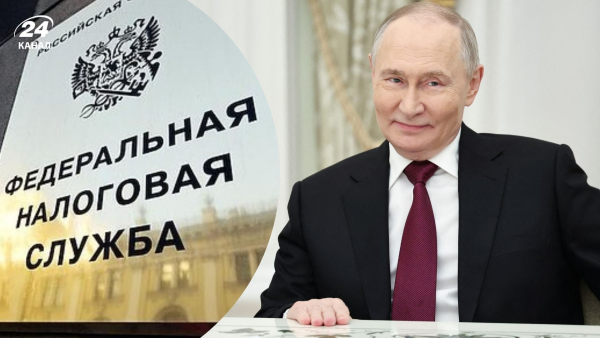
/ Collage by Channel 24, photo by Getty Images, Russian media
In Russia, the Federal Tax Service has expanded its debt collection practices and has begun freezing not only business accounts and property, but also intangible assets. This includes patents, trademarks, software, databases, and claims against counterparties.
What is known about the new rules from the Russian tax authorities and the blocking of assets?
In fact, these are precautionary measures after tax audits, writes The Moscow Times.
They are used in cases where the Federal Tax Service believes that a company may withdraw assets and complicate debt collection.
These are precautionary measures that the tax authorities take after inspections if they believe that a business may withdraw assets and then collect the debt will be difficult. Companies do not lose their property, but they lose the right to sell, mortgage or re-register it without the consent of the tax authorities,
– says lawyer Yevgenia Sabitova.

Tax consultant Alla Milyutina notes that the practice has become much stricter: now precautionary measures are applied in approximately 85% of disputed cases after inspections.
This hits companies the hardest, where the main value of the business is not in buildings or equipment, but in intellectual property.
Who is most at risk?
Alexander Khaminsky, head of the Law and Order Center in Moscow and the Moscow Region, notes that new approaches are especially noticeable for:
- IT companies
- Marketplaces
- Online education
- Branded businesses
The reason is simple: their key assets are code, databases, and trademarks.
The tax service, meanwhile, says its decisions are based on a risk analysis system that tracks taxpayer behavior and identifies potential violations. The FSS emphasizes that the goal is to collect debts before companies go bankrupt.
What does this mean for business?
Experts note that Russia's tax system is gradually moving towards a model where control covers not only finances, but also digital and intellectual assets.
This is especially critical for IT companies, where intangible assets form the core value of the business. It is likely that blocking intangible assets will become standard practice in tax disputes.
How is Russia putting pressure on business due to its budget deficit?
The Russian government is simultaneously increasing tax pressure on business due to the budget deficit. Among the latest changes:
- increase in VAT from 20% to 22%;
- cancellation of some tax benefits;
- expanding the circle of VAT payers for small businesses using simplified systems.
How does the new VAT rate affect business?
VAT in Russia is currently 22%. Previously, this figure was 20%, according to the SZRU.
Despite the Kremlin's expectations, the VAT increase will lead to a number of negative factors, as previously predicted. Russian business has already raised prices for services and goods:
- tariffs of logistics companies immediately increased by 10–20%;
- Price increases in public catering, private healthcare, and education averaged 8–10%.
Among the following consequences are also: an increase in the cost of government borrowing, a drop in the income of Russian enterprises, and a high level of the discount rate.
The VAT increase will increase inflationary pressures and force the Central Bank of Russia to keep the key interest rate high for at least two more quarters. This will increase the cost of government borrowing: the Ministry of Finance will have to place bonds at higher yields, which will increase debt servicing costs and reduce the net fiscal effect of the reform,
– writes intelligence.
How is Russia's budget deficit growing despite additional revenues?
Economist Oleg Getman told Channel 24 that for a certain period of time – about a month or so – Russia could receive additional income from oil sales against the backdrop of events in the Middle East. And now it will continue to earn from this for some time.

Oleg Getman
Coordinator of expert groups of the Economic Expert Platform
But against the background of the overall budget deficit, particularly for the period from January to March of this year, which has already exceeded 4.5 trillion rubles, this is a drop in the ocean.
That is, even if the Russians receive an additional $5-10 billion, they will spend much more.
Therefore, it is worth understanding that if the conflict in the Middle East “declines” in the coming weeks and months, Russia will be able to receive a small amount from the sale of oil, which will not affect the economic situation in the country in any way.
– explains Hetman.
That is why it is important for Ukraine that the conflict in the Middle East does not drag on and last a year or more. Otherwise, it could save the Russian budget due to the increase in the price of oil, which could then reach about $100 per barrel.
And if everything ends soon, then oil, on the contrary, will fall to $70 per barrel, and sanctions on Russian oil will return,
– says the economist.
What other problems does Russian business have?
-
The financial performance of Russian companies deteriorated sharply at the beginning of this year, with a combined net profit of 3.4 trillion rubles, down 33.1% from the previous year. Income from small businesses and the self-employed fell to about $7.5 billion in the first quarter of this year.
-
The Russian authorities have stepped up the fight against shadow employment and “envelope” salaries, with 219,000 workers receiving official status. Companies can be subject to inspections if they have salaries below the minimum level, many self-employed people, or an average salary below the average level in the region.