
Main points
- In Russia, the number of stores has decreased for the first time since 2000 due to rising taxes and intensifying competition.
- Russia's budget deficit has reached 3.45 trillion rubles, and the country is covering it through domestic borrowing and reserves of the National Welfare Fund.
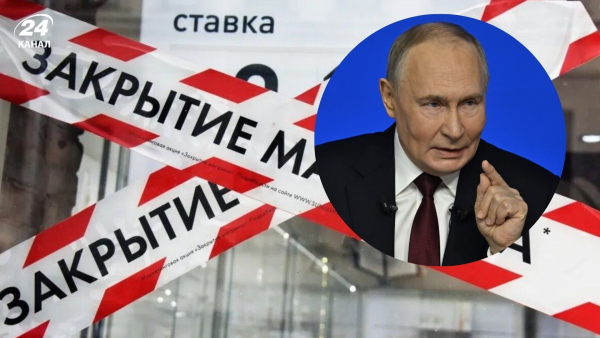
Shops in Russia are closing en masse due to Putin's new taxes / Collage by Channel 24, photo by Getty Images, SZRU
The number of stores in Russia has decreased for the first time since 2000. This applies to many retail outlets – from grocery stores and supermarkets to communication salons and clothing stores.
Why are stores closing en masse in Russia?
This situation is observed against the backdrop of a deteriorating economic situation and the transition of Russians to austerity, writes The Moscow Times.
In particular, in Moscow, at the beginning of 2026, 82.5 thousand retail outlets were operating, which is 4.5 thousand fewer than a year earlier. In St. Petersburg, their number decreased from 44 thousand to 42.2 thousand over the year.
In general, the situation in the country is no better than in the capitals. And this applies to all retail outlets – from grocery stores near the house, supermarkets and fruit stands to communication salons and clothing stores,
– noted the founder of INFOLine Ivan Fedyakov.
According to him, the reasons for the closures are as follows:
- intensifying competition between businesses and marketplaces;
- increase in the cost of trade;
- strengthening migration legislation;
- tax increase.
For example, if previously a store with a turnover of no more than 60 million rubles per month could operate under the simplified taxation system, after the threshold was lowered to 20 million, many were forced to close.
Overall, 2026 will be even worse than 2025, and store closures will affect both the premium and budget segments.
How can Russia cover its budget deficit?
Russia's budget deficit in the first two months of 2026 widened to 3.45 trillion rubles, or 1.5% of GDP, almost reaching the annual forecast. Economist Oleg Getman adds to Channel 24 that the most critical factor for their deficit, both this year and last, is energy prices. And first of all, oil.

Oleg Getman
Coordinator of expert groups of the Economic Expert Platform
For two months of 2026, the world price of Brent crude oil was at $60 per barrel, and accordingly, the Russian Urals brand could be around $40 per barrel, which is quite close to the cost price. And if this situation had lasted until the end of the year, the consequences for Russia would have been critical.
Oleg Getman says that Russians cover the deficit not only with oil revenues. They do it with internal borrowing and thanks to the reserves of the National Welfare Fund, which they have been accumulating for 20 years.
If we take oil, the discount on it is currently around $20-30, so Russia is not yet earning much due to the increase in world prices.
– he explains.
Instead, the possibilities of borrowing on the domestic market are being exhausted. Payments on them already amount to more than 7% of GDP.
- According to the KSE Institute, the total amount of domestic public debt has almost doubled since the start of the full-scale invasion and reached about 30 trillion rubles in early 2026.
- The Russian Ministry of Finance continues to place bonds, including floating-rate bonds. This makes servicing costs more sensitive to high interest rates.
- At the same time, regional debt is also growing rapidly and has approached 3.5 trillion rubles.
But the National Welfare Fund is currently virtually empty. There are now about $30 billion in operable reserves left. Although at the beginning of 2022, the Fund's reserves amounted to over $100 billion. At this rate, it should run out by the end of the year,
– says the economist.
That is, at the end of this year, Russians have only two options left to cover the deficit: a radical cut in all social programs in the fields of medicine, education, and others, or printing rubles, which, in turn, will increase inflation.
Business problems in Russia
-
Seven fashion brands, including Turkish and Kazakh companies, left the Russian market in the first quarter of 2026. Economic realities, the demographic crisis, and competition with “gray” imports are affecting the market, leading retailers to abandon expansion.
-
KamAZ is re-introducing a four-day workweek from June 1, 2026 due to the crisis and falling sales. The truck market in Russia has fallen by 40%, and KamAZ sales have fallen by 15%, forcing the company to cut its annual production plan.