
Main points
- Kyivstar increased EBITDA by 28.5% to UAH 7.5 billion and revenue by 31.3% to UAH 13.9 billion in the first quarter of this year.
- The number of subscribers decreased by 3% to 22 million, while the number of subscribers of integrated services increased by 31.6% to 8.1 million.

Ukraine's largest mobile operator sharply increased profits / Shutterstock
Kyivstar increased revenues and profits against the backdrop of active development of services and telecom infrastructure. As the CEO noted, the company continues to strengthen its market position thanks to new business areas and investments in technology.
How did Kyivstar's profits grow?
In the first quarter of this year, Ukraine's largest mobile operator increased EBITDA by 28.5% to UAH 7.5 billion, and the company's revenue grew by 31.3% to UAH 13.9 billion. This is stated in the company's quarterly report, Interfax-Ukraine reports.
We continue to strengthen our long-term market leadership through the successful integration of Uklon and Tabletki, the groundbreaking Starlink connectivity, and investments in our network and energy independence,
– says the company's CEO, Alexander Komarov.
Amid strong results, the company revised its financial expectations for this year:

- Kyivstar now forecasts revenue growth in hryvnia by 18-21% instead of the previously expected 15-18%.
- The EBITDA forecast was also increased to 14-17%.
- In dollar terms, the company expects revenue to increase by 11–14%, and EBITDA by 7–10%.
According to the results of the first quarter, the operator's revenue in dollars increased by 26.6% to $323 million, and EBITDA increased by 23.5% to $173 million.
The company's net profit grew especially noticeably. In January-March of this year, it jumped by 93.2% in dollar terms to $85 million. In hryvnia, the increase was over 99%.
How has the number of subscribers changed?
The total number of Kyivstar subscribers in the first quarter of this year compared to the first quarter of last year decreased by 3%, or by 700 thousand, from 22.7 to 22 million.
In contrast, Kyivstar's multiplay customers grew by 31.6% to 8.1 million, accounting for 39.6% of the total number of active mobile customers in one month. The number of broadband subscribers increased to 1.2 million, thanks to the integration of approximately 52 thousand customers after the acquisition of the Internet provider Shtorm.
What does this mean?
Kyivstar's results show that Ukraine's telecom market continues to grow actively even during the war. In fact, the operator:
- Increases income;
- Strengthens market influence;
- Expands the ecosystem of services;
- Invests in network stability during blackouts.
It may also mean further increased competition between mobile operators and the development of new tariffs and digital products.
In addition, it is possible that, against the backdrop of rising costs, operators may gradually revise their tariff policies.
Note! Kyivstar continues to demonstrate one of the strongest financial results among Ukrainian companies. The operator not only increases profits, but also actively invests in the development of the network, digital services and energy independence. The increase in financial forecasts indicates the company's confidence in the further growth of the mobile communications and digital services market in Ukraine.
What are the forecasts for Kyivstar tariffs?
Mobile tariffs are regularly increasing, and telecom companies are “hunting” for subscribers who want to switch from their operator to another with lower tariffs. 24 Channel asked Oleksandr Komarov how the price increase affects the customer base and what subscribers can expect in the coming months.
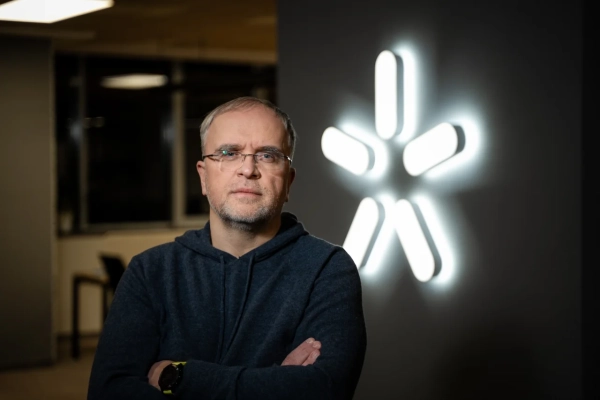
Alexander Komarov
CEO of Kyivstar
Tariffs will increase. It's very simple – the country has double-digit official inflation. We are a subject of this country's economy.
Komarov names two key factors that put pressure on the economics of any business.
The first is inflation.
- In a number of expense items that are critical for the operator, the real growth significantly exceeds the official 12%.
- During peak load periods – mornings and evenings – commercial electricity prices have increased by about 60% over the past year.
- Payments for radio frequency spectrum increased by 23%, and labor costs also increased by more than 20%.
The second is devaluation.
- According to Komarov, the hryvnia exchange rate has fallen by 6-7% year-on-year. This is even better than the pessimistic figures the company had budgeted, but it still creates additional pressure.
- The company reinvests approximately 30% of its revenue into the network, and the lion's share of these investments is in foreign currency: batteries, generators, radio equipment, licensed software (Ericsson, Nokia, etc.) are not purchased for hryvnia. Rather, “pillars and part of services” remain in the national currency.
Why are mobile phone tariffs increasing in Ukraine and Europe?
Market participants explain that this is not only a commercial decision, but also an issue of infrastructure stability in conditions of war and economic pressure. According to economist and telecom market expert Anatoly Amelin, Ukrainian mobile communications today demonstrate a quality that often exceeds the performance of European and even American operators.

Anatoly Amelin
Telecom market expert
Ukrainian mobile Internet and communication are head and shoulders above European and even more so American! Seriously. In Berlin, I caught 4G intermittently. In the city center! In Washington, the speed sometimes made me nervously refresh the page.
At the same time, the price of mobile communication in Ukraine remains one of the lowest in the world. As of the beginning of this year, the average cost of tariffs with a mobile Internet package of 20-40 GB is about 7-8.5 euros per month. For comparison: in Germany, similar services cost 30-40 euros, in France – about 20 euros, in Poland – 10-12 euros.
International studies also confirm this difference: the cost of 1 GB of mobile Internet in Ukraine is about $0.27, while in Germany it is over $2, and in Switzerland it is over $7. According to this indicator, Ukraine is among the ten countries with the cheapest mobile Internet in the world.
However, the low price also has a downside. Over the past two years, Ukrainian operators have been forced to invest significantly in the energy independence of the network and its restoration after shelling.
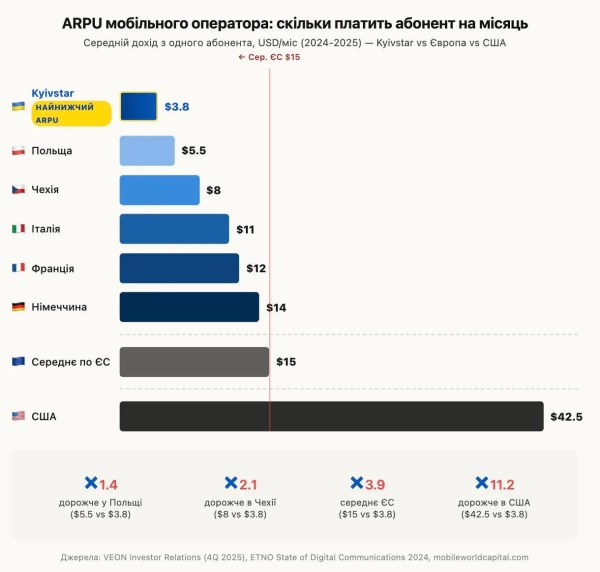
Mobile communication prices in different countries / Infographics from Anatoly Amelin's Facebook
What Ukrainian operators have built over the past two years has no analogues in the world. Nowhere. Not in any country(!): 100% of base stations – with batteries… at least 25% of stations in each region – with generators for 72 hours,
– explains Ameline.
Kyivstar News
-
From May 12, Kyivstar expands the list of countries for international calls to 19, including Europe, the USA, Canada and India. The tariff update allows you to use minutes for international calls, automatically changes the package to 300 minutes and combines them for flexible use.
-
Kyivstar plans to turn off 3G in four regions of Ukraine starting May 26, replacing it with 4G to improve internet quality. Owners of older phones without 4G support may be left without internet connection after 3G is turned off.