
Main points
- BEB detectives eliminated the underground production of counterfeit coffee, conducting 22 searches and seizing property worth about 20 million hryvnias.
- Counterfeit coffee was produced and sold through online stores, messengers, and coffee shops, using fictitious business activities.
BEB exposed underground coffee production / Collage by Channel 24, photo by Pexels, BEB
BEB detectives dismantled a large-scale underground production of counterfeit coffee of famous world brands. In total, they conducted 22 searches and seized property worth about 20 million hryvnias.
What is known about the production of counterfeit coffee in the Kyiv region?
The violations were discovered in the Kyiv region, the Bureau of Economic Security reported.
According to the investigation, the organizers established a full cycle of manufacturing counterfeit coffee – from roasting and bottling to packaging the coffee in branded packaging. They sold the counterfeits through online stores, marketplaces, and coffee shops in various regions of Ukraine.
The counterfeits were likely sold throughout Ukraine through online stores, messengers, coffee shops, and postal services.

In fact, the defendants applied logos of well-known companies to products of dubious origin and sold them as original, said BEB Director Oleksandr Tsyvinsky.
A trademark is not “just a sticker on a package.” It is a reputation, consumer trust, quality control, and many years of business work. And when someone applies someone else's brand to unknown content, it is not “entrepreneurship,” but banal theft and a risk to people. Especially when this “espresso” is roasted in an underground workshop somewhere among boxes and fantasies about easy money,
– says Tsyvinsky.
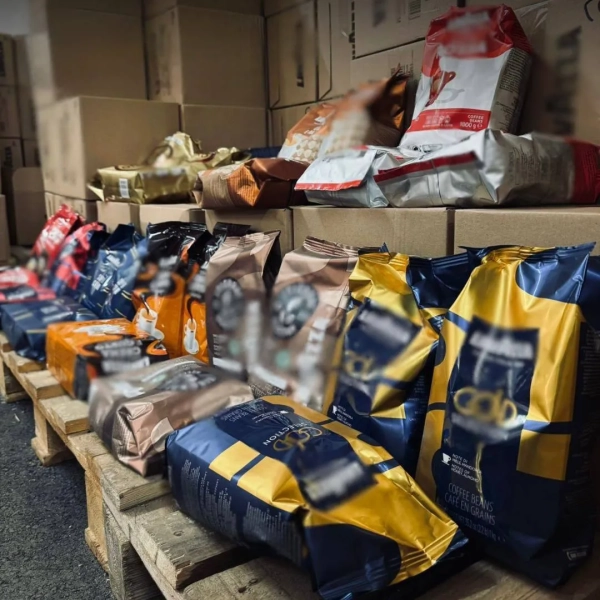
Counterfeit coffee / photo by BEB Director Oleksandr Tsyvinsky
How did the scheme work?
- In the warehouses, the suspects likely set up underground workshops where they roasted, packaged, and packaged coffee under the logos of well-known brands.
- To receive payments, participants in the scheme could use fictitious business activities.
- The fake was advertised on social networks and messengers, and orders were sent via postal services.
It is known that the defendants previously officially cooperated with the trademark owner. However, after the contract expired in 2021, they likely continued to use the brand illegally.
BEB found that the counterfeit products did not undergo any quality control and could pose a threat to the health of consumers. During the searches, detectives seized production equipment, printing materials, thousands of packages of finished products, raw materials, etc. The estimated value of the property is almost 20 million hryvnias.
What does this mean?
The situation once again demonstrates the scale of the shadow market for products in Ukraine. Counterfeit products not only pose risks to consumers' health, but also:
- causes damage to legal businesses;
- reduces tax revenues;
- undermines trust in brands;
- stimulates the development of illegal trade.
What is especially dangerous is that counterfeit products were actively sold through popular online platforms and social networks, where it is more difficult for buyers to verify the origin of the goods.
What is known about the losses from the shadow coffee market in Ukraine?
About 50% of the coffee consumed by Ukrainians is outside legal circulation, said Danylo Hetmantsev, head of the parliamentary tax committee.
When calculating the approximate losses, it was about 7 billion hryvnias. According to him, the average coffee consumption in Ukraine is about 3.5 kilograms per person per year. As a result, this gives approximately 85-105 thousand tons of products annually. At the same time, official imports are much smaller – only about 49 thousand tons.
This difference, in fact, forms the shadow segment of the market. Thus, according to the deputy, “every second cup of coffee” can be either smuggled, counterfeit, or one on which taxes have not been paid.
A highly profitable subspecies of this criminal activity is counterfeiting of famous brands. Entire organized criminal groups specialize in this. They roast coffee and pack it in packages of famous brands. And this product then increases in price,
– says the MP.
What schemes does the business use?
Expert Gennady Kapralov in a commentary on Channel 24 said that in the context of the coffee market, it is more correct to talk about a broader phenomenon – violation of customs and tax legislation.
Currently, businesses use several of the most common schemes for circumventing customs control:
- Undeclared or “black” imports.
- Declaring coffee under the guise of other goods (e.g. chicory or food additives).
- Repackaging of products after import under well-known brands.
- “Business fragmentation” and selling products through a network of sole proprietors to evade taxes.
- Undervaluation of customs value, when the importer submits documents with fictitious prices significantly lower than market prices.

Gennady Kapralov
Lawyer
As a result of such schemes, the state budget loses billions of hryvnias in tax revenues annually. At the same time, in addition to economic losses, there is a threat to public health: products of dubious quality or with an expired shelf life may enter the market, which, after processing and repackaging, are sold under the guise of premium segment products. Such practices significantly undermine fair competition in the market.
On the other hand, expert Andriy Shabelnikov believes that what is happening in the coffee market is not just individual violations, but a systemic problem that really affects legal business.
If you look at the situation through the eyes of “white” business, it becomes clear how different the playing field is. A legal importer is obliged to:
- declare the objective customs value of the goods;
- pay the appropriate import duty;
- pay 20% value added tax;
- undergo phytosanitary control;
- ensure traceability of the origin of grain and comply with storage conditions.
Instead, the shadow sector openly ignores these rules of the game, turning violation of the law into its main competitive advantage. For legal business, this situation is fatal: an entrepreneur who maintains a staff, pays taxes and rent, physically cannot compete with a counterfeit that is sold three times cheaper.

Andriy Shabelnikov
Chairman of the Committee of the National Bar Association on Investment Activities and Privatization
The main risk for the legal segment lies in how the state reacts to such public statements. Traditionally, high-profile news about smuggling becomes a trigger for mass inspections. However, it is much easier for regulatory authorities – the tax service or the State Service for the Protection of Food and Consumer Rights – to come and inspect a registered coffee shop in the city center or an official importer than to look for clandestine underground workshops in industrial zones.
It's easier to grow your business if you have your own car that matches your lifestyle. Yes, the best-selling Škoda Octavia is a balance of comfort and functionality. Nothing superfluous, only the best solutions to make your daily business routine easier. Matrix headlights, wireless phone connection, Front Assist and Cruise Control, three-zone air conditioning and driving mode selection are far from a complete list of “chips” that will allow you to enjoy every trip.
Other illegal businesses exposed by BEB
-
Law enforcement officers have uncovered a scheme to smuggle alcohol into Ukraine under diplomatic cover worth over 4 million hryvnias. Six suspects were charged, and the court set bail at almost 1 million hryvnias each.
-
In Volyn, an underground production of hookah tobacco without permits was discovered, in which residents of Volyn and Lviv regions participated. The seized products are estimated at over 8 million hryvnias, and a case has been opened under the article on illegal production and storage of excisable goods.