
- 1 How does the situation in the Middle East affect global fertilizer supplies?
- 2 How is the Ukrainian agricultural sector suffering from supply problems?
- 3 Have the prices of grain changed as a result of the escalation in the Middle East?
- 4 Do Ukrainian exports depend on Middle Eastern countries?
- 5 What consequences can be expected from the prolongation of the war in the Middle East for the agricultural market of Ukraine?
- 1 How does the situation in the Middle East affect global fertilizer supplies?
- 2 How is the Ukrainian agricultural sector suffering from supply problems?
- 3 Have the prices of grain changed as a result of the escalation in the Middle East?
- 4 Do Ukrainian exports depend on Middle Eastern countries?
- 5 What consequences can be expected from the prolongation of the war in the Middle East for the agricultural market of Ukraine?
The agro-industrial complex is one of the fundamental components of the Ukrainian economy, and its role has increased significantly after 2022. However, the current situation in the Middle East may significantly affect the global agricultural sector, including the Ukrainian one.
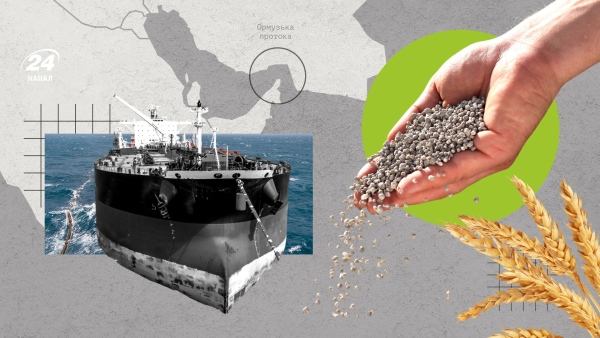
This is not only about the impact of record fuel prices, but also about the reduction in fertilizer supplies through the Strait of Hormuz, through which more than 40% of all supplies of urea and phosphate additives pass. It is also necessary to take into account that the prices of these substances have always been one of the key cost items in the farming and agricultural economy.
24 Channel learned how the situation in the Middle East could affect Ukrainian agriculture, whether a large share of fertilizers is supplied to Ukraine through the Strait of Hormuz, and what risks this poses for the domestic agricultural sector.
How does the situation in the Middle East affect global fertilizer supplies?
Warnings from the UN World Food Programme, researchers at the International Food Policy Research Institute (IFPRI) and market data compiled by S&P Global Energy suggest that the impact of the conflict is spreading beyond the region, not only through rising fuel prices and disruption of shipping routes, but also through reduced fertilizer supplies, all of which are having a knock-on effect on global food production.
As is known, due to the closure of the Strait of Hormuz, the global fertilizer supply route could be reduced by approximately 33%, according to the Turkish news agency Anadolu Ajansı. However, earlier in Reuters it was reported that fertilizer producers in Malaysia had already suspended new orders due to disruptions in supply chains.
Note! The main raw material for ammonia, from which nitrogen fertilizers are made, is blue fuel. According to The Fertilizer Institute, the Gulf countries directly or indirectly provide 49% of the world's urea exports, 30% of ammonia and almost 50% of the world's sulfur trade, which are key components for phosphate fertilizers. Countries such as Qatar, Saudi Arabia, Bahrain and Oman are major exporters of urea, diammonium phosphate (DAP) and anhydrous ammonia.
Thus, the Middle East’s supply problems and rising gas prices have already affected the cost of ammonia production, including in Europe. Interestingly, IFPRI estimates that if supply disruptions continue, a third of global fertilizer trade could be affected.
According to market analysts, the Farmonaut publication states that in February fertilizer prices were at the following level:
- Urea – approximately $580-700 per ton,
- DAP – about 630 – 780 dollars per ton,
- Potash fertilizers – approximately $525-720 per ton,
- Ammonium nitrate – approximately $550-700 per ton.
As a reminder! Back in the first week of March, after the start of the US and Israeli operation against Iran, urea prices in the Middle East closed at $590 per ton, which is $90 more than the week before.
How is the Ukrainian agricultural sector suffering from supply problems?
Deputy Chairman of the All-Ukrainian Agrarian Council, Denys Marchuk, told Channel 24 that this entire supply situation will directly affect the Ukrainian agricultural market, because Ukraine is a consumer of a large amount of imported fertilizers.

Denys Marchuk,
Deputy Chairman of the All-Ukrainian Agrarian Council
Even before the Great War, we had imports, and now domestic production has also decreased, particularly for nitrogen fertilizers. And what is happening in the world through rising prices also affects Ukraine.
Expert from the Ukrainian Agricultural and Food Agency Yevgeny Barkov told Channel 24 that since gas is the main raw material for the synthesis of nitrogen fertilizers, the correlation between the price of the energy carrier and the price of the final product is maximum. Therefore, fertilizer costs increased by an average of 27-29% depending on the crop compared to 2025: ammonium nitrate – +37%, urea – +43%, CAS-32 – +54%.

Yevgeny Barkov,
Coordinator of the Committee of Fertilizer Market Operators of the Ukrainian Agricultural Agricultural Bank (UKAB)
At the same time, the problem with logistics and the reduction in domestic production of ammonium nitrate from 1.99 million tons in 2024-2025 to 1.016 million tons in the 2025-2026 season due to enemy attacks on infrastructure and power outages led to a shortage of ammonium nitrate for the spring sowing campaign of up to 190 thousand tons as of early March 2026.
Pay attention! According to Barkov, the main suppliers for urea are Azerbaijan and Turkmenistan. As for ammonium nitrate, the main logistics hub is the European Union. And in terms of suppliers, Georgia and Bulgaria remain the priority.
As economist Ivan Us explains in a conversation with Channel 24, the first thing to pay attention to is urea. The main suppliers of this fertilizer include Oman and Saudi Arabia.

Ivan Us,
Chief Consultant at the National Institute for Strategic Studies, Candidate of Economic Sciences
However, this is more a problem for other countries than for Ukraine, because the Gulf countries are not the main suppliers of fertilizer for us.
Thus, according to Us, disruptions in fertilizer supplies will not have a critical impact on Ukraine yet, but a global deficit could change the global fertilizer market as a whole. And this would mean risks for Ukraine as well.
Marchuk also shares this view, adding that despite the fact that Ukraine does not directly purchase fertilizers from the Middle East, global price fluctuations still affect our market, because we are part of it.
Regardless of where Ukraine buys fertilizers – in Europe or Central Asia – their cost is increasing due to a reduction in supply while demand is consistently high. In addition, prices are being pressured by the rise in the price of gas, which is the main raw material for production,
– Mr. Denis remarks.
Has the price of grain changed as a result of the escalation in the Middle East?
According to Marchuk, the share of fertilizers in the cost of grain depends on the crop. On average, it can take from 15% to 35%: the cost of barley can be about 15-20% of nitrogen fertilizers, corn – about 35%. That is, the cost of fertilizers is an important component in price formation.
However, currently grain prices are actually remaining at the same positions as before. If we look at the territory of sale of the grain group today, we can see that, for example, second-class wheat costs around 11 thousand hryvnias per ton at the port, and corn – around 10.7 thousand hryvnias,
– says the deputy head of VAR.
Marchuk explains that prices are not currently rising due to increased supply. Problems with the passage of the Strait of Hormuz have complicated exports, so some grain remains on the market.
And, for example, if Ukraine previously supplied about 1.5 million tons of grain to this direction, now it is more difficult to sell it. Because of this, alternative markets have to be sought, which further increases supply and holds down prices.
At the same time, freight and insurance costs are increasing – and these additional costs fall directly on commodity producers,
– says Denys Marchuk.
As of March 23, the weighted average purchase prices of grains and oilseeds on CPT terminal terms, Graintrade reports, were:
- Corn – 10,431 hryvnia per ton,
- Grade 2 wheat – 11,040 hryvnias per ton,
- Grade 3 wheat – 10,659 hryvnias per ton,
- Sunflower – 31,550 hryvnias per ton,
- Soybeans – 20,400 hryvnias per ton.
Interesting! In January, the purchase price for grade 2 wheat fluctuated in the range of 9,600 to 10,600 hryvnias per ton (CPT), according to AgroPortal.
Do Ukrainian exports depend on Middle Eastern countries?
Us claims that the share of Ukrainian agricultural products in exports to the Middle East is not large, but it is there. For example, in some years Lebanon could buy up to 90% of its wheat from Ukraine. From the point of view of exports for Ukraine, this is quite a lot of money.
However, for us, the problem is not so much the loss of the urea exporter market as the loss of the agricultural production market, in particular grain and dairy products. After all, a certain share is definitely present for us in the region, and this should also be borne in mind,
– explains Mr. Ivan.
On the other hand, Marchuk notes that the Middle Eastern market is not key for Ukraine, as the volumes of direct supplies there remain insignificant. At the same time, the markets of Asia and Europe remain strategically important.
For us, Asia remains a premium market in the form of China, as well as the European Union. These are strategic avenues that need to be developed, and these are the markets that are always in demand,
– says Marchuk.
It is also worth paying attention to the African market, although it is more difficult due to price competition from Russia and high logistics costs. Marchuk explains that Russia resorts to price dumping.
What is price dumping: it is an intentionally set lower price for a product in order to crowd out competitors and capture a larger market share.
But Mr. Denis notes that despite this, the African direction is quite promising for farmers due to population growth and, accordingly, demand for food.
What consequences can be expected from the prolongation of the war in the Middle East for the agricultural market of Ukraine?
Marchuk emphasizes that if the situation in the Middle East continues to drag on, then among the risks for Ukraine will remain expensive raw materials in the form of mineral fertilizers and the record cost of fuel, especially diesel.
If we are talking about a conflict that is already affecting the sowing season, then during the harvesting season, when a large amount of machinery is also used, and sometimes even more than during the sowing season, this impact can be even more significant. Thus, if diesel fuel is as expensive as it is now, then production will undoubtedly become more expensive,
– says Mr. Denis.
Another problem is that only Russia will benefit from the continuation of the situation in the Middle East. According to Ivan Us, the first among the three leaders in fertilizer exports, besides Oman and Saudi Arabia, is Russia.
And if two countries fall out of this list, then the first one, that is, Russia, will receive the largest share,
– assures Us.
This is also stated by Barkov, who notes that the increase in the price of nitrogen and phosphorus fertilizers will contribute to the growth of Russia's income and the strengthening of its positions in both Western markets and Asia.
At the same time, in countries that adhere to sanctions or have introduced high import duties on Russian fertilizers – in particular, the EU and Ukraine – prices will increase even more. In such conditions, there is a risk of reviewing strict restrictions and duties on Russian fertilizers in the EU, emphasizes the coordinator of the Committee of Fertilizer Market Operators (UKAB).