
Main points
- Land exchange is possible only between legal owners with registered property rights and without legal encumbrances.
- The exchange procedure includes checking documents, agreeing on terms, concluding an exchange agreement with a notary, and registering ownership.
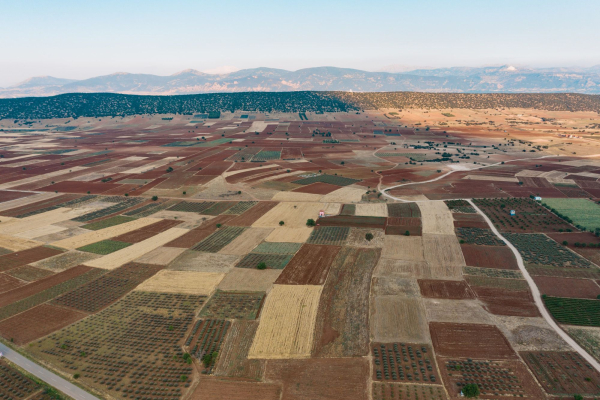
Earth in the middle of a field / Photo Freepik
Agricultural landowners can legally swap land to obtain a more favorable location. However, such a deal has its own rules and risks that are important to consider in advance.
What is a share exchange and when is it possible?
Lawyer Vitaliy Sokurenko, in a comment to Channel 24, said that the first thing to note is that in everyday life the word “share” often refers to a specific land plot, but legally it is not always the same. If a person already has a formed land plot with a cadastral number and registered ownership, then we are not talking about a share at all, but about the exchange of a land plot for a land plot.

Vitaly Sokurenko
Lawyer LEGAL STRATEGY
Land exchange is a civil law agreement under which land owners transfer ownership of their plots to each other on mutually beneficial terms. Such an exchange is a bilateral agreement and is regulated by the norms of the Civil Code of Ukraine (CCU) and the Land Code of Ukraine (LCU). The corresponding exchange of plots is regulated by Part 2 of Article 37-1 of the Land Code of Ukraine. It directly states that owners of land plots of all forms of ownership located in an agricultural land mass can exchange such land plots.
In practice, according to the lawyer, this means that if your plot is located inside the massif, and you want a plot on the edge, you need to find the owner of the edge plot who is ready for an exchange, agree on the terms and draw up a civil law exchange agreement. Exchange is possible only between persons who are legal owners of the land plots. If the plot is leased, exchange is impossible without the consent of the lessor.
Important! Before concluding a transaction, ownership rights to land plots must be registered in the State Register of Real Property Rights to Real Estate. It is also important to comply with legislative restrictions. For example, plots that are under arrest or are the subject of legal disputes cannot be exchanged.
How does the land exchange procedure work?
Vitaliy Sokurenko notes that the exchange procedure includes several key stages. First, documents for both plots are checked: ownership, cadastral numbers, extracts, the presence of leases and encumbrances. Then the exchange itself is agreed: is there a surcharge, who bears the costs of the notary, assessment, extracts, registration. Next, an exchange agreement is concluded with a notary, after which the transfer of ownership is registered in the State Register of Property Rights. If during the process it turns out that there is a problem with the boundaries, the cadastral part will first have to be sorted out through land management documentation.
Advantages and risks of such land exchanges:
-
The advantage is that the owner has the opportunity to obtain a plot in a more convenient location or with better characteristics, as well as the absence of the need for large financial expenses, as when buying a new plot.
-
The downside may be possible legal problems associated with improper preparation of documents, or the risk of appealing the agreement if one of the parties has not fulfilled all the conditions of the law.
Please note! Land exchange in Ukraine is a completely legal procedure that allows citizens to manage their property more effectively. However, the lawyer notes that the successful implementation of such a transaction depends on the correct observance of all legislative requirements and proper preparation of documents. If a question arises about concluding a relevant agreement, you should contact a qualified lawyer, whose task is to ensure that you not only change the contour on the map, but also avoid risks associated with the law.
Arrest of a share does not cancel the contract: in what cases can the tenant suspend payment?
-
The seizure of a land plot does not terminate the lease agreement and does not exempt from rent, unless there is a court ban on use.
-
The tenant can suspend payment only if access to the plot is prohibited as part of criminal proceedings, which must be documented.