
Main points
- Farmer Levin Jacobs from the Netherlands is switching from growing potatoes to nut crops due to the crisis in the potato market.
- His fields are already planted with walnuts and hazelnuts, which could become more profitable in the long term.
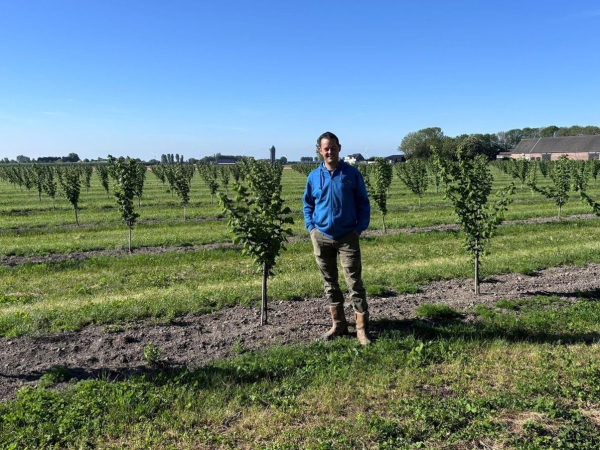
Farmer planted nuts instead of potatoes / Photo Rijnmond
A potato glut and falling prices are forcing European farmers to look for new sources of income. In the Netherlands, farmers have decided to gradually abandon traditional potato cultivation and switch to nut plantations.
Potato glut forces farmers to change approach
In the Netherlands, farmer Levin Jacobs from Den Bommel is gradually reorienting his farm from growing potatoes to growing nuts, Rijnmond reports. The reason for this decision was the crisis in the potato market, where overproduction is increasingly leaving farmers without a profit.
Together with his father, the farmer cultivates 40 hectares of land. However, in recent years, income from traditional crop production has not been enough to support two family farms.
Therefore, the farmer began to look for alternatives and study in detail the experience of growing nuts both in the Netherlands and abroad.

Walnut trees are already growing in the fields instead of potatoes
Today, part of the farm's land is already occupied by new crops. In one field, Levin planted 218 walnuts and about a thousand hazelnut bushes, and in another area, about two thousand seedlings.
In total, 6.5 hectares have already been allocated for hazelnut plantations. The farmer hopes to completely convert the farm to hazelnut cultivation in a few years.
Potatoes are now worth almost nothing. They used to fetch around 20 euro cents per kilogram, but a good harvest in 2025 led to a surplus of around 100 million kilograms in the Netherlands,
– explains the farmer.
It was price fluctuations, he said, that became one of the main factors for changing specialization.
Nuts can be a better investment
However, the new direction also requires patience and significant investment. Hazelnuts begin to produce a full harvest only after about five years, while walnuts grow even longer – the tree can take up to 15 years to form.
Despite this, the farmer is counting on higher profitability. According to his estimates, nuts could cost around 5–6 euros per kilogram, which would potentially provide a better financial result even with a lower yield per hectare.
Last year we only got 30 kilograms of harvest from three hectares – that’s not enough. But we have to start somewhere. In five or six years it will become clear whether this idea worked,
– says Levin.
The world leaders in hazelnut cultivation remain Turkey, Italy and Spain, while the largest walnut producers are China, the USA, Iran and Turkey. That is why this direction remains quite unusual for Dutch farmers, but is increasingly attractive against the backdrop of the instability of traditional crops.
Please note! In Ukraine, the average retail price for peeled hazelnuts ranges from 430 to 1190 hryvnias per kilogram , depending on the processing method, country of origin and size of the nut. Unpeeled hazelnuts (in shell) cost significantly less – from 100 to 310 hryvnias per kilogram.
From service to business: a veteran grows hazelnuts and launches processing
Ukraine also has successful cases of transitioning to hazelnut cultivation and processing.
-
Veteran from Zhytomyr region Volodymyr Matviychuk, with the support of a state grant, is developing an agribusiness for growing and processing hazelnuts.
-
The entrepreneur plans to expand processing, in particular the production of hazelnut paste, and scale the business.
The farmer notes that modern seedlings are capable of producing their first fruits in the year of planting. This makes the crop attractive to those who are just planning to start their own garden.