
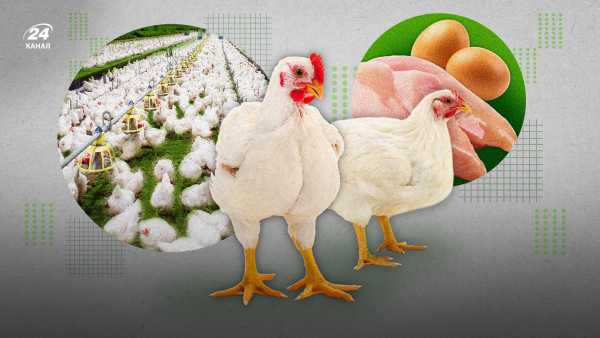
- 1 Can Ukraine abandon fast-growing broiler chickens?
- 2 What new requirements for poultry welfare have already been introduced in Ukraine?
- 3 What is the role of broiler chicken meat in Ukraine?
- 4 What will happen to the price of chicken meat?
- 5 Should we expect the price of eggs to rise?
- 1 Can Ukraine abandon fast-growing broiler chickens?
- 2 What new requirements for poultry welfare have already been introduced in Ukraine?
- 3 What is the role of broiler chicken meat in Ukraine?
- 4 What will happen to the price of chicken meat?
- 5 Should we expect the price of eggs to rise?
Norway has officially confirmed that it is abandoning the breeding of fast-growing chicken breeds, among the reasons being more humane poultry farming standards. Such birds are bred through selective breeding, and accordingly, they gain weight quickly. This leads to the destruction of their bones, muscles and ligaments.
Despite the fact that in Ukraine attention is increasing to poultry keeping standards and they are approaching European requirements, there are currently no plans to abandon fast-growing chickens.
Interestingly, experts' opinions on this situation differ: some believe that Ukraine has good chances to become a world leader in raising poultry with slow live weight growth, while others predict that abandoning fast-growing broiler chickens could lead to an increase in the price of chicken meat.
24 Channel learned how dependent Ukraine is on the meat of fast-growing chicken breeds, how poultry keeping standards in the country have changed in line with European standards, and what changes can be expected in the cost of chicken and eggs.
Can Ukraine abandon fast-growing broiler chickens?
For Channel 24, Doctor of Agricultural Sciences Alla Hunchak explained that the genetic growth potential of modern broilers outpaces the development of their internal organs. Due to too rapid weight gain, which is up to 50-60 grams per day, the skeleton and heart of the bird do not have time to strengthen.

Alla Hunchak
Head of the Laboratory of Physiology, Biochemistry and Poultry Nutrition of the Institute of Animal Biology of the NAAS of Ukraine
Back in 2018-2021, the largest Norwegian supermarket chains, under pressure from animal protection campaigns, completely switched to the Hubbard breed, which grows more slowly – instead of 35-40 days, it takes 46-50 days. This allows the bird to be more active, get sick less often, and have stronger bones.
Despite the fact that Ukrainian legislation and animal welfare standards are approaching European ones, taking into account European integration, there is no talk in Ukraine yet of abandoning the breeding of fast-growing chicken breeds, poultry expert Oleg Katerynych said in a conversation with Channel 24.
In addition, there are no significant changes against the backdrop of the harmonization of legislation and requirements from Europe for Ukrainian industrial poultry farms.

Oleg Katerynych
Doctor of Agricultural Sciences, Chief Researcher of the Scientific and Technical Station of Poultry Farming of the NAAS
At the moment, it is only known that the density of poultry has changed. Previously, 16 chickens were allowed to be kept per square meter, but now it is 12.
At the same time, Hunchak also notes that a similar situation in Ukraine regarding the abandonment of fast-growing chicken breeds is unlikely. But in the perspective of the next 5 or 10 years, it is inevitable.
Ukraine has a lower purchasing power than Norway. Due to the fact that slow-growing breeds of chickens consume 15-25% more feed per 1 kilogram of meat, this will automatically raise the price of chicken. And for most Ukrainians, for whom chicken is the main source of protein, such an increase in price will be critical,
– the expert predicts.
What new requirements for poultry welfare have already been introduced in Ukraine?
Hunchak states that from January 1, 2026, new requirements for poultry welfare came into effect in Ukraine, which is part of harmonization with EU regulations.
- The principles of the “5 Freedoms” are currently enshrined in law: freedom from hunger, work, and malnutrition, as well as from pain and fear, injury, and disease.
- Minimum space requirements have been established for laying hens, pigs and calves.
- Humane slaughter rules have been introduced that minimize suffering.
- Criminal and administrative liability for animal abuse has been strengthened.
However, according to the head of the Laboratory of Physiology, Biochemistry and Poultry Nutrition of the Institute of Animal Biology of the NAAS, despite such changes, Ukraine should also abandon cage keeping of poultry. And the use of antibiotics as a growth stimulant should be excluded.
Requirements that still need to be implemented also include training farmers and staff on modern animal welfare standards and certification systems.
Such changes will be an advantage for exports, because for the European buyer the label “Cage-free” or “Free-range” is often more important than price,
– says Mrs. Alla.
As an example among the world leaders in the poultry industry, Oleg Katerynych cites the Netherlands, which has maintained a high level of quality in Europe for over 10 years.
Their statistics show that such broiler meat accounts for about 25% of the total chicken meat production in the regions.
In addition, meat grown in the country from standard fast-growing broilers is mainly exported.
- For comparison: the country grows poultry using a different technology for itself – not 42 days, but approximately 70-90 days. They use so-called colored broilers with slow live weight growth.
- And now this is a general European trend that is developing rapidly. Because such a bird costs more, because its meat is of higher quality.
What is the role of broiler chicken meat in Ukraine?
Alla Hunchak emphasizes that Ukraine is almost 100% dependent on industrial fast-growing poultry crosses, such as Ross 308 and Cobb 500.
Moreover, Ukraine does not have its own world-class breeding. All genetic material (parental herd or incubation eggs) is imported from global foreign giants (Aviagen, Cobb-Vantress),
– reports the expert.
Modern broilers reach slaughter weight in 38-42 days. Without these hybrids, it would be impossible to ensure such low meat prices and huge production volumes.
And according to Oleg Katerynych, compared to other species, such as pig farming, cattle breeding, sheep breeding, etc., the poultry industry in Ukraine produces about 70% of all animal protein.
The production of broiler chicken meat and table eggs accounts for almost 70% of animal protein in our country. That is, it is the number one industry,
– explains the Doctor of Agricultural Sciences.
At the same time, broilers among the industrial production of poultry meat of various species occupy somewhere 93-95%. This indicates that industrial enterprises do not produce enough meat of turkeys, geese and ducks. In this case, broiler chicken meat almost completely satisfies both domestic demand and is exported.
Katerynych adds that because of this, there is a prospect for Ukraine in raising poultry or broilers with slow growth in live weight.
The country could even become not only a European, but also a world leader in the production of such chicken. And among the reasons, he names the following:
- Arrangement
Currently, this market is growing the most in Western Europe and the Arab countries. Due to the fact that Ukraine is located in relative proximity from production to the consumer, it can establish supplies of products to both European countries and Eastern states.
- Feed resources
Ukraine has sufficient feed resources to raise such poultry.
- Availability of space
Norway is still mostly a mountainous country, where there is not much space, while Ukraine has a lot of territory where it can build large farms for free-range chickens with slow growth in live weight.
The production of fast-growing broiler meat is, first and foremost, a priority for small and medium-sized poultry farms.
For such enterprises, this will be a great prospect in the future,
– Katerynych said.
What will happen to the cost of chicken meat?
Alla Hunchak predicts that a complete abandonment of broilers would lead to a “meat crisis” in Ukraine. If in Norway or France the consumer is willing to pay more for “humanity”, then for Ukraine this could become a serious challenge.
- The cost of meat is conventionally based on two categories: time and feed. A broiler typically uses approximately 1.5–1.6 kilograms of feed per kilogram of gain, while a slow-growing bird needs 2–2.4 kilograms.
- Since feed accounts for about 70% of the cost, this factor alone increases costs by 30–40%.
- Instead of 42 days, the bird will grow for 60-80 days. This means that the poultry farm will be able to grow not 6-7 batches of birds per year, but only 4 batches.
Broilers are selected for hypertrophy of the pectoral muscles. In slow-growing breeds, the yield of white meat is lower, and the proportion of thigh and drumstick is higher. Taking into account logistics and retail margins, the price on store shelves can increase by at least 40 – 60%,
– notes scientist Hunchak.
This will lead to the fact that on the world market (Asia, Africa) Ukrainian chicken will become uncompetitive in price compared to Brazilian or American chicken.
Katerynych says that today the price of chicken meat has already increased per kilogram. However, prices will not change in the future.
There is a restraining factor – the low purchasing power of the population. Mostly only chicken fillets are exported, if we take broilers. Everything else goes to the domestic market. And mostly Ukrainians buy thighs and wings,
– says Mr. Oleg.
Should we expect the price of eggs to rise?
Oleg Katerynych states that the cost of eggs is primarily influenced by the cost of feed. The second factor that has an impact is the availability of electricity and its price. The third factor is logistics.
An expert in the field of poultry farming predicts that feed in Ukraine will continue to increase in price, and the situation with electricity is difficult to predict.
In previous years, it was said that with the onset of warm weather, the price usually fell. That is, if in December the cost of one egg could reach even 10 hryvnias, then closer to May-June it was approximately 4 hryvnias.
However, this year I do not expect such a significant drop in price to be possible. Despite this, there will still be a decrease, albeit imperceptible,
– adds Mr. Oleg.
A minor decrease is expected, primarily due to the large number of producers in Ukraine who keep poultry and produce table eggs.
There are periods when laying hens naturally reduce or stop laying eggs – this cannot be influenced. However, due to the fact that eggs cannot be stored for a long time, a decrease in production will still be felt.