
Main points
- Spring edible mushrooms can be found in various types of forests, mostly in damp areas and dead trees.
- Judas' ear, a mushroom with a jelly-like structure, grows on elderberries and other hardwoods and is used in Chinese and Japanese cuisines, as well as in folk medicine.
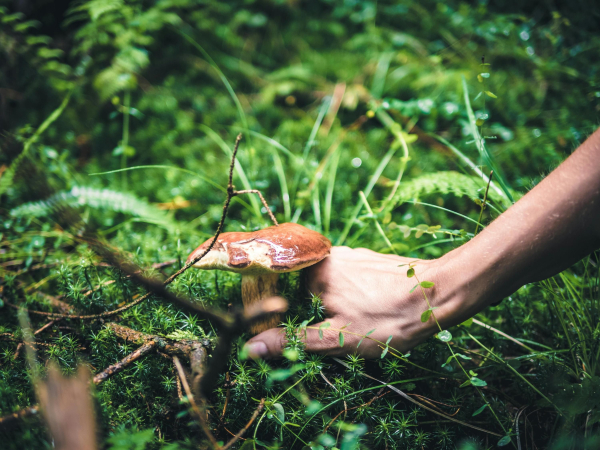
Spring mushrooms / Photo by Pexels
The first spring mushrooms can be found as early as March, the main thing is to know where to look. In particular, mushrooms most often grow on trees or in damp places where it is warm and humid after a cold winter.
What edible mushrooms grow in March?
Viktoriya Gordienko told about which mushrooms can be picked in the spring, according to the Konkurent resource.
You should look for spring edible mushrooms in deciduous forests, clearings, or near streams. Among the species:
- common oyster mushroom : grows from early October to mid-December and in the spring – immediately after the snow melts. Most often, these mushrooms can be found in deciduous and mixed forests, in parks, plantations, gardens, on dead and weakened trees (on walnuts and poplars – more often, on aspens, hornbeams, willows – less often). In particular, this species does not require preliminary treatment before cooking, is easy to clean and stores well;
- red sarcoscypha : grows from late February to May (sometimes in winter, if it is not too cold). Can be found in damp areas, rotten tree branches. Grows both singly and in groups. The mushroom is edible, but before the main preparation, it is worth boiling it for 10 minutes;
- Edible strobilurus : grows from March to May mainly in coniferous spruce forests, in moist sunny areas, on spruce cones, on rotten cones immersed in the soil. Mostly found in groups. Has low nutritional value, belongs to category 4. Therefore, it can be used after 10 minutes of boiling. It is also worth collecting only the caps, because the stems are unsuitable for consumption;
- Flamulina velvety , or winter honey agaric: grows from October to mid-March mainly in deciduous and mixed forests, on dead and living weakened wood, on elms, willows, aspens, walnuts, poplars, hornbeams, lindens, birches, maples, acacias, ash trees. Suitable for consumption after 15 minutes of boiling. If the mushrooms are young, you can collect them with their legs, if they are mature, only their caps.
What other mushrooms can you find in spring?
One of the species that begins to grow in late winter is called Judas' ear or muer. And this mushroom really does resemble an ear, which is why it got its name.
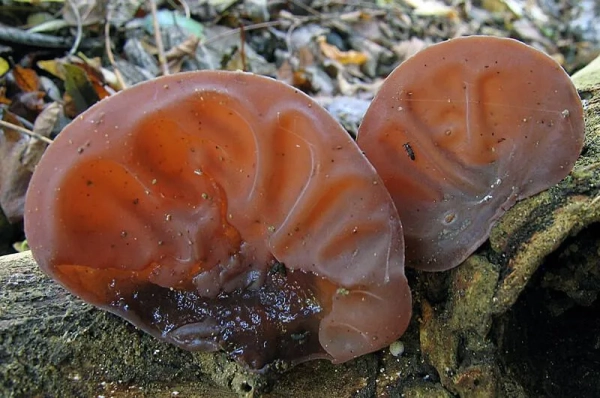
Muer mushroom or Judas ear / Photo vlisi.com.ua
This is a tree species that mainly grows on elderberry and other deciduous trees. It has a jelly-like structure and is very common in Chinese and Japanese cuisine. However, it is also found in Ukraine. As reported on the page of the Scientific Research Department of the Kramatorsk Regional Forestry Institute.
In particular, it is known that the mushroom is even used in folk medicine. It is believed that it can lower cholesterol levels. However, before eating, it is worth pouring boiling water over the fruits – they have a neutral taste and are used only for texture.
What else is known about mushrooms?
-
Flamulina velvety grows even in winter. However, during severe frosts, growth stops, but with warming, it will resume. This mushroom has beneficial properties and is rich in vitamins.
-
Oyster mushrooms, in particular, are a type of mushroom that, when properly prepared, is simply indistinguishable from meat. Another unique feature is that they do not need to be boiled.