
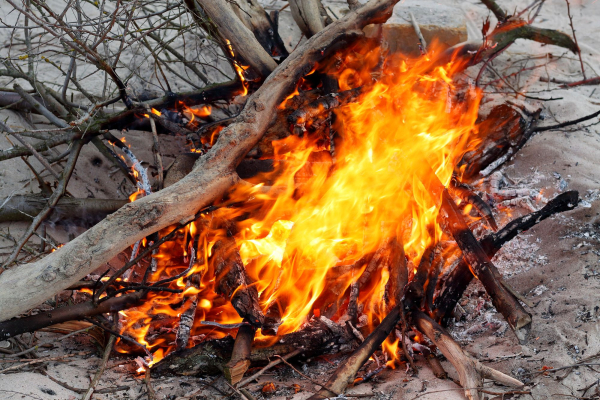
What are the fines for burning dry branches / Depositphotos
In the spring, many homeowners clean up old leaves, dry branches, and debris left over from the previous season. However, you can't just burn them anywhere, because in warm weather, the risk of fire increases several times.
Where can you not burn branches and dry leaves?
Fire safety rules in Ukraine prohibit lighting fires closer than 30 meters from any buildings and structures, the State Emergency Service of Ukraine said.
You can also not light an open fire:
- from parking lots with cars – closer than 25 meters
- from a coniferous forest – closer than 50 meters;
- from deciduous forest – closer than 25 meters.
At the same time, rescuers note that cooking food over an open fire is possible at a distance of 5 meters. However, the place where the fire will be lit must be specially equipped beforehand.
The place for the bonfire should be cleared to the soil layer and surrounded by a strip of cleared earth at least 2.5 meters wide,
– experts noted.
At the same time, under no circumstances should unextinguished coals be thrown away after cooking.
However, the rules allow burning branches, dry grass, and leaves in nature only in exceptional cases. This is only allowed to emergency responders when extinguishing fires in natural ecosystems.
Burning dry grass and leaves is one of the most common causes of fires in open areas, particularly on private land and agricultural lands,
– the State Emergency Service emphasizes.
What are the penalties for violating the rules?
In other cases, Ukrainians can receive hefty fines for burning dry grass and vegetation. A few years ago, the Rada increased the penalties for starting fires, so now the sanctions are:
- for ordinary Ukrainians – from 3,060 to 6,120 hryvnias ;
- for officials – from 15,300 to 21,420 hryvnias.
For burning dead wood in the territories of the nature reserve fund, you can receive a fine from 6,120 to 12,240 hryvnias .
If animals or people die in the fire, the penalty will increase from 21,420 to 30,600 hryvnias . For particularly devastating consequences, even imprisonment from 5 to 10 years is possible.
However, the rules allow burning dry branches, for example, in everyday life:
- for cooking food in an oven, on a grill or other equipment;
- for heating the home.
It is also possible to burn dry branches during cultural ceremonies, for example, for a bonfire on Ivan Kupala. But this requires a separate permit.
In these cases, it is necessary to agree on the place and time in advance with the local authorities,
– the service added.
Important! Under no circumstances should you burn branches or leaves in windy weather. After all, strong winds significantly increase the risk of fire.
What to do with dry leaves and branches?
-
Composting dry leaves and grass is much more beneficial. The result is a natural fertilizer that is well suited for improving soil structure and nourishing plants.
-
The composting process itself is quite simple and does not require complicated conditions. First, you need to prepare a place – it can be a special container or a regular pit on the site. Then you should gradually add organic waste: vegetable and fruit scraps, coffee grounds, tea, grass clippings, fallen leaves, shredded branches, weeds or even paper.
-
At the same time, it is important to remember that bones, diseased or chemically treated plants, as well as inorganic materials such as plastic, metal, rubber, or synthetic fabrics should not be added to compost. For compost to “ripen” properly, it needs air access and sufficient moisture, so the mass should be periodically mixed and moistened.