
Main points
- The Kh-101 missiles that Russia is using to attack Ukraine are equipped with electronics developed back in the 1960s and contain about 50 foreign components, suggesting possible workarounds to obtain the necessary parts.
- Ukrainian air defenses effectively shoot down most Russian Kh-101 missiles, and with the advent of modern IRIS-T and NASAMS air defense systems, these figures are increasing.
- 1 Timeline of recent Russian attacks with Kh-101 missiles
- 2 What is known about the missile that hit Okhmatdyt?
- 3 What is known about the X-101 missile
- 4 X-101: characteristics
- 5 Who launches the X-101 missiles?
- 6 Can the X-101 carry a nuclear charge?
- 7 How many X-101s are left in Russia?
- 8 How to resist X-101
- 9 How Ukrainian air defenses shoot down the Kh-101
- 10 The most effective way to counteract
- 11 Russia has started losing its best missiles during launches
- 1 Timeline of recent Russian attacks with Kh-101 missiles
- 2 What is known about the missile that hit Okhmatdyt?
- 3 What is known about the X-101 missile
- 4 X-101: characteristics
- 5 Who launches the X-101 missiles?
- 6 Can the X-101 carry a nuclear charge?
- 7 How many X-101s are left in Russia?
- 8 How to resist X-101
- 9 How Ukrainian air defenses shoot down the Kh-101
- 10 The most effective way to counteract
- 11 Russia has started losing its best missiles during launches
For its failures on the battlefield, Russia is taking out its fury on Ukrainian civilians and critical infrastructure. One of the tools of Russian missile terror against Ukraine is the Kh-101 cruise missile.
The Kh-101 is the exact missile that Russia used to attack the Okhmatdyt children's hospital on July 8, 2024. How to counter the Kh-101 and what is known about them – read the material on Channel 24 .
Timeline of recent Russian attacks with Kh-101 missiles
Missiles of the Kh-101 type, as well as Kh-555/55 missiles, are the main weapons used by the occupiers to launch massive missile strikes on Ukraine.

- On the night of May 14, Russia used 35 Kh-101 cruise missiles, 29 of which were neutralized.
- During April 2026, the Air Defense of the Defense Forces destroyed 69 Kh-101 cruise missiles.
- On the night of March 24, enemy strategic aviation also launched 18 missiles. They tried to reach the West and the Kyiv region. All of them were shot down.
- On March 14, Russia again launched cruise missiles from Tu-95 aircraft into Ukraine. Then the occupiers launched 24 Kh-101s, all of which were shot down.
- In total, in February 2026, the Air Defense neutralized 87 Kh-101 cruise missiles.
- On February 26, a massive rocket barrage began around 6 a.m., with Kh-101 cruise missile launches around 5 a.m. As of 10 a.m., air defense forces had destroyed 24 missiles.
- On February 22, 2026, Russia launched 18 Kh-101 cruise missiles from strategic aviation aircraft.
- On February 17, 2026, Russian forces again launched a massive combined strike on Ukraine, including the use of 20 Kh-101 missiles. However, air defenses destroyed all targets.
- On February 7, 2026, the Russians used 21 Kh-101 cruise missiles to attack Ukrainian energy facilities. Air defense forces destroyed 14 missiles.
- On February 3, 2026, during another massive combined strike on Ukrainian energy, the Russians used 28 cruise missiles, including the Kh-101 and Iskander-K. Air defense forces neutralized 20 missiles.
- On the morning of January 20, 2026, the Russians launched 15 Kh-101 missiles from the Volgograd region into Ukraine. Air defense forces managed to destroy 13 of the missiles.
- On the night of December 27, Russia again likely launched these missiles from strategic aircraft. This happened around 4 a.m.
- On the morning of November 19, the Russians launched X-101s from aircraft over Ukraine.
- On the night of October 5, the enemy launched these missiles at Ukraine from strategic bombers. The Air Force reported 42 Kh-101/Iskander-K cruise missiles, of which 32 were neutralized.
- On the night of September 20, Russia launched 32 Kh-101 cruise missiles from the airspace of the Saratov region. 29 were neutralized.
- On the morning of September 10, the Russians used 42 cruise and aircraft missiles against Ukraine, including the Kh-101, launched by Tu-95 fighter jets at night.
- On the night of August 30, Russian forces used a total of 37 air, ground, and sea-based cruise/aircraft missiles. Among them were Kh-101 missiles, but the Air Force of the Armed Forces of Ukraine did not report the exact number.
- On August 28, during a massive attack on Ukrainian territory, Russia launched 20 Kh-101 cruise missiles from the airspace of the Saratov region. 18 of them were shot down.
- On the night of August 21, Russia used Kh-101 strategic bombers. The attack was massive and combined.
- On the night of July 12, Russia launched 26 Kh-101 cruise missiles at Ukraine from the airspace of the Saratov region of Russia. Air defense forces destroyed 25 of them.
- On the night of June 29, the enemy launched 41 Kh-101/Iskander-K cruise missiles from the Saratov, Kursk, and Bryansk regions. 33 were shot down, and one was lost in the field.
- On the night of May 26, the Russians launched 9 Kh-101 missiles from Tu-95s in the Saratov region. All 9 missiles were destroyed by air defense forces.
- On the night of May 25, the aggressor country attacked with 55 air- and sea-based Kh-101 cruise missiles, Kalibr from strategic aviation aircraft Tu-95, Tu-160. The enemy launched air targets from the Saratov region of Russia and the Black Sea. Air defense shot down 45 Kh-101 cruise missiles.
- On April 24, 2025, the Russians launched 37 Kh-101 missiles from Tu-95 bombers from the Sarators region. 31 missiles were destroyed by air defense forces, and another 6 attacked Kyiv and Zhytomyr regions.
- On the morning of April 6, Russia launched 9 Kh-101/Kh-55SM cruise missiles at Ukraine. These were launched from Tu-95MS aircraft from the airspace of the Saratov region. The air defense shot down 6 Kh-101/Kh-55SM cruise missiles.
- On February 25, the enemy used 7 Kh-101 cruise missiles from Tu-95 against Ukraine. The Air Force reported shooting down 6 of them.
- On February 20, the occupiers launched a total of 14 missiles, including Kh-101/Kh-55cm, from the Volgograd region of Russia. This time, the Air Force did not release information about the results of the combat operation.
- On the morning of February 1, Russia launched 8 Kh-101/Kh-55 missiles from Tu-95 aircraft during the attack. The enemy raised 6 Tu-95 aircraft and 4 Tu-22M3 aircraft with missiles into the sky.
- On the morning of January 15, the Russians launched 27 Kh-101 and Kh-555 missiles in a combined attack on Ukraine's energy infrastructure. Air defense forces managed to destroy 23 of the missiles.
What is known about the missile that hit Okhmatdyt?
On July 8, 2023, the Russians deliberately struck Ukraine's largest children's hospital, Okhmatdyt, with an Kh-101 missile. This is evidenced by footage showing the Russian missile flying into the hospital and debris found at the scene of the tragedy.
In addition, the Financial Times reported that, according to expert reports, the Russian Kh-101 missile, which is currently perhaps the most mass-produced model in terms of production rates, had about 50 foreign components. This indicates that the Russians, bypassing sanctions, are still obtaining parts needed to manufacture missiles.

Chinese and Thai chips in Russian missile / FT Infographics
However, publications and experts note that this does not mean that the electronics companies whose products Russia uses have violated sanctions. It is likely that this is about smuggling and establishing schemes to circumvent bans on the import of these products.
What is known about the X-101 missile?
X-101 – These are strategic aviation subsonic cruise missiles of the “air-to-air” class. land”. It is declared that this is a new Russian development: they were adopted only in 2013 and underwent “running-in” in Syria as part of the campaign of genocide against the Syrian people, because the Russians used them not so much against military as against civilian targets.
Since the beginning of the Russian invasion of Ukraine, the enemy has been shelling Ukrainian cities with Kh-101 missiles, including Vinnytsia, Kyiv, Dnipro, Odessa, etc. It was the Kh-101 missile that hit a civilian house in the center of the Ukrainian capital in the summer of 2022 and killed a woman.
Pay attention! X-101 – air-launched missiles, they are launched from strategic bombers Tu-160 (12 missiles in two internal compartments) or Tu-95MS (8 missiles on an external suspension). Flight range – over 5.5 thousand kilometers. As a rule, the Russians launch them from the waters of the Caspian Sea or from the city of Volgodonsk in the Rostov region, less often – from the Black Sea. In fact, the planes just need to take off, go on a combat course and launch missiles.
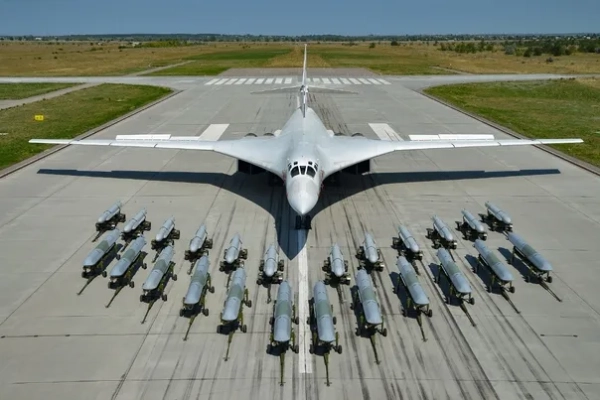
Tu-160 with Kh-101 and Kh-55SM missile kits / photo – Ministry of Defense of the Russian Federation
This is one of the most expensive Russian missiles – The estimated cost of the X-101 is $13 million . This is twice as much as the Caliber missile.
Despite Russia's insistence that these missiles are “new”, “super-accurate”, and even more so – specific Russian development, all of this is a lie.
An analysis of Russian air-launched cruise missiles by experts from the Defense Ministry's GUR showed that “modern” devices are equipped with electronics developed in the 1960s.
The analysis of the guidance and navigation systems of the Kh-55 cruise missiles, as well as their modifications Kh-555 and Kh-101, carried out by Ukrainian experts, showed that the “modern” guidance units were developed in the 1960s and 1970s and were produced by the Voronezh Radio Components Plant, the Minsk Integral Plant, and other enterprises of the Soviet Union. Most of the Kh-101 missiles launched from the territory of Ukraine never hit their intended targets,
– The Ministry of Defense's GUR is tearing the veil off the Russian “analog”.
The lie about purely Russian parts was refuted by experts from Conflict Armament Research (CAR). In July, they came to Ukraine to analyze the contents of Russian weapons and found numerous non-Russian components in the Russian X-101. The experts concluded that the production of the latest Russian precision weapons is entirely dependent on the supply of a limited number of components from several European, American and Asian companies.
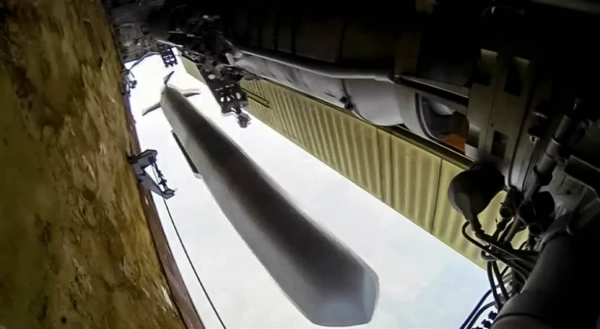
X-101 launch / photo – Ministry of Defense of the Russian Federation
The research results were made public in September 2022 and taken into account when imposing new sanctions on Russia, and “educational work” was carried out with foreign manufacturers of “stuffing” for the Kh-101 and other Russian missiles.
Thus, the supply channel for missile components to Russia was blocked, making them a virtually non-renewable resource. The Russians may still have some stocks of foreign electronics, but the production of the X-101 on an industrial scale (i.e. several dozen per year, according to estimates by Russian military expert Pavel Luzin – about 50 units) is still in the works. ) is no longer an option.
X-101: characteristics
- Carriers: Tu-160, Tu-95MS;
- Class: air – Earth;
- The missile's flight speed is up to 720 kilometers per hour;
- Maximum range: up to 5,500 kilometers;
- Total weight: approximately 2,400 kilograms;
- Warhead weight: up to 960 kilograms;
- Length: 7.4 meters;
- Guidance: inertial system with optical-electronic correction, in the final section – homing;
- Navigation: based on the GLONASS system.
Who launches the X-101 missiles?
This is done by Russian pilots of the Russian Aerospace Forces. Their personal data has been established. On August 14, 2022, the GUR of the Ministry of Defense published data on the command staff of the 52nd Heavy Bomber Aviation Regiment and the 121st Heavy Bomber Aviation Regiment of the 22nd Heavy Bomber Aviation Division, whose personnel are involved in the task of missile strikes from Tu-22M3 and Tu-160 aircraft with Kh-22, Kh-555, Kh-101 cruise missiles on cities and civilians in Ukraine.
Thanks to OSINT investigators, the names of not only the direct perpetrators but also those responsible for Russian missile launches and missile terror against Ukraine are known. Journalists from The Insider, Bellingcat, and Der Spiegel have identified 30 Russian military engineers who are guiding missiles at civilian targets in Ukraine.
Missile guidance is handled by a unit of the Main Computing Center of the Russian Armed Forces. It consists of 3 teams, each of which programs the trajectories of a specific type of missile.
The following Russian war criminals are responsible for the launches of the Kh-101 missiles:
- Artem Chernov;
- Alexey Betekhtin;
- Andriy Ivanyutin;
- Anton Chulykov;
- Olga Pysmovska;
- Pavel Vasiliev;
- Alexey Volkov;
- Anton Shatun;
- Stanislav Minkov.
Can the X-101 carry a nuclear charge?
This option is provided for the Kh-101. The cruise missile has a nuclear variant – the Kh-102 with a thermonuclear charge with a capacity of 250 kt or 1 Mt.
During the shelling of Ukraine, the Russians used the Kh-55 air-launched missile, which is related to the Kh-101. It had a nuclear warhead simulator, a simple blank. This may indicate another attempt at nuclear blackmail, or that the Russians are running out of these missiles and are launching their already intact stock out of desperation.
How many X-101s are left in Russia?
Earlier, now former Defense Minister Alexei Reznikov shared data on the number of Russian missiles. In particular, he reported that at the time of the invasion, the aggressor had 444 Kh-101 missiles and similar Kh-555 air-launched missiles.

The consequences of the X-101 missile hitting a kindergarten in Kyiv / photo by Channel 24
Moscow carried out several large-scale shelling of Ukrainian civilian targets, which is a war crime. Later, Russia, through President Putin and his spokesman Peskov, officially admitted that it had fired on the substations intentionally to force the Ukrainian authorities into negotiations.
Currently, Russia is in short supply of the Kh-101, intelligence data indicates that the enemy is shelling Ukraine with missiles that have just come off the assembly line. At the same time, normal practice is to shoot not new, but old missiles (they have an expiration date and this is how the arsenal is updated). In the case of Russia, there is nothing to update, so they shoot with newly assembled missiles. The release of missiles takes place under sanctions and with the help of parallel imports, and therefore all this turns the Kh-101 into a counterfeit product.
By the way, during the massive attack on Kyiv on January 2, 2024, according to the Defense Express publication, the Russians used missiles manufactured in the 4th quarter of 2023 to attack the capital. This is evidenced by a photo published by the publication with the missile's serial number.
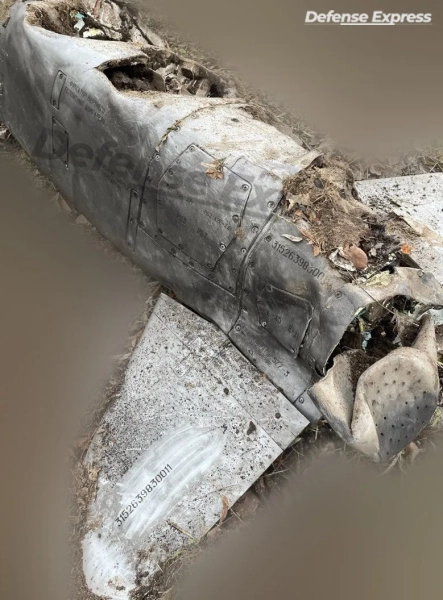
Fragment of the X-101 missile / Photo Defense Express
How to resist X-101
Russia first used the Kh-101 on March 6, 2022, to strike the airport in Vinnytsia and the military airfield in Havryshivka. Then, one missile was shot down by a machine gun. In total, the enemy fired 8 Kh-101s.
The cruise missile that was shot down two days ago in the Vinnytsia region was shot down with a regular machine gun. It was flying very low. It is the Kh-101, supposedly an ultra-modern and ultra-expensive missile. We see that it can be shot down. Therefore, I urge everyone: try, especially those areas of the Vinnytsia region where they know that they are constantly flying. They fly, by the way, at almost the same time,
– n The head of the Vinnytsia Regional Military Administration, Serhiy Borzov, tells how the Ukrainian military shot down the first Kh-101 in March 2022.
Ukrainian air defenses effectively intercept these missiles. They are launched from afar, which gives Ukrainians time to prepare for the visit of uninvited guests. Ukrainian intelligence works very well, and its coordination with air defenses has been worked out in detail over the months of the invasion.
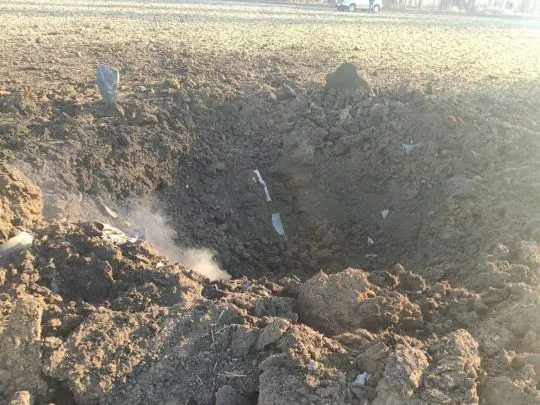
For the first time in Ukraine, a Kh-101 missile was destroyed with a machine gun in March 2022 / Photo – Vinnytsia OVA
The problem for air defense is the unpredictable trajectory of the missile, which allows it to change its target after launch. The X-101 also uses radar-reduction technologies.
Despite this, we can state that most of the Russian Kh-101 missiles are currently shot down by Ukraine, and Russia is simply throwing its millions into the trash. With the advent of modern IRIS-T and NASAMS air defense systems in Ukraine, the number of destroyed Russian missiles will only increase.
Photo of the Russian Kh-101 cruise missile shot down on January 26, 2023 in the Vinnytsia region / Photo – Air Force of the Armed Forces of Ukraine:


How Ukrainian air defenses shoot down the X-101
From the beginning of 2024 to May 8, the enemy launched 364 cruise missiles of the Kh-101/Kh-555/Kh-55 types at Ukraine, carrying out 13 massive attacks. The most massive of them was the attack on January 2, when the occupiers used 70 missiles at once.
During this time, the air defense forces managed to shoot down 294 enemy missiles. That is, the percentage of destruction of these cruise missiles is 80.7%.
The most effective way to counteract
Ukraine's air defense and missile defense forces are doing real wonders and intercepting most Russian missiles in Ukrainian skies. However, there is a much more reliable way – to prevent launches. We are talking about preventive strikes on Russian territory, in particular, airfields where bombers capable of launching the Kh-101 and other missiles are based. Unfortunately, the Armed Forces of Ukraine do not always have the resources for this (Ukraine would benefit from the long-range weapons of its allies). However, the defense forces act creatively, and therefore they look for and find opportunities to “send greetings” to the aggressor.
A telling moment was the attack on December 5, 2022, on the Russian airfields of Diaghilev and Engels near Ryazan and Saratov, respectively. These were the bases of Russian strategic aviation aircraft – representatives of the “nuclear triad”. And it was there that unknown UAVs visited (the Russians say that they were modified Ukrainian drones of Soviet production, Tu-141 “Strizh”, however, Ukraine happily denies this).
As a result of the strikes on the airfields, several occupiers and at least 2 Tu-95s were destroyed. The Russians were frightened and were then forced to transfer bombers further into Russia. So, although the Russians' plans for another shelling of Ukraine were not thwarted, the enemy managed to launch a smaller number of missiles. The launches were carried out by 8 missile-carrying aircraft, compared to 10 in the previous shelling on November 23.
Russia has begun losing its best missiles during launches
British intelligence has reported that Russia has begun losing its best missiles during launches. They have specified that they are talking about AS-23a KODIAK – X-101, X-102.
The summary noted that open-source photographs from March 31 show the debris of a missile that fell into a field in the Saratov region in southern Russia.
A thorough examination showed that the debris was most likely fragments of an enemy AS-23a KODIAK air-launched cruise missile – the NATO designation for the X-101, X-102 missiles.
British intelligence suggested that the debris was likely the result of a malfunction in a missile launched towards Ukraine earlier this morning.
It was noted that the Saratov region is a well-known launch pad for Russian long-range bombers and the base of the Engels airfield, where several bombers are stationed.
British intelligence emphasized that the AS-23a KODIAK is Russia's best precision-guided munition with a range of about 4,000 kilometers. Such missiles are widely used by the occupiers to bomb Ukraine. In particular, strikes on energy infrastructure.
The highly likely malfunction of such a prestigious missile points to problems in its production, likely influenced by sanctions and the rush to meet the demands of war,
– emphasized the British Ministry of Defense.