
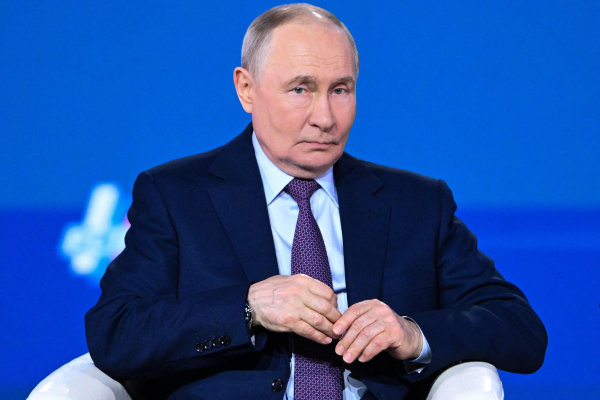
Putin is not afraid of rebellion / GettyImage
Russian elites are already thinking not only about war, but also about what will happen to power after Putin. The question of a successor is increasingly arising due to his age, the closed nature of the system, and the fear of the future among the very top.
Viktor Shlinchak, head of the Institute of World Politics, explained on Channel 24 that Russian elites may already be calculating scenarios for the coming years. According to him, this is where the threat that Putin fears the most may come from.
The question of a successor is already on the agenda among Russian elites
The Russian leadership can now think not only about the current state of war, but also about what will happen to the government in a few years. Shlinchak drew a parallel with the late USSR, when the system also clung to old leaders, and after Brezhnev's death the country very quickly entered a period of personnel instability.
By the way! War fatigue is building up in Russia, and strikes on Russian territory are shattering the image of security that the Kremlin has imposed on society for years. This makes it increasingly difficult for Putin to maintain support and convince Russians that the war should be dragged on.

Because of this, the topic of a successor is already emerging in circles close to the Kremlin. Putin's age, the closed nature of the system, and the lack of a clear mechanism for transferring power only intensify these conversations, as the elites cannot help but calculate what will happen next.
I remember when Brezhnev died, then they started dying every other year. The Central Committee of the Communist Party relied on the same old men, on people over 70,
– explained Shlinchak.
Putin, however, does not seem like a person who is willing to voluntarily give up power or calmly launch a transfer of authority scenario. Because of this, the very emergence of such talk becomes increasingly sensitive for the system, because it is not only about the age of the dictator, but also about the fear of what will happen after him.
Putin fears rebellion most among his own entourage
A popular uprising does not seem to be the main threat to Putin, because he still considers the mood in society to be under control. Much more dangerous for him is a scenario in which the blow comes from within the system, from people who have access to the power apparatus, resources, and the very center of decision-making.
Putin fears rebellion among his own entourage: watch the video
Shlinchak believes that this is why Putin clings to power so much and does not allow even a hint of a normal mechanism for its transfer. For him, the risk is not that someone will take to the square, but that a conspiracy may ripen in his own environment, where everyone has long understood that the issue of the successor will have to be resolved sooner or later.
Putin is not going to give up his power at all. And it is obvious that he is primarily afraid of a rebellion within his own entourage, and not some human or popular uprisings,
– said Shlinchak.
He added that such fear is directly related to the way the Russian control system is currently being rebuilt. Putin continues to hold key processes in his hands, but he does so not through trust, but through the further strengthening of the Federal Security Service, which is increasingly penetrating the internal life of the country and monitoring not only the street, but also loyalty within the system itself.
The FSB uses criticism of the authorities as a trap
In Russia, control works not only through bans, arrests, and fear. The system has begun to operate more subtly: people are given the impression that there is still some space left in the public space for criticism, but in reality this space is needed to identify and punish disloyal people.
They even make it possible to periodically let off steam by inviting people who supposedly criticize the government to federal TV channels,
– noted the head of the Institute of World Politics.
After that, another part of the mechanism kicks in. The security forces and their associated structures don't just observe the reaction, but collect specific information about those who read, distribute, and pick up on such materials, turning even controlled criticism into a tool for selecting the unreliable.
They find out who likes these posts, who watches them, who spreads similar materials, and make lists of people who are so-called unreliable,
– concluded Shlinchak.
Therefore, even ostentatious criticism of the authorities works not against the Kremlin, but for it. This is not a sign of a weakening of the regime, but another way to tighten the screws and keep under control not only the street, but also the mood inside the country itself.
What indicates Putin's weakening and new attempts at escalation?
Signs of a power struggle are increasingly emerging in Russia. Putin has become more vocally criticized, even in public, and along with this, talk has emerged about possible successors.
The Telegraph writes that drone strikes deep into Russia, a slower offensive and economic problems show that the war no longer looks simple and manageable for the Kremlin. Moscow is increasingly faced with a choice: either reduce the scale of the war or go for a wider mobilization with the risk of new tensions at home.
After the trip to China, Moscow again began to raise the stakes through Belarus and use this direction for pressure. Thus, the Kremlin shows that it does not want to lower the temperature, is trying to tie Minsk even more tightly to the war and again plays the game of escalation every time there is talk of negotiations.