
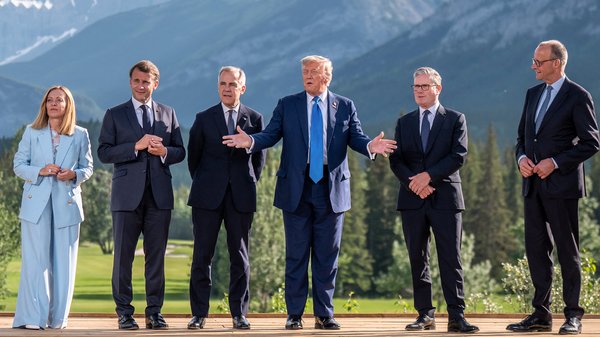
Relations between the United States and European countries were cool even before the war in Iran. This was facilitated by the policies of the Trump administration: trade tariffs and threats of new ones, criticism of the decisions of European countries and accusations of ingratitude towards the United States. The war in Iran further exacerbated disputes between the allies. Sospilne tells how the leading countries of Europe reacted to it and what all this means for the future of transatlantic relations.
United Kingdom: Starmer on a “twin” and the king's visit to the US is under threat
The UK and the US have a long history of the so-called “special relationship”. Despite the fact that Donald Trump is extremely unpopular among the British (2/3 of the population have a negative attitude towards him), the government is taking a more moderate position and is trying to preserve cooperation and trust between the two countries at all costs. The issue of support for Ukraine plays an important role in this: the British understand that without the US it will be impossible for them and other Europeans to maintain it at the current level. That is why London is ready to tolerate the threats and antics of the American president – in the hope that he will listen to his “special” partners. Thus, instead of an open confrontation with the White House after last year's threats to introduce tariffs, Trump was invited to Albion on a state visit. Queen Charles was delegated the role of the one who should reach out to the US president, in particular on the issue of support for Ukraine – and for a while it seemed that relations had been returned to the usual friendly level.
The war with Iran has thrown a new challenge to these relations. Prime Minister Keir Starmer initially refused to provide British military bases for the US campaign. However, within a few days he changed his mind – after Iranian attacks on the UK base in Cyprus. At the same time, Starmer emphasized: Britain is ready to support only defensive actions of the US. This indecision and change of position (qualities for which Starmer is also heavily criticized in Britain) caused indignation from Trump – he stated that he was disappointed with the Prime Minister and expressed regret that he was “not Winston Churchill” and allegedly agreed to support only when the States had already “won the war”. The British Prime Minister refrained from commenting.
In the situation around Iran, he found himself in an awkward “twinkle”: on the one hand, Starmer does not want a conflict with the United States, on the other – he knows well that the majority of Britons are against their country's participation in another war in the Middle East on the side of Washington (the experience of Iraq is still perceived painfully here). The opposition conservatives and right-wing populists from Nigel Farage's Reform UK party (who are currently leading in opinion polls) criticized the prime minister. However, the longer the war in Iran continues, the higher oil prices and, accordingly, the bills of the British, the more the opposition right-wing forces loyal to Trump risk losing the support of voters.
 Donald Trump stands next to Keir Starmer during a “family photo” at the NATO summit of heads of state and government in The Hague, June 25, 2025. Getty Images/AFP/Ben Stansall
Trump’s war with Iran has also sparked debate about planned visits to the US by members of the British royal family. This July, the United States will celebrate the 400th anniversary of its independence, and two visits were scheduled to take place to mark the occasion – in the spring by King Charles and Queen Camilla, and then, during the summer World Cup, by Prince William of Wales and Princess Kate. The war against Iran has sparked debate in the UK about whether the king’s visit would be seen as support for US actions, and whether Trump would embarrass him with his critical remarks about London. If Starmer is not used to this – Trump recently shared a satirical clip on social media that mocks Starmer and his fear of saying no to the American president – then the British are not ready to tolerate the king’s possible humiliation. Some Labour MPs are already calling for the visit, which is reportedly due to take place at the end of April, to be postponed.
 Donald Trump bids farewell to King Charles at Windsor Castle during the official visit of the President of the United States to the United Kingdom, September 18, 2025. Getty Images/Anna Moneymaker
Germany: changing position and fear of a new wave of refugees
German Chancellor Friedrich Merz has shifted his stance on the Iran war even more dramatically than the British prime minister. In the early days of the war, while visiting the Oval Office, Merz expressed support for US plans to overthrow the Iranian regime and remained silent on Trump’s criticism of Britain and Spain’s refusal to provide military bases for the operation. But within days, as oil prices rose due to the blockade of the Strait of Hormuz and the economic consequences of the war became more apparent, Merz changed his rhetoric.
“This war has a huge impact on our energy costs and could potentially trigger mass migration,” Merz said in mid-March, two weeks after the Iran war began. The German chancellor fears that a new conflict in the Middle East would bring with it a new wave of refugees, a sensitive issue for Germany, which has taken in millions of Ukrainians and Syrians over the past decade and where the far-right Alternative for Germany party is gaining popularity. The country already has a large Iranian community, and most Iranians in country-by-country surveys point to Germany as a potential destination for refugees. Merz also believes that Iran will distract the US from the war in Ukraine, and has condemned the easing of US sanctions on Russian oil.
Despite these reservations, Merz refrained from directly criticizing the US actions or questioning their legality under international law, stating that Germany would not participate in the war and supported diplomatic efforts to end the conflict.
 Donald Trump with Friedrich Merz in the Oval Office of the White House on March 3, 2026. Chancellor Merz became the first European leader to visit President Trump since the start of the United States-Israel war against Iran. Getty Images/AFP/Andrew Caballero-Reynolds
Italy: a shaky “bridge” between Europe and the US
The Italian government, led by Giorgia Maloni, until recently seemed to be perhaps the friendliest in Europe towards Donald Trump. Since his return to power, Rome has positioned itself as a mediator, a so-called “bridge” between the critical European countries and the American president. At joint events with European colleagues, where doubts were voiced about Trump's commitment to the ideas of transatlantic unity and calls for autonomy in security matters, Italian officials argued that Europe could not cope without the United States, and therefore it was necessary to try hard to maintain friendly relations. However, Trump's threats against Greenland, and later war with Iran, shook the Italian government's support for the United States.
Speaking in the Italian parliament, Prime Minister Maloni acknowledged that the actions of the US and Israel in Iran are a violation of international law. At the same time, she refused to unequivocally condemn or support them. According to polls, 13% of Italians believe that their country should support the US war against Iran at the diplomatic level, and only 2% are in favor of military participation. 24% expect their government to categorically condemn the US actions, and the largest share, 34%, is in favor of Italian neutrality and efforts to mediate in the conflict.
Maloni, who has been in office for three and a half years – a long time for an Italian prime minister – risks losing support from voters if she takes sides. Her position was already under threat after a referendum defeat in which she called for judicial reform. Many voters saw the plebiscite as an opportunity to voice their opposition to the prime minister on other issues as well.
 Georgia Maloney addresses parliament on the conflict in Iran and the Persian Gulf region, Rome, March 11, 2026. AP/Alessandra Tarantino
Spain: those who are not afraid to say
Spain stands out from other European countries. Its Prime Minister Pedro Sanchez was the only one who was not afraid to directly express his disagreement with Donald Trump's actions in Iran and categorically rejected the possible participation of Spain in the war in any way. “We will not support something that contradicts our values and principles for fear of reprisals from others,” Sanchez said in the first days after the US operation in Iran began. This was in response to Trump's threats to cut off trade with Spain after it refused to use its military bases.
This is not the first time that Spain has openly contradicted Trump. Last summer, it became the only NATO country to refuse to increase defense spending to more than 2% of GDP, a demand that the American president made at the Alliance summit. And while this decision was criticized by other European allies (in particular, the Baltic states and Poland, which invest much larger shares of their GDP in European security and countering Russia), Sanchez's direct refusal to Trump has now caused delight in many European capitals that are not ready to express their disagreement with the United States so directly.
However, Sanchez's decisions are primarily dictated by domestic politics. The future of the government coalition he leads depends on the support of left-wing parties critical of the US. Their popularity has increased against the backdrop of the war in Iran. Most Spaniards are also critical of America, and especially of its current president (77% of Spaniards have a negative attitude towards Trump). Spain's participation in the US war against Iraq in 2003 is considered a disaster here, and mass protests against it led to the fall of the then government. Strong anti-militarist sentiment in Spanish society, which led to the refusal to increase defense spending (only 14% of Spaniards support this), also plays a role.
Despite refusing to join the war against Iran, Spain is already suffering from it. Last week, Prime Minister Sanchez announced a 5 billion euro economic support package for citizens and businesses suffering losses related to the conflict. Spanish media also report an increase in cyberattacks against government institutions, transport and the country's financial system against the backdrop of the war in Iran.
 Spanish Prime Minister Pedro Sanchez addresses parliament about the Israeli and US military operation against Iran during a congressional session in Madrid, March 25, 2026. Getty Images/AFP/Thomas Coex
Europe's crisis of subjectivity and expectations of change in the US
Despite Donald Trump's extreme unpopularity among European voters, governments in Europe must balance the need to avoid losing US defense support (notably for Ukraine and in the confrontation with Russia) and the fear of US tariffs. The war in Iran has given some European leaders the opportunity to express their opposition to Trump's actions more openly. At the same time, most have refrained from overt criticism – although dissatisfaction with US actions is growing due to the economic consequences of the war and the surge in oil prices.
Some analysts have criticized Europe’s lack of decisiveness in responding to the US-Israeli war on Iran as a lack of agency. “If Europe abandons its principles and laws on the external stage, it will not become a powerful global player, but will instead be dragged along by other predatory powers like Putin’s Russia and Trump’s US,” writes Natalie Tocci, director of the Italian Institute of International Relations, in her column for The Guardian. “Intimidated by Washington and drawn into a war whose consequences they will bear the brunt of, our leaders are undermining their own ability to act. While they make passionate speeches about European independence, their cowardice and subservience are paradoxically making Europe much less sovereign on the world stage.”
Europeans are worried that a war in Iran could lead to a deep financial crisis and recession – and hope for its speedy end. Many do not understand what Trump’s ultimate goal is, and his further threats to Iran are seen as a way to escalate the conflict, not end it. However, if the result of a war in Iran is a decline in the popularity of Trump and Republicans in the US and, as a result, a change of administration – without a doubt, many in Europe will breathe a sigh of relief. Although no one is saying this openly now.