
Main points
- Paleontologists have discovered an Edmontosaurus skull with a Tyrannosaurus tooth in its head, indicating an attack by a predator where the victim died directly from the bite.
- The find supports the theory that tyrannosaurs were active hunters, as the skull bore numerous bite marks consistent with the behavior of modern large predators.
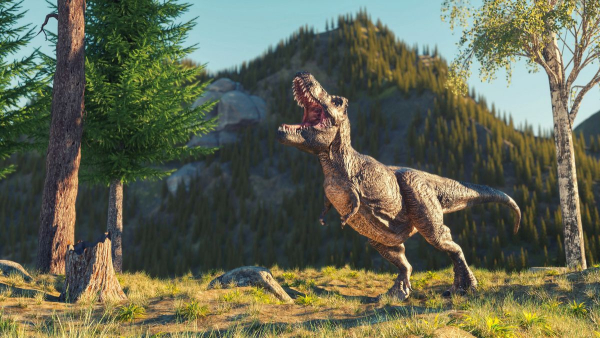
A chance find revealed the hunting tactics of a tyrannosaurus / Depositphotos
While exploring the Hell Creek Formation in Montana, scientists have discovered a nearly complete skull of an Edmontosaurus that lived about 66 million years ago. This herbivorous giant weighed about four tons, but even that size didn't save it from being attacked by the most dangerous predator of its time.
An unusual detail caught the attention of paleontologists: a fragment of a tooth belonging to an adult tyrannosaurus was stuck deep in the victim's nasal bone. The find was first discovered by Marge Baisch and Ken Olson in 2005, but its detailed study is still ongoing, writes Daily Galaxy.
What did the study find out?
Using computed tomography and 3D modeling, scientists were able to carefully study the shape and serrations of the stuck fragment. Analysis showed that the tooth belonged to a large tyrannosaur with a skull length of about one meter.
The position of the tooth and the angle of its entry into the bone suggest that the predator attacked its prey from the front, coming face to face. This frontal impact was so powerful that the tip of the tooth broke off upon contact with the massive nasal bone of the Edmontosaurus.
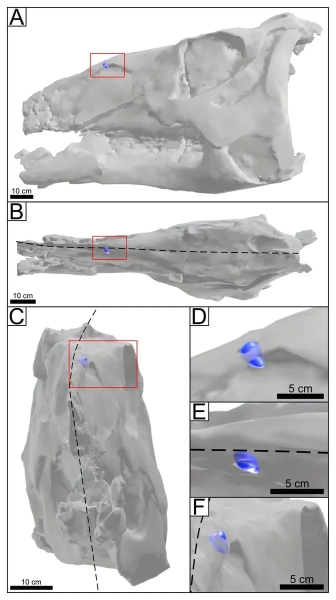
Visualization of a 3D model based on computed tomography data / Photo by Ty K.A. Weinberg-Henzler/John B. Scannell
One of the most important discoveries was the lack of any signs of healing around the wound, the study in the journal PeerJ says. This is direct evidence that the victim either died directly from the bite or was eaten immediately after death.
This fact reinforces the position of scientists who consider tyrannosaurs to be active hunters, and not just vultures looking for already dead prey. Although the debate about their diet has been going on for decades, such finds allow us to observe the behavior of these giants directly, and not just rely on assumptions.
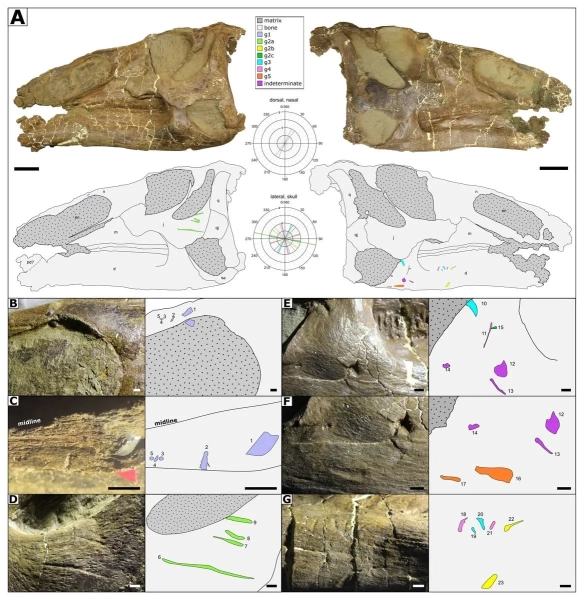
Skull with impacted tooth and corresponding teeth marks / Photo by Ty K.A. Weinberg-Henzler/John B. Scannell
In addition to the fatal tooth, 23 more bite marks were found on the skull of the Edmontosaurus. They are located on both sides of the jaw and behind the eyes – in places where duck-billed dinosaurs had massive chewing muscles. Paleontologists suggest that after the kill, the predator began to eat the head of the victim, focusing on the most nutritious soft tissues. The marks on the bones correspond to the behavior of modern large predators, which move on to less fleshy parts of the body only after the main reserves of meat on the trunk have been exhausted.
Interestingly, the scientists also identified traces of eating a special tissue called “exoparia.” This suggests that tyrannosaurs were very careful about consuming their prey. The absence of the rest of the Edmontosaurus skeleton at the excavation site could mean that the carcass was either completely torn and stretched by other predators, or the skeleton disintegrated naturally under the influence of the environment. The presence of cracks on the surface of the skull confirms that it lay in the open air for a long time before being buried under a layer of sandstone.
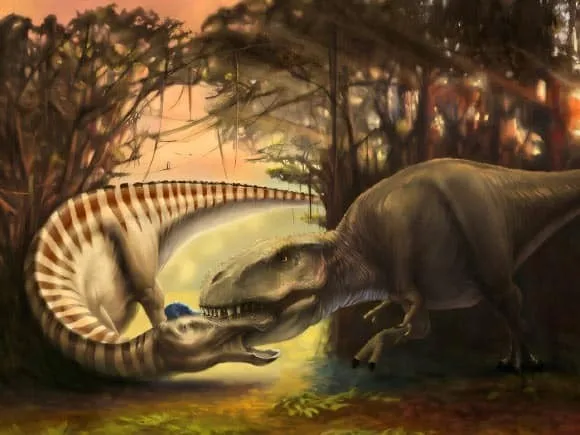
Tyrannosaurus rex attacking an adult Edmontosaurus / Image by Jenn Hall/Montana State University/Museum of the Rockies
Estimates suggest that the tyrannosaur that left this tooth may have weighed between 1,807 and 6,100 kilograms (4,000 and 13,000 lb). Its skull was significantly larger than that of juveniles or related nanotyrannus, suggesting it was an adult, dominant predator.
The researchers believe the find is one of the most striking examples of predator-prey interactions in the fossil record, revealing not only the mechanics of the bite but also a deeper understanding of the complex ecosystem that existed on Earth long before humans.