
Main points
- The Darvaza gas crater in Turkmenistan has been burning for over 50 years due to a constant leak of methane from underground layers, which makes it difficult to extinguish.
- Despite significant efforts, including international negotiations, the problem of extinguishing the crater has not been solved due to the complexity of the underground structure and the risks of gas accumulation.
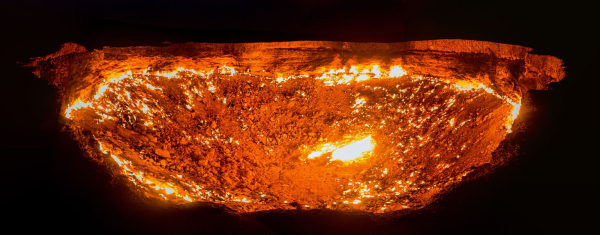
Darvaza gas crater / Depositphotos
The giant Darvaza gas crater in the Karakum Desert has been burning for decades. What began as an industrial accident has become a tourist attraction and a complex environmental and engineering problem, the solution to which is fraught with risks underground.
Why was extinguishing the crater more difficult than it seemed?
The Darvaza gas crater in central Turkmenistan has long been one of the most famous natural and man-made objects in Central Asia. In the dark, it looks almost theatrical: a large ring of fire in the middle of an endless desert plain. It is for this eerie appearance that the place received the popular nickname “Gateway to Hell” and has attracted tourists for decades, despite its remote location, says 24 Channel .
How did it all start?
The most common theory is that the crater was created by a Soviet drilling accident. It is believed that in 1971, a drilling rig hit an underground gas chamber, causing the ground to collapse. Engineers decided to set fire to the methane that was escaping, hoping that the flames would die down in a few days, according to Atlas Obscura. The fire was not intended to be long-lasting, but it has been burning for more than half a century.
Over time, Darvaza has ceased to be just a curiosity. Today, the crater is seen as a symbol of energy waste, environmental damage, and the consequences of the Soviet industrial legacy.
Interesting fact! In 2014, Canadian explorer George Kourounis became the first person in history to risk his life and descend into the “Gate of Hell” to explore it and learn about the features, temperature and gases involved in the formation of the object. It took 18 months to plan this scientific expedition under the supervision of a specialized professional team from National Geographic. Kourounis was tied with a thick rope and lowered into the “Gate of Hell”; he was wearing a special suit made of several layers of Kevlar, which protected him from the heat; he was also equipped with a special breathing apparatus.
A man's descent to the “Gates of Hell” – watch the video:
Why is this a problem for Turkmenistan?
In January 2022, then-Turkmen President Gurbanguly Berdimuhamedow publicly called for a way to extinguish the flames. He stressed that the facility was harming the environment, affecting the lives of local residents, and burning natural gas that could be economically beneficial to the country, as reported by France 24.
The political weight of the issue is also explained by the scale of Turkmenistan's gas reserves. The country has significant resources of this fuel, so the appearance of continuous burning in the desert is perceived as considerable economic negligence.
At the same time, the problem is not limited to the crater itself. International experts have long drawn attention to methane leaks from outdated infrastructure – wells and pipelines, many of which date back to Soviet times.
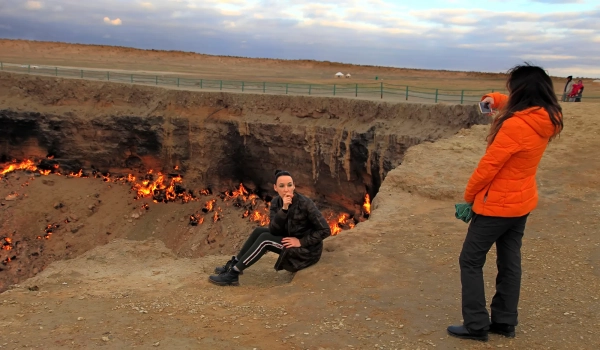
The Darvaza gas crater has become a tourist magnet / Photo Depositphotos
In an effort to address this issue, the United States and Turkmenistan are even negotiating possible measures to reduce methane emissions in 2023, Bloomberg reported. This is important for the country not only from a climate policy perspective, but also to preserve a valuable export resource.
However, the role of the crater itself in climate risks is ambiguous. Due to combustion, much of the methane is converted to carbon dioxide and water vapor before it enters the atmosphere. This does not make the fire safe, but it does mean that it has less of a critical direct impact on the climate than it seems.
However, according to the ESA study, total emissions for 2020–2025 are estimated at 71±21 kt CH4, while cumulative emissions since crater formation are conservatively estimated at over 800±300 kt CH4. This indicates that the actual totals may be significantly higher due to unburned methane released in the decades prior to the flare.
Why is “Hell's Gate” so difficult to extinguish?
The main difficulty is that the problem is not only on the surface. The flame is supported by a constant flow of gas from underground layers. Therefore, even if you block the access of oxygen or fill in the crater, this does not guarantee a final solution. Methane can find new cracks and come out in other places.
That's what fire safety researcher Guillermo Rein of Imperial College London emphasizes. Any work must begin with a detailed study of the underground structure of the fault that feeds the crater, he says. Without this, attempts to block the flow could not only fail, but also create a dangerous buildup of gas.
A similar view is expressed by geoscientist Mark Ireland from Newcastle University. He emphasizes that the region is rich in hydrocarbons, so the crater cannot be considered an isolated source. In any case, the gas must find a way out. If you block one channel without controlling the source, another may appear.
As a result, Darvaza has become not only a geological phenomenon, but also a symbol of the industrial mistake of the Soviet Union. Now it is both a tourist magnet and a political challenge. It is this multifaceted nature that explains why loud statements about the closure of the facility are heard regularly, but a practical solution has not yet been found. Engineers will have to not just put out the flames, but actually deal with the entire underground gas movement system.