
Main points
- Scientists at CERN have discovered a new elementary particle, Xi-cc-plus, which has a unique structure with two charm quarks and one bottom quark, making it significantly more massive than a proton.
- This discovery was made possible by the modernization of the Large Hadron Collider equipment and is important for testing quantum chromodynamics models and studying rare phenomena.
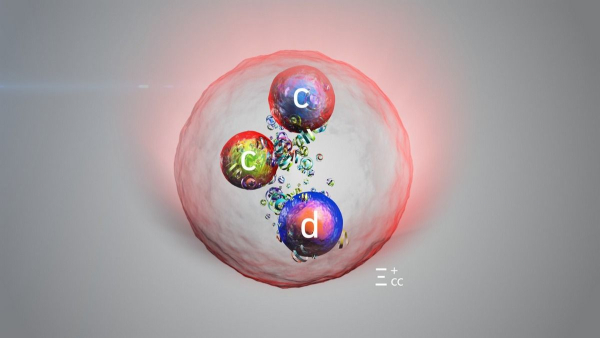
CERN physicists discover the jubilee eightieth particle / CERN
Scientists at CERN have announced the discovery of a new particle that will be an important milestone in the study of the subatomic world. The discovery was made possible thanks to a large-scale modernization of the equipment of the Large Hadron Collider. The new object in the hadron family has a unique structure that makes it much more massive than the usual components of the atomic nucleus, opening up new horizons for theoretical physics.
Why is the discovery of this particle considered a real breakthrough for science?
The new elementary particle was named Xi-cc-plus. It became the eightieth particle identified using the world's most powerful accelerator. Although it belongs to the same family of baryons as the protons and neutrons we are familiar with, its characteristics are impressive. In particular, the object is about four times heavier than a proton, writes ScienceAlert.
All matter around us is made up of baryons, which are in turn made up of fundamental building blocks called quarks. There are six so-called “flavors” of quarks in nature, sometimes called “flavors”: up, down, magic, strange, true, and beautiful. Ordinary protons are made up of two up and one down quark.
The Xi-cc-plus structure, however, is much more exotic: it contains two charm quarks and one bottom quark. It is the presence of two heavy quarks instead of light ones that makes the particle so massive.
This event was the first significant result since the LHCb detector upgrade was completed in 2023. The project involved more than 1,000 scientists from 20 countries, with researchers from the University of Manchester playing a key role. They designed and built the critical modules of the silicon pixel detector, which acts like an ultra-fast camera. This equipment is capable of taking 40 million pictures per second, allowing it to record particle decays with exceptional precision.
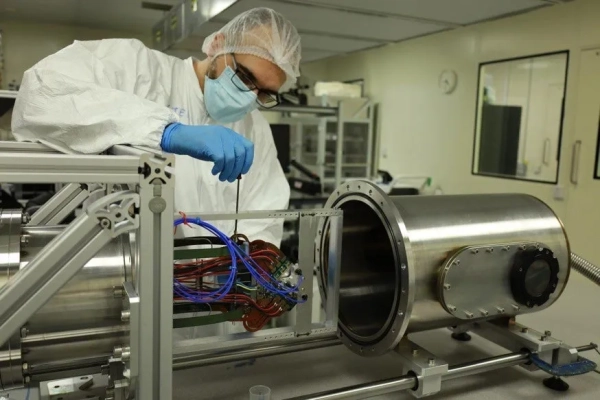
Dr Stefano de Capua tests the LHCb silicon detector modules / Photo by Amy O'Connor/STFC UKRI
LHCb experiment spokesman Vincenzo Vagnoni said in a statement on the CERN website that this is only the second time in the world that a baryon with two heavy quarks has been observed. The previous such particle was discovered almost 10 years ago, in 2017. At that time, it had two charm quarks and one top quark. However, the new discovery turned out to be much more difficult to observe, since its lifetime is about six times shorter than its predecessor.
The theories were not wrong.
The existence of Xi-cc-plus has been predicted theoretically for many years. In fact, for more than two decades, there has been controversy in scientific circles over previous unconfirmed claims of observations of this particle. New data from the collider finally puts an end to this question: the measured mass is 3619.97 megaelectronvolts, reports Phys.org. This value does not correspond to previous dubious claims, but it fits perfectly with current theoretical predictions.
The statistical significance of the discovery is 7 sigma, which is significantly higher than the gold standard of scientific confirmation of 5 sigma. This means that the probability of random error is practically zero.
To detect Xi-cc-plus, scientists analyzed data from proton-proton collisions recorded during 2024. The result was a clear signal consisting of approximately 915 decay events into three lighter particles.
What does this give us and what will happen next?
CERN Director General Mark Thomson stressed that this success demonstrates the unique capabilities of the updated detector and the professionalism of the teams that ensure the operation of the huge accelerator complex. The Large Hadron Collider, located in a 27-kilometer-long tunnel at a depth of about 100 meters under the border of France and Switzerland, continues to reveal the secrets of the Universe.
The new discovery will allow theorists to better test models of quantum chromodynamics, the theory that explains the so-called strong interaction. It is this force that holds quarks together, forming not only ordinary protons, but also more exotic structures such as tetraquarks or pentaquarks.
Research will continue as part of the next phase of the program – LHCb Upgrade 2. Scientists plan to use the capabilities of the future high-luminosity accelerator to collect even larger amounts of data and study rare phenomena that have so far remained inaccessible to the human eye.