
Main points
- The study showed that tyrannosaurs did not neglect carrion and could eat the remains of carcasses when more available resources were exhausted.
- Graduate student Josephine Nielsen used 3D scanning to study tooth marks on the bone, discovering that they were the marks of a smaller tyrannosaur that had fed on the body of a much larger relative.
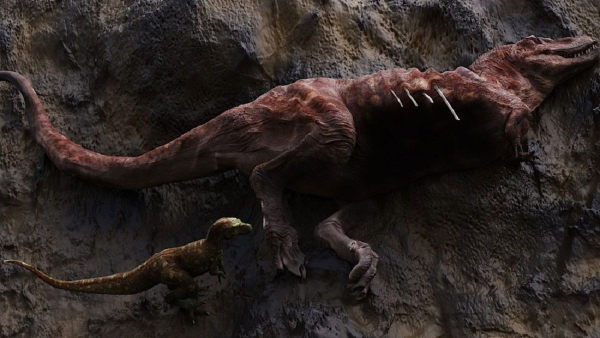
New discovery about tyrannosaurs changes understanding of their behavior / Josephine Nielsen, Aarhus University
New research by paleontologists has shown that tyrannosaurs didn't just hunt other animals. Analysis of tooth marks on fossil bone has helped scientists reconstruct the behavior of these predators in prehistoric ecosystems more than 75 million years ago.
Tyrannosaurus rexes are traditionally thought of as invincible hunters at the top of the food chain. However, new research from the Department of Geosciences at Aarhus University in Denmark has revealed something unexpected about the ancient creatures' behavior, SciTechDaily reports.
What interesting things have scientists learned about tyrannosaurs?
A study published in the scientific journal Evolving Earth shows another side of the lives of these prehistoric giants. It turned out that tyrannosaurs could behave quite pragmatically and did not neglect carrion, eating the remains of carcasses after most of the meat had already rotted.
The study was led by graduate student Josephine Nielsen, who used 3D scanning techniques to examine 16 distinctive tooth marks on a fossil metatarsal bone belonging to a large tyrannosaur that lived more than 75 million years ago.
According to the researcher, in a virtual 3D environment, she was able to measure the depth, angle, and location of the prints in detail. This allowed her to conclude that they were not accidental damage – they were left by a smaller tyrannosaur that fed on the body of a much larger relative.
The bone shows no signs of healing from the bite, and the marks themselves are located on the foot, an area where there was little meat during its lifetime. This suggests that the predator was finishing off the remains of a long-dead animal, effectively “scrubbing” the carcass in the final stages of decomposition. Thus, even hard bones could have become a source of food when more accessible resources were depleted.
Fun fact: Nielsen didn't work with the original fossil specimen. Because of the risk of damaging the rare find, she analyzed a detailed digital model and a 3D-printed copy created in a university lab. This allowed her to examine the smallest details without physical contact with the artifact.
What is known about the bone?
The bone itself, about 10 centimeters long, was found by an amateur paleontologist in the Judith River Formation in Montana, a region with intense erosion that well preserves the remains of dinosaurs that lived in an active ecosystem about 75 million years ago.
It is believed that the owner of the bone could have reached 10-12 meters in length and weighed several tons during his lifetime. The find was later transferred to the Badlands Dinosaur Museum in Dickinson, North Dakota.
Digitizing fossil material has opened up new possibilities for research. The scientist applied the CM (Category-Modifier) classification system, which allows for a standardized description of each trace – from superficial tooth touches to deep crushing bites. Thanks to this, researchers can more accurately determine the nature of interactions between dinosaurs, without relying only on visual assumptions.
The work also involved Canadian paleontologist Taya Weinberg-Henzler and Denver Museum curator Fowler, who served as external supervisors for the student project. Nielsen met them while volunteering at a dig in Montana in the summer of 2024, which is when the idea for the study, which eventually led to a scientific publication, was born.
According to the researcher, modern technology is increasingly helping to reveal the behavioral characteristics of dinosaurs. Now even insignificant traces can contain important information about their habits, social interactions and role in ancient ecosystems.