
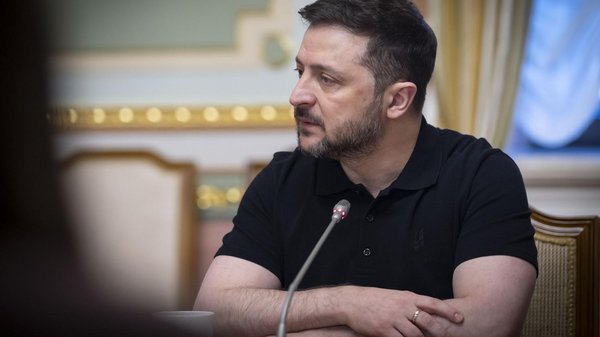
Ukrainian President Volodymyr Zelenskyy said that in just 2 weeks of the US and Israel's war against Iran, Russia earned about $10 billion. This gives Putin more confidence in continuing the war against Ukraine, the president stressed.
President Zelenskyy announced this in an interview with CNN.
According to Zelensky, due to US and EU sanctions and Ukraine's long-range strikes on Russia's energy infrastructure, Russia faced a deficit of over $100 billion in 2026. But it was able to make money due to the temporary suspension of US oil sanctions.
On March 12, the United States issued a 30-day license to purchase Russian oil and petroleum products currently stranded at sea. The U.S. Treasury Department believes this will help stabilize global energy markets.
The president also reported that Russia had transferred to Iran not only intelligence information for attacks on American military bases in the Middle East, but also Shahed-type strike drones, a license for which it had previously received from Iran.
“I have 100 percent facts that the Iranian regime used them against American bases and against our — I mean in the Middle East — neighbors of Iran. They used these drones. We saw the intelligence that was shared with us, and there were Russian details in these Iranian drones,” the president said.
When asked whether Ukraine was ready to supply weapons to the US and countries in the Middle East, Zelenskyy answered in the affirmative.
“We received messages from the United States. I also spoke with the Emirates and Saudi Arabia, we spoke with Qatar and Jordan. We understand what it is like when at the very beginning of a war you find yourself under massive attacks. We remember that. And I said that we and the Americans are partners. We are ready to help the Americans, and we are ready to help our allies in the Middle East. We are ready to help save the lives of civilians. I have already sent three large groups of experts, military experts from our army, and they will help,” the president said.
Earlier, Zelensky reported that Ukraine has already sent three “serious teams” of specialists to the Middle East, each of which numbers dozens of people, to provide expertise and assistance in countering Iranian “shaheeds.”
Israeli and US military operation against Iran
On February 28, Israel attacked the Iranian capital Tehran. US President Donald Trump later said that the US military had launched a “major combat operation” against Iran to “eliminate imminent threats from the Iranian regime”. He accused the Iranian government of “funding and training” militants in Syria, Lebanon, Iraq and Hamas in Palestine. According to him, the aim of the military operation is to “destroy Iran's missile industry and navy” and “ensure that the world cannot be destabilised”.
The Islamic Revolutionary Guard Corps (IRGC) said it had launched missiles and drones towards Israel, and also attacked US military bases in Qatar, Saudi Arabia and the United Arab Emirates.
Amid the US military operation against Iran, French President Emmanuel Macron said that Paris is calling for an urgent meeting of the UN Security Council.
The European Union said it reaffirmed its “unwavering commitment to ensuring regional security and stability” in the Middle East.
Ukrainian President Volodymyr Zelenskyy said it was fair to give the Iranians a chance to get rid of “the terrorist regime and guarantee the security of all peoples who have suffered from attacks from Iran.”
On February 28, Trump announced that Iran's Supreme Leader Ali Khamenei was dead, a claim later confirmed by the Islamic Republic News Agency (IRNA).
On March 1, the IRGC announced that it was launching “the most devastating offensive operation in the history of the Islamic Republic” against Israel and “American terrorist bases.” Trump called on the Iranian regime to abandon these plans and threatened to strike “a very strong blow” in response.
On March 2, US Secretary of State Marco Rubio said that the next phase of the US military operation against Iran would be even more destructive.
On March 6, Trump declared the need for a complete change in Iran's leadership, adding that he already had several candidates for the role of “a good leader.”
On March 8, Iran's Assembly of Experts elected the son of the assassinated Ayatollah Ali Khamenei, Mojtaba Khamenei, as the third supreme leader of the Islamic Republic.
Trump declined to comment on the election of Mojtaba Khamenei, saying only: “We'll see what happens.” Before that, the American president said that the new leader of Iran “won't last long” if he doesn't receive the approval of the White House.